

Get this step wrong, and a perfectly reasonable claim turns into a denial. Get it right, and you've protected both the practice's revenue and the patient's wallet.
Authorization has become a bigger headache for behavioral health, TMS, and outpatient practices as payers tighten utilization management rules year over year. In its 2024 State of Claims survey, Experian Health found that authorization issues ranked among the top reasons billing professionals cited for claim denials, at 36%. This guide breaks down what authorization actually is, the five main types you'll encounter, and how to figure out which one applies to a given service.
Key Takeaways
- Authorization is multiple processes that confirm medical necessity and reimbursement before, during, or after care
- Missing or expired authorization is a leading cause of denied claims and delayed patient care
- Five main types: prior, concurrent, retroactive, referral, and extended care/specialty
- Match the type to service urgency, payer plan, and documentation readiness—not habit alone
- Behavioral health and specialty practices face recurring auth demands generic billing workflows often mishandle
What Is Authorization in Medical Billing (and Why It Matters)?
Authorization is a payer's confirmation that a specific treatment, test, or medication is covered and medically necessary. It typically happens before the service is delivered, though payers sometimes allow retroactive approval after the fact.
Three terms get mixed up constantly—only one of them is payer approval:
- Eligibility verification confirms a patient has active coverage — it says nothing about whether a specific service will be paid for
- Referral is a clinical recommendation from a primary care physician to a specialist — it doesn't guarantee payer approval on its own
- Authorization is the payer's specific sign-off that this exact service, for this exact patient, meets its coverage criteria
A patient can have active insurance and a valid referral and still get denied because nobody secured the authorization. All three are separate checkboxes.
Why Authorization Matters in the Revenue Cycle
A missing or expired authorization number is one of the most common ways a clean claim becomes a denied one. The downstream effects hit harder than most front-office teams expect.
Per the AMA's 2023 Prior Authorization Physician Survey, physicians and staff field an average of 43 PA requests per week—about 12 staff hours weekly. More than a third of practices employ staff who work on nothing else.
Without a solid authorization process, practices typically see:
- Delayed patient care while requests sit in review queues
- Longer appeals cycles that stretch A/R days well past 60 or 90
- Administrative overload on front-desk staff already juggling scheduling and check-in
That bandwidth drain is where many practices lose revenue even when coding and claim submission are solid.
Types of Authorization in Medical Billing
Authorization isn't one workflow. It shows up in five distinct forms, depending on when the payer reviews medical necessity relative to when care happens. Using the wrong type (or assuming one covers a scenario it doesn't) is a top driver of denials.
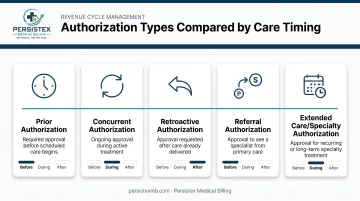
Prior Authorization
Prior authorization (also called pre-authorization or pre-certification) is approval secured before a service is delivered. The provider submits diagnosis and procedure codes along with clinical documentation justifying the request.
It's the only type that happens strictly before care, and it's also the highest-volume authorization workflow most practices manage. It fits best for:
- Advanced imaging (MRI, CT, PET)
- Elective surgeries
- Specialty medications
- Inpatient admissions
The upside is predictable reimbursement: you know before treatment whether the payer will pay. The trade-off: approvals expire, and payer terminology for the same concept varies constantly. Assume nothing is standardized across plans.
Strong approval rates usually come from managing the full authorization lifecycle: initial requests, medical-necessity documentation, peer-to-peer reviews, and re-authorizations for continuing treatment. Specialty-specific coding knowledge beats generic templates here. Persistex builds prior auth workflows around payer rules and clinical documentation so practices spend less time chasing status and fewer claims die for missing approval.
Starting in 2026, CMS's interoperability rule (CMS-0057-F) will require covered Medicare Advantage, Medicaid, and CHIP payers to decide expedited requests within 72 hours and standard requests within 7 calendar days, plus publish specific denial reasons. That's a meaningful shift from today's inconsistent turnaround times.
Concurrent Authorization
Concurrent authorization happens while care is already underway. Instead of a single approval, the payer reviews progress notes periodically to confirm the treatment still qualifies as medically necessary.
Unlike prior auth's one-time approval, this is a rolling process tied to ongoing documentation. It applies most often to:
- Inpatient hospital stays
- Extended rehabilitation programs
- Multi-session outpatient therapies
The catch: miss a review window, and the extended portion of care goes unpaid, even if the earlier portion was fully approved. There's no grace period for a forgotten submission date.
Retroactive (Retro) Authorization
Retroactive authorization is requested after the service has already been delivered. It's reserved for emergencies or situations where getting prior approval simply wasn't possible.
This reverses the normal approval sequence, which is exactly why insurers structurally favor denying these requests. It's meant for:
- Trauma cases
- Emergency admissions
- Sudden changes in coverage status
It is not a routine workaround for a missed deadline. Retro requests carry higher denial rates than prospective authorization, and success hinges almost entirely on documented medical urgency. Texas regulations, for example, require carriers to respond to preauthorization requests for post-stabilization or life-threatening conditions within an hour. That is a narrow, emergency-specific carve-out, not a general retro-auth allowance.
Referral Authorization
Referral authorization ties to a primary care physician sending a patient to a specialist, most common in HMO-style plans. It centers on network and care-pathway rules rather than a cost-based medical necessity review.
It's best suited for HMO plans where a specialist visit only gets reimbursed if a referral is on file. Common limits include:
- Validity for a single named specialist only
- Caps on the number of covered visits
- No payment if the patient sees a different specialist or exceeds the visit cap
Deviate from those terms and reimbursement is at risk.
Extended Care / Specialty Authorization
This type covers care delivered in phases: physical therapy, home health, durable medical equipment (DME), or specialty drug regimens. Rather than a single point-in-time decision, the payer approves a batch of visits or a defined period.
It requires recurring progress reports to keep coverage active. It fits:
- Multi-visit treatment plans
- Step-therapy protocols requiring documented "fail first" history
- Home health and DME needing periodic recertification
Medicare, for instance, caps outpatient PT/OT certification periods at 90 days before recertification is required, and home health plans of care must be reviewed at least every 60 days. Skip a follow-up report, and coverage can stop mid-treatment, even when the patient still clearly needs care.
How to Choose the Right Type of Authorization for Your Practice
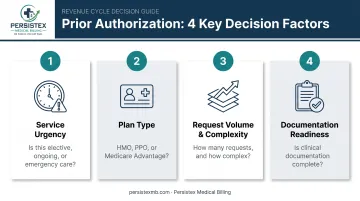
The correct authorization type depends on the service, the timing, and the payer plan — not on whichever term your front-desk team happens to default to. Four factors should drive the decision:
- Service urgency: Is it elective, ongoing, or emergency-based? That determines prior vs. concurrent vs. retro.
- Plan type: HMO, PPO, and Medicare Advantage plans each carry different referral and authorization rules.
- Request volume and complexity: High request volume affects whether in-house tracking is realistic or a liability.
- Documentation readiness: Are clinical notes, imaging, and history available to support the request on the first submission?
What to Check Before Finalizing Your Authorization Workflow
A few recurring mistakes derail even experienced billing teams:
- Assuming payer terminology is standardized across plans (it isn't)
- Letting approvals expire before the service is scheduled
- Treating a predetermination letter as a binding approval (it usually isn't)
- Relying on retroactive authorization as a routine fallback instead of a rare exception
Practices with high authorization volume, especially behavioral health providers managing recurring multi-session treatment plans, often find in-house tracking unsustainable. One missed renewal window can undo weeks of approved care.
That is where specialty-focused revenue cycle management helps. Persistex's RCM workflow coordinates prior authorization with eligibility verification and benefits checks in the pre-visit phase. It then carries that data through medical-necessity documentation, peer-to-peer reviews, and re-authorizations so "approved" turns into "actually paid."
Common Services That Require Authorization
Certain services consistently trigger authorization requirements across most payers, though the specifics vary by plan:
- Advanced imaging — MRI, CT, PET scans
- Elective surgeries, including orthopedic procedures
- Specialty medications and biologics
- Inpatient admissions
- Durable medical equipment (DME)
- Multi-session therapies — psychotherapy or counseling series, chiropractic care plans
Never assume a service is automatically exempt or automatically required. Verify case-by-case against the specific plan, since two payers covering the same CPT code can apply entirely different authorization rules.
Conclusion
Authorization exists because payers assess medical necessity at different points in the care timeline: sometimes before treatment, sometimes during it, occasionally after. Knowing which type applies to which service, and tracking renewal windows and documentation requirements, is what separates a clean claim from a denied one.
As payer rules keep shifting (2026's CMS interoperability requirements are one example), certified billing specialists who manage this step consistently protect both revenue and patient care continuity. Persistex's team holds CPC and CPB certifications through AAPC, plus RHIT and CCS credentials through AHIMA—the credentials accurate authorization work requires.
Frequently Asked Questions
What is authorization in medical billing?
It's a payer's confirmation that a specific service is covered, medically necessary, and will be reimbursed. It's distinct from eligibility verification and from a referral.
What is the authorization process in medical billing?
First, determine if authorization is needed. Then submit the request with clinical documentation, wait for the payer's decision, and document the approval on the claim before billing.
What is the difference between authorization and preauthorization in medical billing?
"Authorization" is the umbrella term covering prior, concurrent, and retroactive approvals. "Preauthorization" specifically refers to approval obtained before service delivery — though the terms are often used interchangeably.
How many types of authorization are there in medical billing?
Most billing teams work with five main types: prior, concurrent, retroactive, referral, and extended care/specialty authorization. Payer terminology for each can still vary.
What happens if a service is provided without required authorization?
The claim is likely denied, leaving the provider unpaid unless a retroactive request or appeal succeeds. The patient may also become responsible for the cost.
Does Medicare require prior authorization?
Traditional Medicare requires it for a limited set of services, such as certain DME and select hospital outpatient procedures. Medicare Advantage plans apply authorization far more broadly across services.