Many behavioral health practices lose revenue not because they picked the wrong diagnosis, but because they billed the wrong procedure code, skipped an add-on code they were entitled to, or documented session time that didn't match the code submitted. Anxiety and depression accounted for a growing share of outpatient behavioral health claims in recent years, which makes accurate coding here a direct line to practice revenue.
This guide breaks down the core CPT codes for psychiatric evaluation, psychotherapy, medication management, screening tools, and TMS therapy — plus the modifiers and documentation habits that keep claims from bouncing back.
Key Takeaways
- CPT codes describe the service; ICD-10 codes describe the diagnosis—link both correctly on every claim.
- Most-used codes: 90791/90792 (evaluation), 90832/90834/90837 (psychotherapy), 99202-99215 (E/M).
- Screening code 96127 and psychotherapy add-ons are often underused, leaving billable work unbilled.
- TMS codes 90867-90869 need documented failed prior treatments before most payers will approve.
- Specialized billing review cuts coding-related denials and speeds collections.
CPT Codes vs. ICD-10 Codes: Why the Distinction Matters
CPT and ICD-10 codes answer different questions on every claim:
- CPT (Current Procedural Terminology): what was done during the visit
- ICD-10: why the service was medically necessary
For any anxiety or depression claim, both codes must appear and link correctly, according to AMA's overview of the CPT code set.
This distinction trips up more people than you'd expect. Patients (and sometimes front-desk staff) often ask "what is depressive anxiety disorder?" That's a diagnosis coding question, not a procedure coding one. It typically points to F41.8, the ICD-10 code for other specified anxiety disorders, which includes mixed anxiety-depressive presentations.
Here's what catches practices off guard: a claim can be denied even when the ICD-10 diagnosis is correct if the linked CPT code doesn't match the session note. Payers don't just check that both codes exist. They check that the diagnosis pointer connects a valid reason to a valid service. Review both systems together at submission, not in isolation.
CPT Codes for Psychiatric Evaluation & Psychotherapy Sessions
Intake and Ongoing Therapy Codes
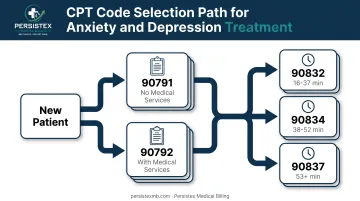
New anxiety or depression patients typically start with an evaluation code:
- 90791 — Psychiatric diagnostic evaluation without medical services (used by therapists and psychologists)
- 90792 — Psychiatric diagnostic evaluation with medical services (used by psychiatrists and prescribers)
Both are usually billed once per episode of care, not at every visit.
From there, ongoing therapy sessions are billed by documented time, not by a default template:
| Code | Session Length |
|---|---|
| 90832 | 16-37 minutes |
| 90834 | 38-52 minutes |
| 90837 | 53+ minutes |
If a clinician's note says 40 minutes but the biller defaults to 90837 because "that's what we usually bill," that's a documentation mismatch waiting to be flagged in an audit.
Add-On and Crisis Codes
When a psychiatrist or nurse practitioner provides therapy on the same day as a medication management visit, three add-on codes apply:
- 90833 — 16-37 minutes
- 90836 — 38-52 minutes
- 90838 — 53+ minutes
These pair with a primary E/M visit and rank among the most commonly missed revenue opportunities in psychiatric practices. Clinicians often document the therapy conversation, but the biller only submits the E/M code.
A critical rule: add-on codes must always accompany a primary E/M code. They cannot be billed standalone.
For acute presentations such as active suicidal ideation or an anxiety-driven panic crisis, crisis psychotherapy codes apply instead:
- 90839 — First 60 minutes of crisis psychotherapy
- 90840 — Each additional 30 minutes (add-on to 90839)
These codes aren't reported alongside 90791, 90792, or standard psychotherapy codes on the same encounter, per CMS coverage guidance on psychotherapy for crisis.
Volume makes code accuracy non-negotiable. The share of patients with a mental health diagnosis in FAIR Health's claims data rose 39.8%, from 13.5% in 2019 to 18.9% in 2023, with generalized anxiety disorder the most common diagnosis reported, according to FAIR Health's 2024 study.
Practices that mismatch documented time and CPT selection put a growing share of claims at audit risk.
E/M Codes, Medication Management & Screening Tools
Office Visits for Medication Management
Psychiatrists and psychiatric NPs/PAs managing medication typically bill office E/M codes rather than psychotherapy codes:
- New patients: 99202-99205
- Established patients: 99211-99215
Since 2021, these codes are selected by medical decision-making (MDM) or total time on the date of service, not by history or exam detail, per AMA's current E/M guidance. When E/M is combined with a psychotherapy add-on code, the E/M level comes from MDM, and psychotherapy time can't be double-counted as E/M time.
This is exactly where denials happen. Molina Healthcare's 2025 payment policy, for example, denies same-provider, same-day pairings of the psychotherapy add-ons (90833/90836/90838) with high-level E/M codes 99204, 99205, 99214, or 99215 unless documentation clearly shows the therapy was substantial, separate, and non-overlapping with the E/M work.
A practice that bills a 60-minute therapy add-on next to a maximum-complexity E/M visit without distinct time and content documented for each is inviting exactly this kind of denial.
Screening Codes and Behavioral Assessment
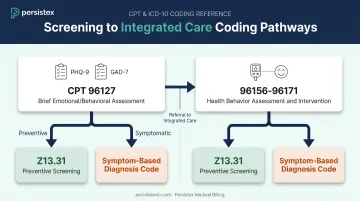
CPT 96127 covers brief emotional/behavioral assessments using standardized tools like the PHQ-9 (depression) and GAD-7 (anxiety). It's billed per instrument, so administering both tools on the same day can generate multiple units. Confirm payer-specific unit limits before assuming automatic reimbursement.
The ICD-10 pairing matters here too:
- Z13.31 — Use for asymptomatic, preventive depression screening
- Symptom-based diagnosis code — Use when the assessment was prompted by presenting symptoms
Bill the wrong pairing and 96127 can get denied even though the service itself was performed correctly.
For integrated care settings, Health Behavior Assessment and Intervention codes (96156-96171) apply when you address the behavioral side of a physical health condition alongside anxiety or depression. A common example is a diabetes patient whose depression is affecting self-management.
Practices often leave these codes off claims simply because they don't know the family exists.
TMS Therapy CPT Codes for Treatment-Resistant Depression
Transcranial Magnetic Stimulation uses its own dedicated code family, reserved for depression that hasn't responded to standard medication or therapy:
- 90867 — Initial TMS treatment, including cortical mapping and motor threshold determination
- 90868 — Subsequent TMS delivery and management, per session
- 90869 — Subsequent motor threshold re-determination with delivery
TMS billing carries a heavier prior authorization burden than standard psychotherapy or E/M claims. Payers typically require documented trial-and-failure of multiple medication classes and evidence-based psychotherapy before approving coverage.
For 90867–90869, pair the correct CPT with clear medical-necessity notes, required modifiers, and proof of failed prior treatments. Incomplete authorization packets are a common reason these claims stall or deny, so build the clinical story into the file before the first session is billed.
Modifiers, Documentation & Common Denial Triggers
Modifiers That Matter
Three modifiers show up repeatedly on anxiety and depression claims:
- Modifier 25 — Use on an E/M code when a significant, separately identifiable E/M service occurs the same day as another procedure. Notes must show work beyond that other service (Novitas Modifier 25 fact sheet).
- Modifier 59 — Used for distinct procedural services; not appropriate on an E/M code (use 25 instead there).
- Modifier 95 or GT — Telehealth modifiers, with rules that vary by payer and by whether the plan still recognizes GT.
Why Claims Actually Get Denied
The recurring denial triggers on these claims are:
- Time-documentation mismatches — the note says 35 minutes, the claim says 90837.
- Missing add-on justification — 90833/90836/90838 billed without clear separation from the E/M visit.
- Duplicate billing — E/M and psychotherapy submitted together without modifier 25 support.
- Insufficient session notes — no clear start/stop time, modality, or clinical content addressed.
Every session note needs three things to defend the billed code: documented time (start/stop or total minutes), modality, and the specific clinical content addressed.
Payer rules also aren't uniform. Commercial plans, Medicaid, Medicare, and Medicare Advantage each set their own time thresholds and telehealth requirements — what satisfies one payer's modifier 25 documentation standard won't automatically satisfy another's.
Pre-submission review is often where practices stop the denial cycle. Persistex's CPC/CPB-certified coding team audits diagnosis-to-procedure linkage and documentation support before claims go out, contributing to a 98% clean claim rate across clients.

For behavioral health practices juggling MassHealth, Blue Cross Blue Shield, and a rotating cast of commercial plans, that review catches mismatches before they turn into denials.
Frequently Asked Questions
What is depressive anxiety disorder?
It describes a mixed presentation of anxiety and depressive symptoms that don't independently meet full criteria for either diagnosis. Code it under ICD-10 as F41.8; that is a diagnosis code, not a CPT procedure code.
Can anxiety and depression be coded together?
Yes. When both conditions are independently diagnosed and meet full criteria, code them separately (for example, F41.1 plus F32.1). Subthreshold mixed presentations use the single F41.8 code instead.
What CPT code is used for a therapy session for anxiety or depression?
The code depends on documented session length, not the diagnosis: 90832 for 16-37 minutes, 90834 for 38-52 minutes, and 90837 for 53 minutes or more.
What CPT code is used for depression or anxiety screening?
CPT 96127 covers standardized screening tools like the PHQ-9 and GAD-7. The paired ICD-10 code depends on whether the screening was preventive (Z13.31) or prompted by symptoms.
What is the difference between a CPT code and an ICD-10 code?
CPT codes describe the service or procedure performed. ICD-10 codes describe the diagnosis that justifies why that service was medically necessary. Claims need both, correctly linked.
Is TMS therapy for depression covered by insurance?
Most major payers cover TMS (90867-90869) for treatment-resistant depression. Coverage usually requires documented medication and therapy trial-and-failure plus prior authorization approved in advance.