
Here's the problem: RPM billing spans multiple CPT codes, each with its own time or data threshold. Miss a data-day count by one day, forget a consent form, or blur the line between RPM and telehealth, and the claim gets denied — or worse, never gets billed at all.
This guide breaks down the RPM CPT codes, the 2026 billing updates, how Medicare, Medicaid, and private payers reimburse these services, who can order and bill them, and the documentation habits that keep claims audit-ready. Persistex Medical Billing works with primary care, internal medicine, and outpatient practices on exactly these kinds of full-cycle revenue cycle challenges, and RPM is quickly becoming one of the trickiest corners of that work.
Key Takeaways
- RPM uses five to seven distinct CPT codes, and two new ones (99445 and 99470) arrive in 2026
- Medicare payment varies by locality; national averages alone won't tell you what you'll collect
- Only one practitioner can bill RPM per patient in a 30-day period
- Documented consent, time logs, and device compliance are the top audit triggers
- Bill RPM alongside CCM when rules allow—but never double-count the same time or effort
What Does RPM Stand For? RPM Billing Basics Explained
RPM stands for Remote Patient Monitoring. It's a CMS-recognized clinical service with its own CPT codes and payment rules. It is not a wellness perk or a marketing term borrowed from consumer wearables.
CMS defines it plainly: a patient uses a connected medical device to collect physiologic data (blood pressure, weight, glucose, oxygen saturation). The data transmits automatically, and a clinician uses it to manage the patient's condition.
The Three Components That Get Paid
Every billable RPM program has three moving parts:
- The device — a connected medical device that meets FDA's definition of a medical device and uploads data automatically
- Data transmission — the device collects and sends readings without the patient manually entering them
- Clinical review — a physician or qualified healthcare professional reviews the data and acts on it
RPM vs. RTM vs. Telehealth
These terms get lumped together constantly, but they're billed differently:
- RPM requires electronically collected, automatically uploaded physiologic data
- RTM (remote therapeutic monitoring) can use patient self-reported data and covers musculoskeletal or respiratory conditions
- Telehealth is a separate service category entirely — RPM is not classified as a Medicare telehealth service
You cannot bill RPM and RTM together for the same service period. Mixing them up on a claim is a fast way to trigger a denial.
RPM CPT Codes & Billing Guidelines for 2026
Seven codes now make up the RPM billing landscape. Two are brand new for 2026, and they close a real gap for lower-engagement patients who previously fell through the cracks.
| CPT Code | What It Covers | Threshold |
|---|---|---|
| 99453 | Initial device setup and patient education | One-time, per episode of care |
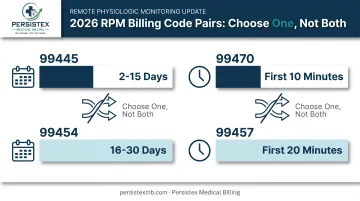
| 99445 (new) | Device supply plus data transmission | 2–15 days in a 30-day period |
| 99454 | Device supply plus data transmission | 16–30 days in a 30-day period |
| 99470 (new) | Treatment management, with live interaction | First 10 minutes per calendar month |
| 99457 | Treatment management, with live interaction | First 20 minutes per calendar month |
| 99458 | Additional treatment management (add-on) | Each additional 20 minutes |
| 99091 | Physician/QHP data collection and review | 30 minutes per month |
Why 99445 and 99470 Matter
Before 2026, a patient who transmitted data for only eight days—or a clinician who spent 12 minutes on readings—often went unbilled. Both fell short of the 16-day and 20-minute thresholds.
The CMS 2026 Physician Fee Schedule final rule closed that gap with 99445 and 99470.
These codes are alternatives, not add-ons. Bill 99445 or 99454 for a given monitoring period—never both. The same rule applies to 99470 versus 99457.
What Counts as Interactive Communication Time
For 99457, 99458, and 99470, the interaction must be real-time and synchronous — a two-way conversation, not a one-sided message. That means:
- Phone calls with the patient or caregiver qualify
- Secure portal messaging alone does not meet the requirement
- Care coordination time can count toward the total, but at least one live interaction is still required
Telehealth Rules and Commercial Payers
RPM codes are not restricted by telehealth originating-site or geographic waiver rules. CMS does not classify RPM as telehealth.
Do not assume every commercial payer adopted the 2026 codes on day one. Private insurers often lag Medicare updates, so confirm 99445 and 99470 acceptance with each payer before you submit.
Medicare, Medicaid & Private Payer Reimbursement for RPM
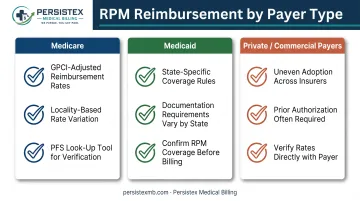
Medicare pays for RPM under the Physician Fee Schedule, but the exact dollar amount depends on your locality. CMS applies separate geographic adjustments (GPCI) to the work, practice expense, and malpractice components of each code, so the same CPT code pays differently in Boston than in rural Vermont.
Practical tip: Don't rely on national averages from third-party blogs. Run your codes through the CMS Physician Fee Schedule Look-Up Tool for locality-specific figures before budgeting expected RPM revenue.
Medicaid and Private Payer Coverage
Medicaid RPM policy isn't uniform. Some states cover the full CPT set; others cover only a subset or impose different documentation rules. If you're billing MassHealth or another state program, confirm the current covered-codes list rather than assuming Medicare rules apply automatically.
Commercial coverage has grown, but adoption remains uneven across carriers. Before billing any private payer for RPM:
- Confirm which CPT codes they currently accept
- Check whether prior authorization is required
- Verify reimbursement rates directly rather than assuming Medicare parity
Special Rules for Clinics and Co-Managed Patients
Rural Health Clinics and Federally Qualified Health Centers don't bill RPM the same way standard practices do. Since 2025, these facilities report individual RPM CPT codes separately and receive payment outside their standard AIR or PPS bundled rate.
A separate limit applies across all settings: only one practitioner may bill RPM for a patient in a 30-day period. This prevents duplicate billing when a patient sees both a primary care physician and a specialist monitoring the same condition. Coordinate with co-managing providers before setting up parallel RPM programs.
Who Can Order and Bill for RPM Services
RPM must be furnished by a physician or qualified healthcare professional (QHP) eligible to bill Medicare E/M services, and it generally requires an established patient relationship.
Current CMS policy does not require a formal physician order or ordering-provider information on the claim itself. That misconception often carries over from older telehealth rules. Documentation still matters: the clinical rationale for starting RPM should live in the chart.
Who Can Perform Which Parts
Not every task needs the billing provider's hands-on involvement:
- 99453 (setup/education) — clinical staff can complete this under general supervision
- 99454 (device monitoring) — also permitted under general supervision by auxiliary personnel
- 99457/99458 (treatment management) — staff time counts, but the billing QHP must review data, make treatment decisions, and ensure the required live interaction occurs
Two conditions apply regardless of who's doing the legwork:
- RPM must address a documented acute or chronic condition — not general wellness tracking
- Informed patient consent must be obtained and documented before billable services begin
Documentation & Compliance Requirements to Avoid Denials
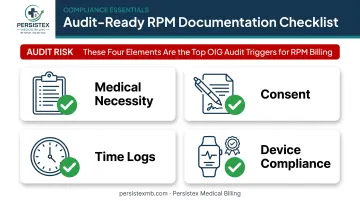
RPM claims get flagged more often for documentation gaps than for coding errors. The Office of Inspector General's 2024 oversight report found that 43% of Medicare RPM enrollees didn't receive all three required components: education, device supply, and treatment management. Total RPM payments exceeded $500 million that year. That's the scale of scrutiny practices are working under.
What Your Chart Needs to Show
- Medical necessity — the specific condition being monitored, expected duration, and clinical rationale for using RPM over standard visits
- Consent — captured, dated, and on file before billing starts
- Time logs for 99457/99458/99470 — dates, duration, and a brief summary of each interactive communication
- Device compliance — the device must meet FDA's medical-device definition with automatic data upload; a consumer fitness tracker doesn't qualify, even if it's a well-known brand
One distinction matters in audits: the device does not need to be "FDA-cleared." It must meet FDA's definition of a medical device and upload data automatically—a narrower bar than many practices assume.
Common Audit Red Flags
- Incomplete or missing time logs for treatment management codes
- Undated or absent consent forms
- Data-day counts that don't match the billed code (2–15 days billed as 99454 instead of 99445, for example)
- No documented evidence of clinical review or care plan adjustments based on the data
Close these gaps before submission and you cut the documentation denials that drive most RPM claim flags.
Common RPM Billing Challenges (and How Persistex Helps Solve Them)
Two problems come up constantly once practices scale their RPM panels past a handful of patients.
Tracking data-transmission windows manually. With 99445 now covering 2–15 days and 99454 covering 16–30 days, practices juggling dozens of patients often miss the correct billing window. They under-bill a patient who hit 16+ days, or try to bill 99454 for someone who only transmitted for nine.
Capturing staff time across scattered channels. Interactive communication happens over phone calls, portal messages, and care coordination check-ins. Without a dedicated system, that time is easy to lose track of. Lost time means lost revenue, or worse, unsupported claims if it's logged inaccurately.
This is where outsourcing pays off. Persistex Medical Billing brings CPC/CPB-certified coders and a 98% clean claim rate across its client base to RPM’s detail-heavy billing requirements. For primary care, internal medicine, family medicine, and outpatient practices already juggling high patient volumes, that means:
- Claims reviewed against current CMS and payer-specific RPM requirements before submission
- Coding accuracy that catches data-day and time-threshold mismatches before they become denials
- A team that treats RPM the way it treats every other service line: chase every dollar, document everything, and stay audit-ready year-round
If RPM billing is eating into hours your clinical staff should be spending on patients, that's a problem worth handing off.
Frequently Asked Questions
What does RPM stand for in medical billing?
RPM stands for Remote Patient Monitoring. It is a CMS-recognized, separately billable clinical service with its own distinct CPT codes, separate from generic telehealth or wellness categories.
What are the RPM billing guidelines for 2026?
The biggest changes are two new CPT codes: 99445 for 2–15 days of data transmission and 99470 for the first 10 minutes of monthly treatment management. Both are alternatives to existing codes rather than add-ons.
How much does Medicare pay for RPM?
Rates vary by CPT code and geographic locality due to GPCI adjustments. Check the current CMS Physician Fee Schedule Look-Up Tool for exact, locality-specific figures rather than relying on national averages.
Who can order RPM for a patient?
RPM must be furnished by a physician or qualified healthcare professional eligible to bill Medicare E/M services, typically for an established patient. CMS doesn't currently require a formal written order on the claim.
Can RPM be billed alongside chronic care management (CCM)?
Yes. RPM and CCM can be billed concurrently for the same patient as long as every requirement for both services is met and no time or effort is counted twice.
Is patient consent required for RPM billing?
Yes. Documented informed consent must be obtained before RPM services are furnished and billed, and it needs to be dated and kept on file.