One behavioral health provider put it plainly after partnering with Persistex Medical Billing: her practice had gone from chasing payments to predictable monthly revenue, finally freeing her to focus on patients instead of paperwork. That shift doesn't happen by accident. It happens because of healthcare revenue cycle management (RCM) — the end-to-end financial process connecting the moment a patient books an appointment to the moment your practice actually gets paid.
This guide covers what RCM means, the steps involved, why it matters, common pitfalls, and how to decide between an in-house team and an outsourced partner. Specialty practices — behavioral health, TMS therapy, pediatrics, chiropractic — face RCM complexities that generic billing approaches often miss, and we'll dig into that later on.
Key Takeaways
- RCM covers the full financial lifecycle of a patient encounter, from scheduling through final payment.
- Most RCM cycles break into 7-9 core steps spanning front-end, mid-cycle, and back-end functions.
- Single-specialty practices face an 8% first-submission denial rate; 60% of medical-group leaders saw denials rise in 2024.
- Practices without in-house billing expertise increasingly outsource RCM to specialty-trained partners.
What Is Healthcare Revenue Cycle Management?
RCM stands for Revenue Cycle Management: the administrative and financial process that tracks a patient's account from first contact through final reimbursement. It answers a simple question: did the practice get paid what it earned, and how fast?
That's a much bigger scope than medical billing alone. Billing is one task inside RCM. The full cycle also includes scheduling, insurance eligibility verification, coding, claims management, collections, and financial reporting.
Three Stages That Work as One System
RCM breaks down into three functional stages that feed into each other:
- Front-end: registration, insurance verification, prior authorizations
- Mid-cycle: coding, documentation, charge capture, utilization review
- Back-end: claims submission, denial management, reimbursement, reporting
A failure in one stage rarely stays contained. Miss an eligibility check at the front end, and you'll be fighting a denial at the back end weeks later, after the appointment is long over and the patient has moved on.
HFMA projects the outsourced U.S. RCM market will hit $189.6 billion in 2025, growing at roughly 10% annually through 2030. That figure covers outsourced functions specifically, a sign of how many practices have decided this work needs dedicated expertise.
One Framework, Many Specialties
RCM applies whether you run a pediatric clinic or a multi-provider primary care practice, but coding rules and payer requirements shift by specialty:
- Behavioral health and psychiatry
- Family and internal medicine
- Primary care and pediatrics
- Chiropractic and podiatry
Each carries its own billing codes, documentation standards, and authorization quirks. Generic billing approaches treat them all the same, which is where denials and lost revenue start.
The Steps of the RCM Cycle: From Patient Registration to Payment
Ask ten billing experts how many steps make up the RCM cycle, and you'll get answers ranging from 7 to 12. AHIMA frames it as three phases containing 10 core functions. Most practices, though, find it easiest to think in terms of these eight stages.
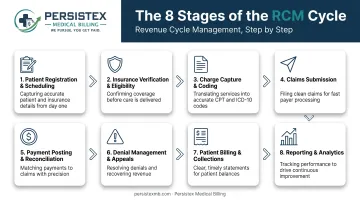
Patient Registration & Scheduling
Every claim's fate is partly decided the moment a patient books an appointment. Front-desk staff collect demographic and insurance details, and small errors here (a misspelled name, a wrong policy number) surface as denials weeks later. Getting this right at intake heads off a cascade of downstream problems.
Insurance Verification & Eligibility
Before the visit happens, real-time eligibility checks confirm active coverage, benefit levels, and whether prior authorization is required. This is often where behavioral health and other specialty claims stall. Session limits, medical-necessity documentation, and peer-to-peer reviews trip up practices without specialty billing experience.
Charge Capture & Medical Coding
After the visit, coders translate documented services into CPT, ICD-10, and HCPCS codes. Coding errors remain one of the leading causes of denials. A mismatched diagnosis-to-procedure link or a missing modifier is enough to trigger a rejection.
Claims Submission
Claims get scrubbed for errors, then submitted electronically as clean claims within each payer's timely filing limit. Skipping the scrub step is how avoidable denials slip through.
Payment Posting & Reconciliation
Once payers respond, remittances are posted and matched against what was actually expected. This is where underpayments hide: a claim paying $40 under the contracted rate looks fine unless someone reconciles every EOB and ERA line by line.
Denial Management & Appeals
Denials happen. Single-specialty practices face an aggregate 8% first-submission denial rate, and that figure has been climbing. What separates practices that recover this revenue from those that don't is simple: does someone actually investigate and appeal, or does the claim just get written off?
Patient Billing & Collections
With deductibles climbing, clear statements and flexible payment plans matter more than ever. Confusing bills generate complaints; transparent ones get paid.
Reporting & Analytics
None of it improves without measurement. Days in A/R, clean claim rate, and denial rate by payer show exactly where the cycle breaks down and where to fix it first.
Why RCM Matters: Benefits for Healthcare Practices
Strong RCM protects your margins as reimbursements shrink and operating costs climb.
It also gives your team their time back. One solo psychiatry practice owner was spending more than 15 hours a week on billing instead of seeing patients, and revenue had plateaued. After outsourcing to Persistex, collections rose and those hours returned to patient care. In his words: "Collections increased 28% and I got 15 hours a week back. They feel like part of our team."
Beyond time and money, effective RCM benefits practices in a few other concrete ways:
- Improves patient experience through accurate, transparent billing—fewer confused calls and billing complaints
- Lowers compliance risk with consistent coding and documentation that reduce audit exposure
- Stabilizes cash flow so predictable collections replace the feast-or-famine cycle
None of this requires a hospital-sized budget. It requires a system that actually works front to back.
Common RCM Challenges and Denial Triggers
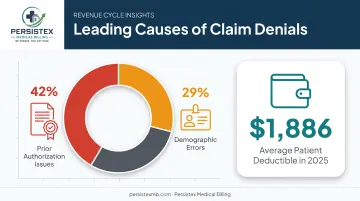
Most denials trace back to problems that start well before a claim ever reaches a payer. In an MGMA Stat poll, medical-group leaders identified prior authorization issues (42%) and demographic errors (29%) as the top drivers of claim denials at their organizations. Those are front-end mistakes, not clinical ones.
Two other pressures compound the problem:
- Payer rules keep shifting. Coverage policies, authorization requirements, and documentation standards change frequently, and staffing shortages make it harder for smaller practices to keep pace.
- Patients owe more out of pocket. Among covered workers with a deductible in 2025, the average single-coverage deductible reached $1,886, with over a third facing at least $2,000.
MGMA's 2023 data also found 33% turnover among business-operations-support staff industry-wide. Stack front-end errors, staffing churn, and rising patient balances, and RCM is hard to run with a skeleton crew.
In-House vs. Outsourced RCM: Choosing the Right Approach
There's a real case for keeping RCM in-house. You get direct control, staff who know your patients personally, and institutional knowledge that doesn't walk out the door.
But sustaining that internally is getting harder:
- Recruiting and retaining certified billing and coding staff in a tight labor market
- Keeping pace with payer policy changes and annual CPT/ICD-10 updates
- Investing in claim-scrubbing and reporting technology that a solo practice can't easily justify
Outsourcing addresses each of those gaps directly — certified coders on staff, dedicated denial follow-up, and technology-driven claim scrubbing without the overhead of building it yourself.
Why Specialty Practices Need More Than Generic Billing
Behavioral health practices carry extra layers of complexity: psychotherapy and psychiatric coding, modifier requirements, session-limit authorizations, telehealth rules, and heavier payer scrutiny on medical necessity. Generic billing companies, built for volume rather than nuance, often mishandle these details — and denials pile up.
Persistex Medical Billing focuses on that specialty depth. Its AAPC- and AHIMA-certified team maintains a 98% clean claim rate, with documented results that include 40% fewer denied claims, A/R days cut from 90 to 30, and an average $125,000 monthly collections boost for client practices.
One multi-provider behavioral health clinic that started at a 35% denial rate cut denials substantially, added $85,000 in monthly revenue, and brought A/R down to 22 days.
What to Look for in Any RCM Partner
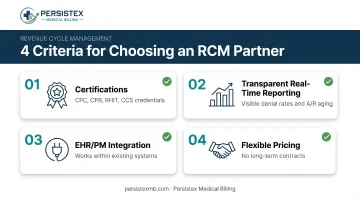
Whether or not you choose Persistex, use these criteria to evaluate any partner:
- Certifications — look for CPC, CPB, RHIT, or CCS-credentialed staff, not just "billing experience"
- Transparent, real-time reporting — you should see denial rates, A/R aging, and collections trends whenever you want, not just at month-end
- EHR/PM integration — the partner should work inside your existing system (AdvancedMD, Kareo, athenahealth, DrChrono, TherapyNotes, and similar platforms), not force a switch
- Flexible pricing with no long-term contracts — percentage-based or flat-rate options that scale with your practice size, without locking you in
Frequently Asked Questions
What does RCM stand for?
RCM stands for Revenue Cycle Management, the financial process that manages a patient's account from registration through final payment.
How many steps are in the RCM cycle?
Most models describe 7-9 core steps, from registration through reporting. Some frameworks, like AHIMA's, break it into as many as 10-12 depending on granularity.
What is the difference between medical billing and RCM?
Billing is one component of RCM. RCM also covers scheduling, eligibility verification, coding, collections, denial management, and financial reporting.
Why do behavioral health practices need specialized RCM support?
Behavioral health uses unique CPT codes, needs frequent prior authorizations, and faces heavier payer scrutiny. Generic billing teams often mishandle those details, which leads to preventable denials.
Should a small practice handle RCM in-house or outsource it?
It depends on staffing capacity and specialty complexity. Smaller or specialty practices typically benefit most from outsourcing, since it avoids the cost and time of hiring and training billing staff internally.
What KPIs should practices track to measure RCM performance?
Days in A/R, clean claim rate, denial rate, and net collection rate are the core metrics for gauging revenue cycle health. Track them monthly to catch bottlenecks before they hurt cash flow.