

That single missing modifier just cost the practice a reimbursable claim, and it's happening more often as payers tighten scrutiny on podiatry billing heading into 2026.
Podiatry coding sits at the intersection of routine foot care exclusions, surgical global periods, modifier stacking rules, and annual AMA and CMS updates. Even seasoned billing staff get tripped up by the details.
This guide breaks down the most common 2026 podiatry CPT codes by category, the modifiers each one requires, and the documentation habits that keep claims clean. For practices that want a second set of expert eyes on this, Persistex Medical Billing works with podiatry offices across Massachusetts and New England on exactly these coding challenges.
Key Takeaways
- Match each service—routine foot care, wound debridement, surgery, or E/M—to its own frequency limits and documentation rules
- Q-modifiers (Q7, Q8, Q9) and modifier -25 are the top denial triggers on foot care and same-day E/M claims
- 2026 updates include a CMS efficiency adjustment on surgical work RVUs, new skin substitute payment rules, and revised remote monitoring codes
- Tight ICD-10 linkage is required to support medical necessity and avoid routine foot care denials
Understanding Podiatry CPT Codes in 2026
CPT codes are five-digit identifiers maintained by the American Medical Association and updated every year. The CPT 2026 code set took effect January 1, 2026, and payers use these codes, alongside linked ICD-10 diagnoses, to decide whether a service gets covered and at what rate.
Podiatry billing carries a unique wrinkle: many routine services, like nail debridement or corn removal, are excluded from Medicare coverage unless tied to a qualifying systemic condition.
A diabetes diagnosis alone does not unlock coverage. The record must also document Class A, B, or C peripheral findings on the same foot being treated. This at-risk documentation rule is enforced strictly across most Medicare Administrative Contractors.
Beyond coverage rules, two payment changes matter most for 2026:
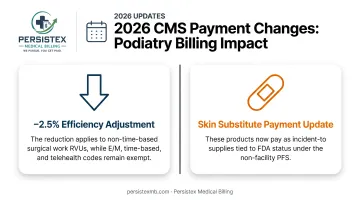
- -2.5% efficiency adjustment on work RVUs for many non-time-based surgical codes, per the CY 2026 Medicare Physician Fee Schedule final rule; E/M, time-based, and telehealth-list services are exempt
- Skin substitutes: covered products now pay as incident-to supplies under the non-facility PFS, tied to each product's FDA status—confirm the current HCPCS code before billing, since quarterly updates change these often
Most Common Podiatry CPT Codes for 2026
Routine Foot Care & Nail Procedure Codes
These are the highest-volume, highest-denial codes in podiatry billing.
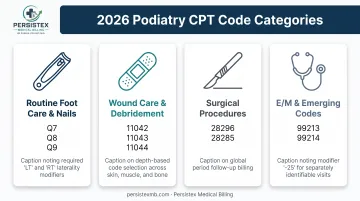
- 11720 (debridement, 1-5 nails) and 11721 (debridement, 6+ nails) require Q7/Q8/Q9 plus LT or RT. Medicare guidance generally limits coverage to once every 60 days without documented justification for more frequent care.
- 11730 (nail avulsion) and 11750 (permanent removal with matrixectomy) each apply to one nail—do not bill both for the same digit on the same date. Repeat avulsion on the same toe within ~32 weeks needs a KX modifier and supporting documentation.
- 11055-11057 (paring of hyperkeratotic lesions) tier by lesion count: one lesion (11055), two to four (11056), or five-plus (11057). Each tier needs its own medical necessity note, not just a lesion count.
Wound Care & Debridement Codes
- 97597/97598 cover selective debridement, first 20 sq cm and each additional 20 sq cm. Use these for diabetic ulcers and record wound size, depth, tissue type, and method.
- 11042/11045 apply when debridement reaches subcutaneous tissue. Do not bill both families for the same wound on the same date—code to the deepest tissue removed and document that depth, not only the ulcer grade.
Surgical Procedure Codes
- 28292/28296 (bunion correction) and 28285 (hammertoe correction) usually carry extended global periods that bundle related post-op visits. Confirm the global indicator in the CMS Physician Fee Schedule before billing any follow-up separately.
- 28810/28820 (toe amputation, with/without metatarsal) require the applicable toe modifier (TA, T1-T9, T5, T6-T9) and documentation of vascular status supporting the amputation level.
- 27702 (total ankle replacement) needs component-specific op-note detail—tibial, talar, or spacer—especially on revisions. Build that detail into standard templates so it is not added only after a denial.
Evaluation & Management and Emerging 2026 Codes
- 99202-99205 (new patient) and 99212-99215 (established patient) are selected by medical decision-making complexity or total time on the date of service, not a checklist of history and exam elements.
- Modifier -25 is required when an E/M service is billed alongside a same-day procedure, but only when the E/M represents work above and beyond the procedure's usual pre- and post-service work.
- 20610 (joint injection/aspiration without imaging) needs the matching drug HCPCS code, dose, and JW/JZ documentation for any discarded medication.
- Remote Therapeutic Monitoring (2026): 98975 (setup) now uses a 2-day monitoring threshold; 98977 covers device supply for 16–30 days; new 98985 covers the 2–15 day gap. Not designed for diabetic foot care, but usable for orthotic or off-loading adherence when documentation supports it.
Essential Modifiers Every Podiatry Practice Must Know
In podiatry, the right modifier often decides whether a claim pays or denies. Here's the shortlist that matters most.
| Modifier | Use Case | Key Rule |
|---|---|---|
| Q7, Q8, Q9 | Routine foot care Class findings | Q7 = 1 Class A; Q8 = 2 Class B; Q9 = 1 Class B + 2 Class C; all from the same foot |
| LT / RT | Laterality | Required alongside Q-modifiers; Q-modifiers alone don't establish which foot |
| TA, T1-T9 | Toe-specific identification | TA = left great toe; T1–T4 = left toes 2–5; T5 = right great toe; T6–T9 = right toes 2–5 |
| 25 | Same-day E/M with a procedure | Requires a separately identifiable service; a routine pre-op assessment doesn't qualify on its own |
| 59 / XS | Distinct procedure, different nail/toe | Use only when no more specific anatomical modifier applies |
| KX | Medically necessary repeat procedure | Confirms documentation supports an exception to standard frequency limits |
| JW / JZ | Drug wastage reporting | JW reports discarded drug; JZ confirms nothing was wasted; both required on applicable injectable claims |
AMA guidance on Reporting CPT Modifier 25 does not require a separate diagnosis, but the note must show E/M work distinct from the procedure. A line like "patient tolerated procedure well" does not meet that standard.
Common ICD-10 Codes Paired with Podiatry CPT Codes
The CPT code tells the payer what was done. The ICD-10 code tells them why it was medically necessary. This pairing is where a large share of podiatry denials originate.
| Category | Example Codes |
|---|---|
| Diabetes-related | E11.621 (with foot ulcer), E11.40 (neuropathy), E11.51 (peripheral angiopathy) |
| Nail/skin conditions | L60.0 (ingrowing nail), L84 (corns and callosities) |
| Vascular/joint | M25.571 (ankle pain), I73.9 (peripheral vascular disease) |
| Ulcers | L97.4- (heel/midfoot), L97.5- (other foot) |
Pairing rules that prevent common denials:
- E11.621 alone doesn't replace the specific L97.4- or L97.5- code for ulcer location and depth
- L97.4- and L97.5- require added digits for laterality and severity
- L60.0, L84, M25.571, or I73.9 alone don't establish routine foot care coverage under Medicare
- Use the ICD-10 file in effect on the date of service; the October 1 update applies through the following September
Avoiding Denials: Documentation and Billing Best Practices
Nationally, CMS data shows an 11.2% improper-payment rate on podiatry claims, tied to roughly $216.9 million in projected improper payments.
Insufficient documentation drove 76.4% of those errors; incorrect coding accounted for another 11.5%, according to CMS's Podiatry Care compliance tips.
Documentation, not coding knowledge, is the real bottleneck for most practices.
Practical steps that cut denials:
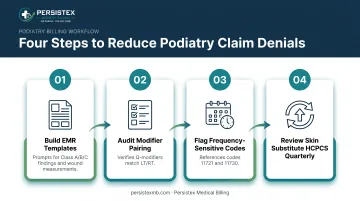
- Build EMR templates that prompt for Class A/B/C findings, wound size and depth, and the last visit date for the underlying systemic condition
- Audit modifier pairing before submission—every Q-modifier needs a matching LT/RT, and -25 claims need a distinct E/M note
- Flag frequency-sensitive codes (11721, 11730) in scheduling so staff catch early rebooking before it becomes a denial
- Review skin substitute HCPCS codes quarterly—product-specific codes change more often than most teams expect
Specialized billing partners often own this tracking end to end. Persistex maintains a 98% clean claim rate with CPC- and CPB-certified coders who catch modifier and frequency issues before submission—so practices spend less time on appeals.
Frequently Asked Questions
What is the CPT code for a foot exam?
No single CPT code covers a generic foot exam. Podiatry visits are billed under standard E/M codes—99202–99205 for new patients or 99212–99215 for established patients—based on medical decision-making complexity or total time.
What is the CPT code for foot surgery?
"Foot surgery" spans dozens of codes depending on the procedure. Common examples include 28292/28296 for bunion correction, 28285 for hammertoe repair, and 28810/28820 for toe amputation.
What are the common ICD-10 codes used in podiatry?
The most frequent categories are diabetes-related codes (E11.621, E11.40), ingrown nail (L60.0), vascular disease (I73.9), and diabetic ulcer codes (L97.4-, L97.5-). Match the diagnosis to the procedure so the claim supports medical necessity.
How often does Medicare cover routine nail debridement (CPT 11721)?
Medicare generally covers 11721 once every 60 days when medical necessity and the correct Q-modifiers are documented. Bill more often only when the chart clearly justifies medical necessity.
What modifier is required for routine foot care under Medicare?
Q7, Q8, or Q9, depending on documented Class A, B, or C findings, paired with LT or RT to identify the affected foot.
Do podiatry CPT codes change every year?
Yes. The AMA updates the CPT code set annually, and CMS revises payment policy each year as well. Reviewing coding guidance before January 1 is essential for every practice.