
The disconnect usually starts small. A front-desk scheduling error here, a missed prior authorization there. But those small gaps compound. Unresolved claim denials cost private medical practices an average of nearly 5% of net patient revenue annually, according to a 2024 AMA analysis.
This guide breaks down what revenue cycle management actually means, walks through the standard 7-step process, and explains why getting RCM right often determines whether a practice grows or just survives.
Key Takeaways
- RCM manages a patient's entire financial journey, from scheduling to final payment
- Most healthcare organizations run RCM through a standard 7-step framework
- Strong RCM reduces denials, stabilizes cash flow, and improves patient billing experience
- Behavioral health practices face coding challenges generic billers often miss
- In-house vs. outsourced RCM affects revenue predictability and growth potential
What Is Revenue Cycle Management in Healthcare?
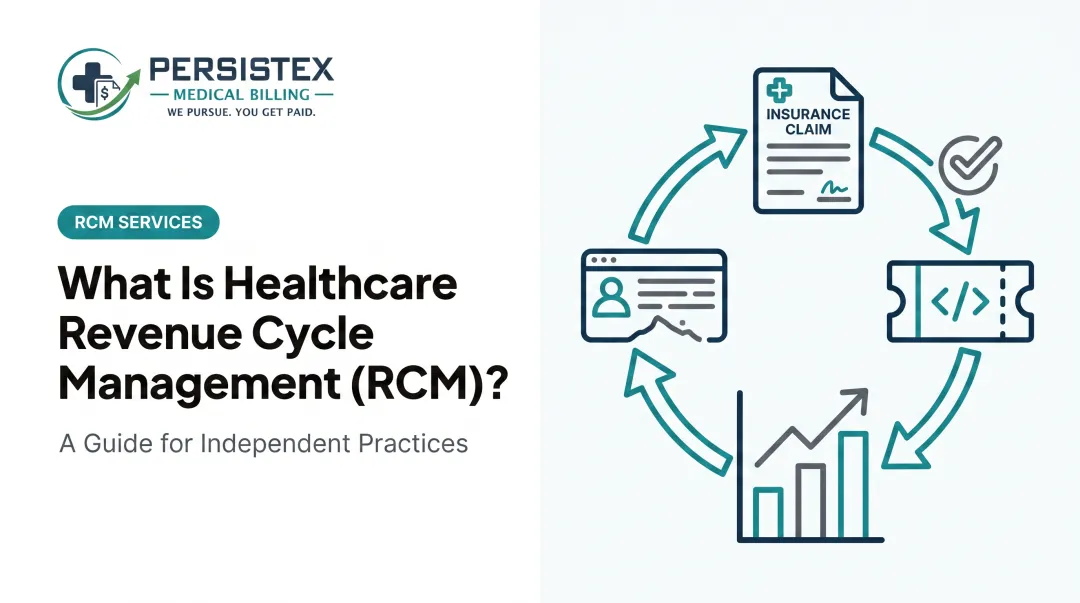
Revenue cycle management is the complete financial process that tracks a patient's interaction with a provider, starting the moment an appointment gets scheduled and ending when the balance is paid in full.
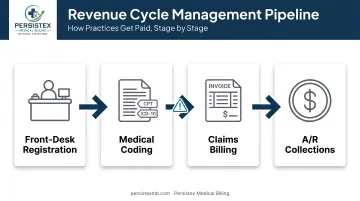
Think of it as a pipeline. Patient information flows in one end. Money flows out the other. Every step in between (verification, coding, submission, payment posting) either keeps that flow moving or creates a clog.
RCM isn't a single department's job. It requires coordination across:
- Front-desk staff collecting demographics and insurance details
- Medical coders translating clinical documentation into billable codes
- Billers submitting and tracking claims
- A/R and collections staff working balances through final payment
When any link in that chain breaks, the whole cycle slows down. Unresolved denials eat into net revenue the same way: it's rarely one big mistake, but dozens of small ones scattered across departments.
RCM vs. Medical Billing: What's the Difference?
Medical billing and RCM get used interchangeably, but they're not the same thing. Medical billing is one component of RCM, specifically, generating and submitting claims to insurance companies for payment, according to AAPC's definition.
RCM covers the entire financial lifecycle:
- Scheduling and registration
- Insurance eligibility checks
- Medical coding
- Claims submission (this is where billing lives)
- Denial management
- Patient collections
Persistex Medical Billing draws the same line. Its Medical Billing service line handles claim submission, payment posting, denial appeals, and structured A/R follow-up at 30-, 60-, and 90-day intervals.
Its broader RCM service line adds insurance verification, prior authorization management, and fee schedule analysis. Billing is the engine. RCM is the whole vehicle.
The 7 Steps of the Revenue Cycle Management Process
Despite differences across specialties and practice sizes, most healthcare organizations follow the same 7-step RCM framework. Each stage below is where revenue is either protected—or quietly lost.
Step 1: Patient Registration and Scheduling
This is where the cycle begins, and where a surprising number of denials get created before a patient even sees a provider. Front-desk staff collect demographic details and insurance information at scheduling or check-in.
A misspelled name, an outdated policy number, or a missing group ID can trigger a claim rejection weeks later. Registration errors remain one of the leading causes of downstream denials.
Step 2: Insurance Verification and Eligibility
Before service is rendered, staff confirm active coverage, co-pays, deductibles, and whether prior authorization is required. Skipping this step is how practices end up billing patients for services insurance never intended to cover.
For behavioral health and other specialty services, authorization rules change by payer and can stall care if they are handled late. Real-time eligibility checks plus full authorization lifecycle management catch coverage gaps before the visit—not weeks later when the claim denies.
Step 3: Medical Coding and Charge Entry
Coders translate diagnoses and procedures into standardized CPT, ICD-10, and HCPCS codes. This sounds mechanical. It isn't.
Behavioral health coding alone requires distinguishing between assessment, treatment, and evaluation-and-management requirements. Time-based psychotherapy codes 90832, 90834, and 90837 can only be reported once per date and generally can't overlap with assessment code 90791 on the same day, per AAPC's coding guidance.
Telehealth adds another failure point: wrong place-of-service codes or missing modifiers get clean documentation rejected at submission. Get those details wrong, and the claim bounces.
Step 4: Claims Submission and Processing
Clean claims, meaning complete and accurate on the first submission, move through the system far faster than claims requiring correction. Industry guidance points to a 98% clean claim rate as the target benchmark, per HFMA's KPI tracking resource.
Persistex reports maintaining that exact 98% clean claim rate across its full client base, achieved through pre-submission scrubbing, coding validation, and payer-specific policy checks before a claim ever leaves the building.
Step 5: Payment Posting and Reconciliation
Once payers respond, staff record payments and reconcile them against Explanation of Benefits (EOB) or Electronic Remittance Advice (ERA) statements. This step catches underpayments, contractual write-offs, and posting errors before they get buried in the books.
Step 6: Denial Management and Appeals
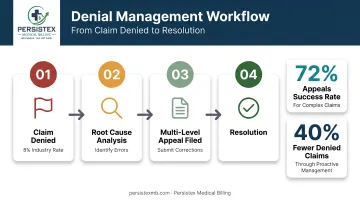
Not every claim gets paid the first time. Single-specialty practices see an 8% aggregate first-submission denial rate, a figure that's held steady since 2019, according to MGMA's 2023 DataDive dataset.
Denial management means identifying why a claim was rejected, correcting the underlying issue, and appealing where appropriate. Persistex's approach, root-cause analysis followed by multi-level appeals, has delivered a 72% appeals success rate and 40% fewer denied claims for clients overall.
Step 7: Patient Billing and Collections
After insurance pays its share, any remaining balance goes to the patient. This step includes clear statements, payment plan options, and consistent follow-up communication, all of which reduce the odds of that balance turning into bad debt.
Why Revenue Cycle Management Matters for Healthcare Practices
Strong RCM determines whether a practice has predictable cash flow or lives claim-to-claim.
Denied claims are expensive to fix, not just to lose. MGMA data cited by the AMA once put the average cost of reworking a single denied claim at $25. That figure is over a decade old, so the real cost today is almost certainly higher once staff time and delayed reimbursement are factored in.
Here's how the core benchmarks stack up:
| Metric | Industry Benchmark |
|---|---|
| Clean claim rate | 98% (target) |
| Denial rate | 5-10%, below 5% is optimal |
| Days in A/R | 30-40 days (ideal range) |
Beyond the numbers, well-managed RCM builds patient trust. Transparent billing, accurate statements, and clear communication about what's owed keep patients from feeling blindsided and support retention.
It also keeps practices aligned with HIPAA and payer regulations. That reduces audit exposure and the financial risk that compounds when processes stay inconsistent.
Common RCM Challenges That Drain Practice Revenue
Even well-run practices bleed revenue through a handful of recurring problems.
- Specialty coding complexity: Behavioral health session codes, modifier rules, and specialty documentation requirements trip up generalist billers constantly. Practices with dedicated specialty coding expertise report up to a 35% reduction in coding-related denials.
- Slow or mismanaged appeals: A denial that sits unaddressed for weeks often becomes a permanent loss. Payers have filing deadlines, and once they pass, that revenue is gone for good.
- Administrative overload: A 2009 Health Affairs study found physicians spend roughly 3 hours per week on health plan interactions alone—clerical staff spend far more. Practices with dedicated billing partners often reclaim 15+ hours per week.
- Extended A/R cycles: When claims sit unresolved for 60, 90, or more days, cash flow becomes unpredictable. One Persistex client cut A/R from 90 days down to 30, a two-thirds reduction that made monthly cash-flow planning far more predictable.
In-House vs. Outsourced RCM: Choosing the Right Model
There's no universally right answer . The better fit depends on practice size, specialty, and how much bandwidth staff actually have.
Running RCM In-House
Keeping billing internal gives practices direct control over every step. The tradeoff:
- Requires ongoing investment in certified coders and billers
- Demands continuous training as CPT and payer rules change
- Needs billing technology that integrates with your EHR
For solo practitioners especially, this often means one person juggling scheduling, coding, and follow-up. The AMA flags that setup as a common small-practice RCM pitfall.
Outsourcing RCM
Outsourcing trades some control for specialized expertise and scalability without the overhead of building an internal department. Specialty practices, particularly behavioral health and primary care, tend to benefit most, since unique payer rules and coding requirements are precisely where generic billing services fall short.
Persistex Medical Billing built its model around that gap. Its team holds CPC and CPB certifications through AAPC, plus RHIT and CCS credentials through AHIMA, and delivers measurable outcomes:
- 98% clean claim rate across all clients
- 40% fewer denied claims
- A/R reduced from 90 to 30 days in documented cases
- 72%+ appeals success rate
The company integrates with major platforms including AdvancedMD, Kareo, athenahealth, DrChrono, and TherapyNotes. Pricing is percentage-based or flat-rate, with no long-term contracts required.

Evaluating an RCM Partner: Quick Checklist
Before signing with any billing partner, confirm they offer:
- Specialty expertise relevant to your practice type, not generic multi-specialty coverage
- EHR/practice management integration with your existing system
- Transparent reporting you can review anytime, not black-box dashboards
- Flexible contract terms that don't lock you in if results fall short
Frequently Asked Questions
Can you explain revenue cycle management in a simple way?
RCM is the financial process that tracks a patient's journey from appointment scheduling through final payment. It covers registration, insurance verification, coding, claims submission, and collections.
What are the 7 steps of the revenue cycle?
Registration and scheduling, insurance verification, coding and charge entry, claims submission, payment posting, denial management, and patient billing and collections. Each step feeds directly into the next.
What is the difference between medical billing and revenue cycle management?
Medical billing is one step within RCM, specifically generating and submitting claims. RCM spans the entire financial lifecycle, from scheduling through final collections.
What are common KPIs used to measure RCM performance?
The core indicators are clean claim rate (target: 98%), denial rate (industry average 5-10%), and days in accounts receivable (ideal range: 30-40 days).
How much does outsourcing revenue cycle management typically cost?
Outsourced RCM is commonly priced as a percentage of collections or a flat monthly rate. Pricing varies based on practice size, claim volume, and specialty.
Is revenue cycle management only necessary for hospitals, or do small practices need it too?
Solo practitioners and small clinics depend on effective RCM just as much as hospitals. Without it, even a handful of denied claims can destabilize monthly cash flow.