

Introduction
Revenue cycle management is the financial backbone of every healthcare practice. Get it wrong, and even the best clinical care can't keep the lights on.
In 2026, that backbone is under real strain. Denials are climbing, practice margins are razor-thin, and staffing shortages make manual billing workflows nearly impossible to sustain. Many practices struggle just to keep claims moving through the pipeline, let alone optimize them.
At the same time, AI, automation, and regulatory shifts are reshaping how practices get paid. This article breaks down the top 2026 RCM trends, what's driving them, how they're already changing daily operations, and what practices of every size should watch next.
Key Takeaways
- AI and agentic automation are moving RCM from reactive claims cleanup to predictive denial prevention
- Staffing shortages are pushing more practices toward specialized outsourcing partnerships
- Cybersecurity now functions as a revenue protection strategy, not just an IT concern
- Patient billing transparency and regulatory rules are reshaping collections strategy
- Behavioral health billing complexity rewards niche coding expertise over generalist billing
Key RCM Trends Shaping 2026
Trend 1: AI, Automation & the Rise of Autonomous Coding
Medical coding has spent the last decade moving from fully manual work to computer-assisted coding, where software suggests codes for a human to confirm. In 2026, that's shifting again, this time toward autonomous coding, where AI assigns codes directly with minimal human review, plus predictive analytics that flag denial risk before a claim ever leaves the building.
This isn't a fringe experiment anymore. 60% of healthcare organizations surveyed at the 2023 HFMA Annual Conference said they were already using autonomous coding or actively planning to adopt it. That's a majority, not an early-adopter minority.
Where automation is showing up in daily workflows:
- Eligibility verification checks run automatically before a patient's appointment, not after
- Prior authorization requests get flagged, drafted, and routed with less manual chasing
- Payment posting reconciles against remittance files without line-by-line manual entry
Catching a denial risk before submission is far cheaper than fighting it after the fact. It also takes pressure off short-staffed billing teams who no longer have to rekey every claim or authorization request.
Deloitte's modeling suggests technology could save revenue-cycle professionals 41% to 50% of their time across the stages it analyzed—time that can go toward appeals, patient communication, or higher-value work instead of repetitive data entry.

Trend 2: Strategic Outsourcing to Offset Labor Shortages & Cost Pressure
Billing and administrative roles remain some of the hardest positions for practices to fill. That staffing gap is a direct driver behind the outsourcing surge heading into 2026.
An MGMA Stat poll of medical-practice leaders found 36% planned to outsource or automate part of their revenue cycle in 2025, with billing vacancies frequently cited as a cause of claims delays and growing accounts-receivable backlogs.
Specialty-focused partners make that model concrete. Rather than routing claims through rotating call-center staff, Persistex assigns certified coding teams—including CPC, CPB, RHIT, and CCS credentialed professionals—who focus on behavioral health and other outpatient specialties. That model shows up in the numbers:
- 99.2% coding accuracy with certified specialists
- 35% reduction in coding-related denials
- Named account teams instead of anonymous ticket queues
Why outsourcing keeps growing:
- Relieves clinical staff of administrative work they never wanted in the first place
- Brings certified coding expertise that's expensive and slow to build in-house
- Offers percentage-based or flat-rate pricing with more predictable costs than hiring, training, and retaining an internal billing department
A solo psychiatry practice that outsourced its billing reported 28% higher collections and reclaimed 15 hours per week previously lost to billing administration, time redirected straight back to patient care.
Trend 3: Cybersecurity Becomes a Core Revenue Protection Strategy
Every claim that moves through a billing system carries sensitive financial and patient data. That makes providers a persistent target, and a breach doesn't just create a compliance headache. It stops collections cold.
The 2025 Proofpoint-Ponemon healthcare study found that 93% of healthcare organizations experienced a cyberattack in the prior 12 months.
The Change Healthcare outage put a real face on what that means for practices: in a follow-up AMA survey, 90% of physician practices reported ongoing revenue loss from unpaid claims months after the incident, and 34% couldn't make payroll as a result.
Proactive measures now spreading industry-wide:
- Encryption of financial and clinical data both in transit and at rest
- Multi-factor authentication on billing and EHR system logins
- Vendor risk management for clearinghouses and billing partners
- Continuous security audits rather than annual check-the-box reviews
A single breach can freeze claims processing for weeks and quietly erode patient trust in the process. That's why cybersecurity now belongs on the CFO's dashboard, not just the IT team's.
Trend 4: Patient-Centric Billing & Regulatory-Driven Transparency
Patients are shouldering more of their own healthcare costs, and they're bringing retail-level expectations with them. They want to know what something will cost before they get the bill, and they want to pay it without calling a billing office during business hours.
Regulation is reinforcing that expectation. The No Surprises Act requires providers to furnish a Good Faith Estimate to uninsured or self-pay patients who request one or schedule care in advance, and patients can dispute a bill that lands $400 or more above that estimate.
Patients are backing this up with their wallets. In the 2023 Voice of the Patient survey, 56% of patients said they'd likely switch providers after a poor billing experience.
Tools practices are deploying to keep up:
- Real-time eligibility checks at scheduling, not at check-in
- Pre-service cost estimates tied directly to a patient's actual benefits
- Flexible, personalized payment plans instead of one-size-fits-all statements
- Self-service portals for viewing bills and making payments
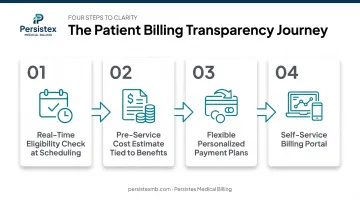
Fewer billing disputes, faster collections, and better patient retention all follow from getting this right.
Trend 5: Rising Complexity in Specialty & Behavioral Health Billing
General billing knowledge doesn't stretch far enough for specialty services. Behavioral health and TMS therapy in particular carry coding rules, authorization hurdles, and payer scrutiny that generic billing teams routinely mishandle.
TMS billing, for example, relies on CPT codes 90867 through 90869 for initial mapping, treatment sessions, and re-evaluation, each with payer-specific modifier and medical-necessity documentation requirements. Behavioral health adds its own layer: psychotherapy codes 90832–90838, psychiatric evaluation codes 90791 and 90792, session-limit authorizations, and telehealth billing rules that shift by payer.
Federal enforcement is intensifying too. The Department of Labor's 2025 MHPAEA report found compliance corrections affecting more than 18 million participants across 39,000-plus health plans between August 2023 and July 2025, with 2 million participants in plans that had to loosen prior authorization requirements for mental health and substance use disorder benefits.
The payoff for specialty expertise is measurable. Persistex client results in behavioral health and specialty outpatient billing include:
- 40% fewer denied claims after tightening coding and documentation workflows
- A 72% appeals success rate through root-cause analysis and multi-level appeals
- A 98% clean claim rate across clients
Practices without specialized coding knowledge risk higher denial rates and slower reimbursement as payer scrutiny keeps tightening.
What's Driving These RCM Trends
Technology, money, and regulation are converging at the same time, and that's why 2026 feels like an inflection point rather than a gradual shift.
- Technology maturity: AI and automation tools have gotten cheaper and more accurate, lowering the barrier for practices that couldn't justify the cost two years ago.
- Patient expectations: Retail-style transparency and digital payment options are now baseline expectations for patients.
- Cost pressure: MGMA found 90% of medical groups reported higher operating costs year-over-year in 2025, with labor often consuming 50–60% of operating spend.
- Margin squeeze: An October 2025 MGMA Stat poll found 48% of medical-group leaders saw worse operating margin per physician than the year before.
- Regulatory pressure: Ongoing enforcement around price transparency and mental health parity keeps raising the compliance bar.
- Competitive dynamics: Practices that modernize collections and billing gain a real edge over competitors still running manual, reactive processes.
How These Trends Are Impacting the Healthcare Industry
These shifts aren't theoretical. They're already changing how practices operate, spend, and staff.
Operational Impact
Workflows are moving away from reactive claim corrections toward proactive denial prevention. Instead of fixing a rejected claim after the fact, teams catch eligibility issues and documentation gaps before submission—cutting rework and speeding reimbursement.
Business Impact
Investment dollars are shifting. Rather than expanding in-house billing headcount, practices are putting budget toward capabilities that scale more predictably than payroll:
- Automation tools
- Outsourcing partnerships
- Cybersecurity infrastructure
Workforce Impact
The skills RCM teams need are changing too. Routine data entry is being automated or outsourced. Remaining in-house staff need fewer keystrokes and more judgment in:
- AI oversight
- Exception handling
- Data interpretation
Future Signals for RCM Beyond 2026
RCM won't stop evolving once 2026 ends. Three signals are already taking shape:
- Agentic AI expansion: tools that run multi-step billing tasks with human oversight—not just rule-based automation—are moving from pilot to production.
- Clinical-financial integration: tighter links between clinical documentation and financial clearance will flag denial risk earlier, sometimes before a claim is generated.
- Widening performance gap: practices that skip modernization—through technology or specialized partners—will see denials climb and collections lag further behind early adapters.
Track these shifts now so your 2027 stack, staffing, and partner choices aren't reactive.
Conclusion
The RCM trends shaping 2026 are already changing how practices get paid:
- AI-driven automation
- Strategic outsourcing
- Cybersecurity as revenue protection
- Patient-centric billing
- Specialty coding expertise
Practices that adapt early—through in-house technology or a partner like Persistex—see fewer denials, faster collections, and more predictable cash flow. For practices of every size, strong revenue cycle strategy is now a financial necessity.
Frequently Asked Questions
What are the latest trends in revenue cycle management?
The defining 2026 trends are AI-driven automation and autonomous coding, strategic outsourcing to offset staffing shortages, cybersecurity as a revenue protection strategy, and patient-centric billing transparency.
Can you explain revenue cycle management in a simple way?
Revenue cycle management is the end-to-end process of tracking patient revenue from scheduling through final payment. It covers insurance verification, coding, billing, claims submission, and collections.
What are the four P's of revenue cycle management?
The four P's are patient access, pre-authorization and charge capture, payer and claims processing, and payment and collections. Each stage affects how quickly and completely a practice gets paid.
How is AI changing medical billing and coding in 2026?
AI has moved from simply assisting coders to enabling autonomous coding and predictive denial analytics. This reduces manual errors, catches risk before submission, and speeds up reimbursement.
Should small or specialty practices outsource their revenue cycle management?
Yes, especially for solo or specialty practices lacking in-house coding expertise. Outsourcing typically reduces denials, and one Persistex client reclaimed 15 hours a week after outsourcing billing.
Why is behavioral health billing more complex than general medical billing?
Behavioral health billing involves unique CPT codes, session-limit authorizations, and payer scrutiny tied to mental health parity enforcement. Generalist billing teams often mishandle these specialty-specific requirements.