
This breakdown is written for practice owners, administrators, and billing staff who need to understand how revenue actually moves through their organization. Get this wrong, and you're looking at slower cash flow, more compliance exposure, and denied claims that quietly drain your bottom line.
Here's the problem: "full cycle billing" gets thrown around constantly in healthcare, but most practices only pay attention to the claim submission stage. That's one piece of a much bigger puzzle.
This article covers what the process actually is, how each step functions, what affects its performance, and when outsourcing it makes sense for your practice.
Key Takeaways
- Full cycle billing spans patient registration through zero-balance collection — not just claims submission
- The process runs through 7 core stages, and each one can independently cause revenue leakage
- Clean claim rate, days in A/R, and denial rate are the metrics that reveal whether your cycle works
- Specialty practices like behavioral health face added complexity that generic billing setups often miss
What Is the Full Cycle Billing Process?
Full cycle billing is the comprehensive management of a patient's entire financial journey through your practice. According to the Healthcare Financial Management Association, that journey starts at the patient's initial appointment and continues through registration, benefits verification, care delivery, claim submission, and final reimbursement.
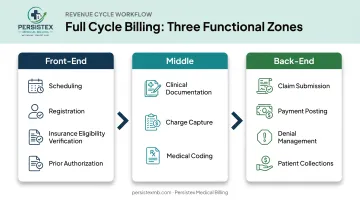
The process breaks down into three functional zones:
- Front-end: Scheduling, registration, insurance eligibility verification, and prior authorization
- Middle: Clinical documentation, charge capture, and medical coding
- Back-end: Claim submission, payment posting, denial management, and patient collections
The goal is to convert delivered care into collected revenue with minimal delay or loss.
Full Cycle vs. Back-End-Only Billing
Many billing services only pick up after a claim has already been coded and generated. That's back-end billing, and it skips the front-end error prevention that stops denials before they start. If your insurance verification is sloppy or your intake data is wrong, no amount of back-end cleanup will fully fix it.
Billing Cycle vs. Full Cycle Billing Process
These terms get confused often. A "billing cycle" refers to a recurring time interval — the 30-day window a payer takes to process a claim, for example. The "full cycle billing process" is the entire workflow that spans that interval and beyond, continuing until the account balance reaches zero.
You'll also hear full cycle billing called end-to-end revenue cycle management, or RCM. In day-to-day practice, billing teams often use these terms interchangeably.
Why the Full Cycle Billing Process Matters in Healthcare
Healthcare billing carries a level of complexity most other industries never touch. Multiple payers, shifting coding regulations, prior authorization thresholds, and HIPAA compliance rules all stack on top of each other. A fragmented billing approach creates inefficiency and real financial risk.
MGMA's 2023 Practice Operations report, which surveyed nearly 1,000 organizations across specialties, found that 8% of claims are denied on first submission. A later MGMA Stat poll found that 60% of medical groups reported higher denial rates than the year before.
What Goes Wrong in Siloed Billing
When registration, coding, and billing teams operate independently instead of as one connected system, predictable problems show up:
- Eligibility errors at check-in slip through unnoticed
- Coding mistakes generate denials weeks later
- Follow-up on unpaid claims falls through the cracks between departments
- Nobody owns the account until the money is actually collected
Full cycle billing is an operational best practice, not a regulatory checkbox. It closes these gaps by putting front-desk, clinical, and billing functions on the same information instead of passing problems downstream.
This is where specialty expertise starts to matter. Behavioral health, primary care, and other outpatient practices face coding rules and prior authorization thresholds that generic billing workflows often miss.
Persistex Medical Billing pairs CPC, CPB, RHIT, and CCS-certified coding with persistent denial follow-up, helping client practices maintain a 98% clean claim rate. For a behavioral health group juggling session authorizations and payer-specific documentation rules, that depth is often the difference between a clean claim and a weeks-long appeal.
How the Full Cycle Billing Process Works (Step-by-Step)
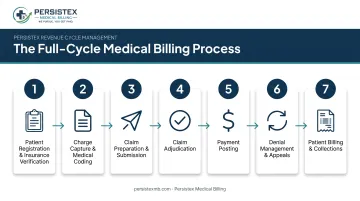
The cycle starts before the patient ever walks in, and it doesn't end until the account balance is zero. Inputs: patient demographics, insurance information, and clinical documentation
Output: a paid claim and a settled account
Checkpoints along the way catch errors before they cost revenue:
- Eligibility checks
- Coding audits
- Claim scrubbing
- Denial reviews
Step 1: Patient Registration & Insurance Verification
Staff collect demographic and insurance details, then verify active coverage and eligibility before the visit happens. This single step prevents many downstream denials. A wrong policy number or an expired coverage plan caught here saves weeks of rework later.
Step 2: Charge Capture & Medical Coding
Coders translate clinical services into standardized CPT and ICD-10 codes. Accuracy here directly drives reimbursement and denial risk. A mismatched diagnosis-to-procedure link is one of the most common reasons claims bounce back.
Step 3: Claim Preparation & Submission
Billers scrub claims for errors and submit them electronically to the payer, usually through a clearinghouse, within a defined filing window. Medicare generally requires claims within 12 months of the service date; commercial payers often set shorter limits.
Step 4: Claim Adjudication
The payer reviews the claim against coverage rules and decides whether to approve it, partially approve it, or deny it. This decision determines everything that happens next in the cycle.
Step 5: Payment Posting
The billing team posts approved payments to the patient account, then calculates any remaining balance from the payer's explanation of benefits. That balance feeds the final collection steps.
Step 6: Denial Management & Appeals
Teams investigate denied or underpaid claims, correct them, and resubmit or appeal. Practices that stop at the first denial leave real money uncollected. Persistex reports a 72% appeals success rate on denied claims, built on root-cause analysis of why each denial happened.
Step 7: Patient Billing & Collections
The practice bills the patient for remaining responsibility. Follow-up and flexible payment options continue until the balance hits zero. That settled balance—not claim submission—is the real finish line for full cycle billing.
Key Factors That Affect the Full Cycle Billing Process
Several variables determine whether your cycle runs smoothly or bleeds revenue at every stage:
- Input accuracy: Errors in patient demographics or insurance details at registration cascade into denials weeks later
- Coding precision: Correct specialty-specific codes and modifiers — such as psychotherapy CPT codes — directly affect approval rates and reimbursement speed
- Payer-specific rules: Each insurer sets different timely filing limits, documentation requirements, and prior authorization thresholds that change your cycle length
- Staffing and technology: Manual processes, in-house software, or an outsourced RCM partner each produce different error rates and days in A/R
- Compliance requirements: HIPAA and payer audit rules constrain how patient data gets handled and documented at every stage
The American Medical Association's private-practice guidance sets benchmark targets of 95% for first-pass resolution and coding accuracy, with days in A/R kept under 30. Hitting those numbers consistently usually requires either dedicated in-house infrastructure or a specialized billing partner.
For New England practices, regional payer knowledge matters as much as clean coding. MassHealth and Blue Cross Blue Shield of Massachusetts each set their own rules on psychotherapy session limits, telehealth billing, and prior authorization — and Harvard Pilgrim and Tufts Health Plan add another layer of requirements.
Persistex reviews claims against these regional policies and works inside systems practices already use, so payer-specific checks stay in the workflow instead of sitting on top of it.
Common Misconceptions & When Full Cycle Billing May Not Be the Right Fit
"Full cycle billing just means submitting claims faster." Not quite. Speed without front-end error prevention just means you're sending mistakes to the payer faster. Real full cycle billing includes prevention up front and persistence on every unpaid dollar after.
"A fast cycle is a healthy cycle." Not necessarily. A claim can clear submission in record time and still come back denied, underpaid, or flagged for documentation issues. Speed measures throughput, not accuracy.
When You Might Not Need It
Full cycle billing isn't a one-size-fits-all requirement. A small, low-volume solo practice with simple billing needs and solid in-house administrative capacity may not need a fully outsourced RCM partner.
Growing practices that add providers or specialty services often outgrow pure in-house capacity. Even then, a full handoff isn't always required. Modular support from a flexible partner like Persistex Medical Billing can cover only the gaps:
- Strong clean claim rates and low days in A/R may need only targeted help
- Coding audits or denial appeal assistance can close specific gaps without a full handoff
- Percentage-based or flat-rate pricing, with no long-term contract, lets you scale support with volume

Frequently Asked Questions
What does the full cycle billing process mean?
It means managing every stage of a patient's billing journey, from registration and insurance verification through coding, claim submission, payment posting, and final collections, as one connected system rather than isolated steps.
What are the steps in the full cycle billing process?
The core stages are: registration and eligibility verification, coding and charge capture, claim submission, adjudication, payment posting, denial management, and patient collections.
How many days are in one billing cycle?
There's no single fixed number. It depends on the payer and claim complexity. Most practices track "days in A/R" instead, with under 30 days considered a strong target for private practices.
What's the difference between front-end and back-end billing?
Front-end billing covers pre-visit tasks like registration and eligibility checks. Back-end billing covers claims, payment posting, and collections after the visit. Full cycle billing unifies both.
Why should healthcare practices outsource full cycle billing?
Outsourcing gives practices access to certified coders and dedicated denial follow-up. Persistex clients, for example, have seen A/R drop from 90 to 30 days and denials fall by 40%.
What is a good clean claim rate for full cycle billing?
A clean claim rate of 95% or higher is strong performance for most practices. Specialized RCM partners like Persistex target and maintain rates around 98%.