
Introduction
Behavioral health and other independent outpatient practices lose real money every month to denied claims, coding mistakes, and slow payer reimbursements. That leakage is a structural drain on practice revenue.
MGMA's 2023 DataDive found an 8% aggregate first-submission denial rate across single-specialty practices, a number that has barely moved since 2019, according to MGMA's analysis of practice denial trends. Every denied claim means delayed cash, extra staff hours, and sometimes revenue that never gets recovered at all.
Billing and revenue management (BRM), known in healthcare as Revenue Cycle Management (RCM), is the umbrella term for everything between scheduling a patient and collecting the final dollar owed. This guide breaks down what BRM means for a medical practice, its core pillars, and how a specialized partner like Persistex Medical Billing helps stabilize collections and cut avoidable denials.
Key Takeaways
- Billing and Revenue Management (BRM) covers the full financial journey of a patient encounter, from eligibility checks to final payment
- Healthcare RCM is built on five pillars: patient access, coding, claims, payment/AR, and denial management
- Medical billing splits into three categories: professional, institutional, and outpatient/ancillary
- Single-specialty practices see an 8% first-submission denial rate industry-wide
- Specialty-focused coding teams deliver higher clean claim rates than generic billing services
What Is Billing and Revenue Management?
Billing and revenue management (BRM) combines two related but distinct disciplines. Billing is transactional: generating invoices or claims and sending them out. Revenue management is analytical: making sure every dollar a practice earns gets collected, tracked, and reported.
In healthcare, this combined discipline goes by a more specific name: Revenue Cycle Management (RCM). As the Healthcare Financial Management Association defines it, RCM tracks patient revenue from the initial appointment through final payment, spanning registration, benefit verification, care delivery, claim submission, and reimbursement.
The Core Functional Components
For medical practices, BRM breaks into five functional areas:
- Charge capture & coding: translating services into billable CPT/ICD-10 codes
- Claims billing: compiling and submitting claims to payers
- Payment posting & collections: applying payments and following up on balances
- Patient account management: handling statements, disputes, and financial communication
- Reporting & business intelligence: tracking KPIs like denial rates and A/R aging
This mirrors the "charging, billing, payments, customer management, BI" framework used across billing platforms in every industry. Healthcare just swaps subscriptions and invoices for CPT/ICD-10 codes and payer rules.
Why This Matters for Behavioral Health Practices
Behavioral health billing is rarely straightforward. Therapy, psychiatry, and related outpatient services often involve time-based CPT rules, modifier requirements, session limits, and prior authorization documentation that general billers miss.
Many commercial and Medicare Advantage plans also require prior authorization for higher-intensity services such as partial hospitalization (PHP) and intensive outpatient (IOP). Miss one authorization step, and the claim can be denied before medical necessity is even reviewed.
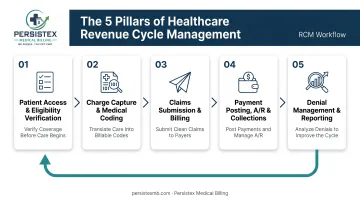
The 5 Pillars of Billing and Revenue Management in Healthcare
Ask "what are the five pillars of revenue management" in a SaaS or telecom context, and you'll get a different answer than in healthcare. The underlying logic, though, is identical: intake, execution, collection, and insight.
Pillar 1: Patient Access & Eligibility Verification
This pillar confirms insurance eligibility, benefits, and prior authorization before the patient is seen. Skipping this step is how avoidable denials happen. A quick eligibility check catches lapsed coverage, wrong plan details, or missing authorization requirements while there's still time to fix them.
Pillar 2: Charge Capture & Medical Coding
Accurate CPT and ICD-10 coding is the foundation of a clean claim. Coding errors remain one of the leading causes of denials industry-wide. For specialties with nuanced coding, such as behavioral health, TMS, and chiropractic care-plan authorizations, this pillar matters more than most.
Pillar 3: Claims Submission & Billing
Once charges are coded, the team compiles them into a claim and submits it electronically to the payer. The key performance metric here is clean claim rate: the percentage of claims accepted on first submission without edits or rejections.
Pillar 4: Payment Posting, A/R & Collections
Staff post payments, manage patient balances, and follow up on aging receivables. HFMA's KPI benchmarks suggest days in A/R should sit between 30-40 days, with less than 10% of A/R aging past 90 days. Practices that drift beyond that range are usually looking at a follow-up problem, not a payer problem.
Pillar 5: Denial Management & Reporting/Analytics
This pillar closes the loop. Teams file appeals, identify root causes, and use dashboards to feed those insights back into the earlier pillars so the same denial reason doesn't keep recurring. Without this feedback step, practices end up fixing the same mistake month after month.
What Are the Three Types of Medical Billing?
Medical billing splits into three recognized categories, each tied to a specific claim form and provider type.
| Billing Type | Claim Form | Used By |
|---|---|---|
| Professional | CMS-1500 (paper) / 837P (electronic) | Individual providers, clinicians, solo practices |
| Institutional/Facility | UB-04 (CMS-1450) | Hospitals and facility-based services |
| Outpatient/Ancillary | Hybrid, typically via 837P | Multi-provider outpatient clinics |
Professional billing applies to individual providers submitting claims for their own services — relevant to solo psychiatry, behavioral health, and family medicine practices billing under CMS-1500 standards.
Institutional billing covers hospital-based or facility services using the UB-04 (CMS-1450) form.
Outpatient/ancillary billing is where most multi-provider clinics live. It is not a separate CMS claim form category, but a hybrid of professional billing practices applied at scale across multiple providers and service lines.
Many practices need expertise across more than one type at once. A family medicine group, for example, may file professional claims for physician visits while also managing ancillary billing for in-house lab work or imaging.
Why Effective Billing and Revenue Management Matters for Your Practice
Poor billing drains revenue, burns staff time, and can put your compliance standing at risk.
Cash Flow Impact
Predictable, faster reimbursement beats the boom-and-bust cycle that manual or reactive billing creates. When claims get denied and reworked weeks later, cash flow turns unpredictable, and payroll and overhead planning get harder.
Compliance Risk
Proper BRM keeps practices aligned with HIPAA, payer contracts, and coding regulations. HHS explicitly classifies billing and claims processing as business-associate activities.
Any outsourced billing partner needs a signed business associate agreement covering safeguards, breach reporting, and subcontractor controls. Skipping this exposes practices to audit risk they may not realize they carry.
Administrative Burden
MGMA's 2026 Regulatory Burden Report found that 90% of practices reported increased prior authorization burden over the past year. Many now dedicate multiple full-time staff to admin work instead of patient care.
Billing inefficiencies remain a top driver of burnout among independent practices.
How Persistex Delivers End-to-End Billing and Revenue Management
Persistex is a specialized billing and RCM partner for behavioral health and outpatient practices where coding complexity and prior authorization requirements create outsized revenue risk.
Coverage That Doesn't Stop Halfway
Persistex handles the entire cycle: patient scheduling and eligibility verification through final payment posting. Each client gets a dedicated named account team, not a rotating call center. That means the person handling your denials this month is the same person who'll know your payer mix next month.
Results That Show Up in the Numbers
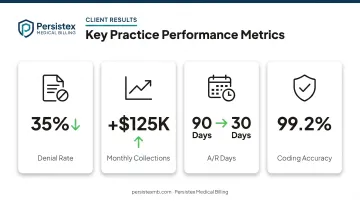
Documented client outcomes include:
- 40% fewer denied claims, with one behavioral health clinic dropping from a 35% denial rate to a fraction of that
- $125K average monthly collections boost reported across client accounts
- A/R days cut from 90 to 30, with some behavioral health clients reaching 22 days
- 99.2% coding accuracy, driven by CPC/CPB (AAPC) and RHIT/CCS (AHIMA) certified coders
Built for Specialty Complexity
Persistex's certified team specializes in the coding and authorization nuances that trip up generalist billers: behavioral health session authorizations, chiropractic care-plan documentation (CMT codes 98940-98943), and pediatric well-visit coding.
Pricing is percentage-based or flat-rate, with no long-term contracts required. Persistex integrates directly with AdvancedMD, Kareo, athenahealth, DrChrono, and TherapyNotes.
Massachusetts-based with deep regional payer knowledge (including MassHealth and Blue Cross Blue Shield of Massachusetts), Persistex now serves 500+ providers nationwide. The team has processed more than $50M in claims at a 98% clean claim rate.
Frequently Asked Questions
What are the three types of billing?
The three recognized categories are professional billing (CMS-1500, for individual providers), institutional billing (UB-04, for facilities), and outpatient/ancillary billing, a hybrid category many multi-provider clinics need.
What are the 5 pillars of revenue management?
The five pillars are patient access and eligibility verification, charge capture and coding, claims submission, payment posting and A/R management, and denial management with reporting and analytics.
What's the difference between medical billing and revenue cycle management?
Medical billing is one component — submitting claims and invoices for payment. RCM is the broader end-to-end financial process, covering everything from scheduling through final collections and reporting.
How soon can a practice expect results after switching billing and revenue management providers?
Most practices complete onboarding within 2-4 weeks and see measurable improvements in claims acceptance and collections within 30-60 days.
Is outsourcing billing and revenue management HIPAA compliant?
Yes, when the partner operates under a proper business associate agreement (BAA) with documented safeguards and U.S.-based data handling. Reputable RCM partners treat the BAA and related controls as a standard contractual requirement.
Which practices benefit most from specialized revenue cycle management services?
Behavioral health practices and other specialties with complex coding and prior authorization requirements see the largest measurable gains from specialized RCM expertise compared to generic billing services.