

Introduction
Every unpaid claim sitting in your system is money you've already earned but haven't collected yet. That's accounts receivable (AR), and for most independent practices, it's the single biggest lever affecting cash flow.
Many practices struggle with slow reimbursements, rising denial rates, and growing patient balances. Each of these pushes AR days higher and makes revenue harder to predict.
This guide breaks down what AR management actually means, how the process works stage by stage, the challenges that commonly derail it, and the strategies that keep AR under control.
Key Takeaways
- AR is earned revenue still owed by insurers and patients—an asset on the books, not just a tracking metric
- Healthy practices keep Days in AR between 30-40 days, with less than 10% of total AR aged past 90 days
- Rising denial rates stall cash flow unless claims get proactive follow-up before they age out
- Specialty billing (e.g., behavioral health) adds coding complexity that slows AR without expert handling
- Outsourcing AR management can shorten collection timelines and free staff time for patient care
What Is AR Management in Medical Billing?
Accounts receivable in medical billing is the outstanding balance owed to a healthcare provider by insurers and patients for services already delivered. It sits on the practice's balance sheet as an asset, representing money that's technically yours but hasn't landed in your bank account yet.
AR management is the active work of tracking, following up on, and collecting those balances. It means monitoring charges as they're billed, watching payments come in, applying adjustments, and catching denials before they turn into permanent revenue loss.
AR vs. Accounts Payable (AP)
These two terms get confused constantly, but the direction matters:
- AR is money owed to your practice — from insurers and patients for care you've provided
- AP is money your practice owes to others — vendors, suppliers, landlords, staff
Both need active management, but they pull in opposite directions on your cash flow. Neglect AR and money stalls out before it reaches you. Neglect AP and you damage vendor relationships.
A financially healthy practice manages both. AR typically demands more day-to-day attention because it involves multiple parties—payers and patients—with different rules.
Key Components of the AR Cycle
Four elements move through every AR cycle:
- Charges — the billed amount for services rendered
- Payments — reimbursements from insurers and patients
- Adjustments — contractual write-downs required by payer agreements
- Denials — payer refusals that require correction, appeal, or write-off
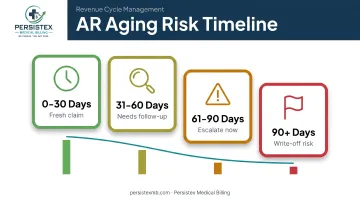
Practices track where balances sit using AR aging buckets: 0-30, 31-60, 61-90, and 90+ days. These buckets show how "stuck" your revenue is.
A claim in the 90+ bucket is far more likely to become bad debt than one still in the 0-30 window. That risk is why aging reports are the backbone of any AR strategy.
Why AR Management Matters for Practice Financial Health
Predictable cash flow depends on efficient AR. Payroll, supplies, rent, and growth investments all need reliable revenue timing: not just eventual payment, but timely payment.
Poor AR management doesn't just slow things down. It costs real money. Denials are becoming more frequent, not less. MGMA's 2023 DataDive found an 8% first-submission denial rate for single-specialty practices. In a follow-up 2024 poll, 60% of medical-group leaders said their denial rates had increased year over year.
The aging risk is real: the longer a balance sits unresolved, the more likely it becomes uncollectible.
- Claims stuck past 90 days often end in write-offs
- Payer rules on timely filing can permanently bar resubmission
- Staff attention naturally drifts to newer, "easier" claims, leaving old balances to rot
Patient experience takes a hit too. Disorganized AR produces confusing statements, duplicate bills, and disputes that erode trust. Practices with tight AR processes send clear, timely bills so patients know what they owe and why, which speeds patient-side collections as well.
The AR Management Process: Key Stages
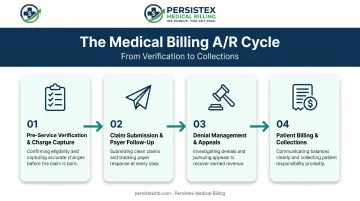
AR management is a sequence of stages. Handle any one poorly and collections stall.
Pre-Service Verification and Charge Capture
Everything starts before the patient even walks in. Insurance eligibility verification confirms coverage, benefits, and any prior authorization requirements ahead of the visit. Accurate charge entry afterward (correct CPT/ICD-10 codes matched to documentation) prevents avoidable denials before a claim is ever submitted.
Skip this step and you're setting up denials that could've been caught in five minutes.
Claim Submission and Payer Follow-Up
Clean, error-free claims get paid faster. Every rejected claim needs rework, resubmission, and another round of payer processing, which can add weeks to your collection cycle.
Following up matters just as much as submitting correctly. A systematic cadence (checking unpaid or underpaid claims at set intervals instead of waiting on the payer's timeline) keeps claims from quietly aging into the 60- and 90-day buckets.
Denial Management and Appeals
Denials are a work queue, not a dead end. Effective denial management means:
- Identifying the root cause (eligibility error, coding mismatch, missing documentation)
- Correcting the underlying issue
- Resubmitting or appealing within payer deadlines
Practices that work denials as an active queue, rather than a pile to revisit occasionally, recover far more revenue.
Patient Billing and Collections
Once insurance adjustments are applied, remaining patient responsibility needs its own follow-up track. This means clear statements, flexible payment options, and a consistent schedule for pursuing outstanding balances.
Specialty work raises the stakes on every earlier stage. Behavioral health claims, for example, often need precise CPT codes, modifiers, and medical-necessity documentation.
Get those details wrong and you rarely face a single denial. You can create a repeating pattern across an entire patient panel until the coding habit itself is fixed.
Common Challenges That Slow Down AR
Most AR bottlenecks trace back to a handful of recurring problems.
- Rising claim denials. Eligibility errors, missing documentation, incorrect coding, and authorization mismatches drive most denials. MGMA research also flags incorrect modifier use—especially Modifier 25—as a frequent cause.
- Growing patient financial responsibility. High-deductible plans keep shifting cost to patients. KFF's 2025 Employer Health Benefits Survey found 34% of workers with a deductible now face at least $2,000 out of pocket, up from 26% in 2020—raising patient-side AR risk and bad-debt exposure.
- Manual, disorganized follow-up. Without automation or a defined cadence, unpaid claims pile up. Staff get buried, older balances get deprioritized, and recoverable revenue simply ages out.
AR Best Practices and Metrics to Track
A few disciplined habits consistently separate healthy AR from chronically backed-up AR:
- Verify eligibility before every visit, not just for new patients
- Submit clean claims the first time: scrub for errors before they leave the building
- Follow up on outstanding balances on a fixed schedule, not reactively
- Monitor denial trends to catch recurring coding or documentation issues early
- Offer patient payment plans to reduce bad debt on high-deductible balances
Those habits only stick if you measure them. Two metrics show whether AR is improving or quietly aging out.
Tracking Days in AR
Days in AR measures how long, on average, it takes to collect payment after billing. The formula:
(Current receivables − credit balances) ÷ (gross charges for the prior 12 months ÷ 365)
According to HFMA's KPI benchmarks, a healthy target is 30-40 days, with total AR over 90 days kept below 10% and self-pay AR over 90 days below 30%.
Reviewing Aging Reports
Review AR aging by bucket (0–30, 31–60, 61–90, 90+) so follow-up matches urgency:
- 0–30 days: Confirm clean submission and payer receipt
- 31–60 days: Work status checks and simple fixes before denials harden
- 61–90 days: Escalate appeals, documentation gaps, and underpayments
- 90+ days: Prioritize recovery or controlled write-off before the balance goes cold
How Outsourced AR Management Helps Practices Recover More Revenue
Handling AR in-house works fine until claim volume outpaces staff capacity. That's usually when denials start slipping through, follow-up becomes reactive, and collection cycles stretch out.
Outsourcing addresses this directly:
- Dedicated follow-up resources whose entire job is chasing unpaid claims
- Reduced administrative burden on front-desk and clinical staff
- Faster collection cycles through consistent, expert-driven processes
Persistex Medical Billing built its model specifically around this gap. Rather than routing clients through a rotating call center, Persistex assigns dedicated named account teams: professionals who know a practice's specialty, not generic support staff working a ticket queue.
The coding and billing team holds AAPC and AHIMA credentials (CPC, CPB, RHIT, CCS). The company's guiding philosophy, "persistence + expertise," shows up as relentless claim follow-up and multi-level appeals—not a one-and-done submission mentality.
Practices partnering with Persistex have seen:
- AR days cut from 90 to 30
- A 98% clean claim rate across clients
- An appeals success rate exceeding 72%
- A behavioral health clinic with eight providers cutting denials by 40% and generating $85,000 in additional monthly revenue
- Multi-provider clinics recovering $200K+ in previously lost revenue

For specialties like behavioral health, where coding complexity and authorization rules often trip up generalist billers, that specialized expertise matters far more than raw staffing numbers.
Frequently Asked Questions
What is AR in medical billing?
AR is the outstanding balance owed to a healthcare provider by insurers and patients for services already rendered. It's listed as an asset on the practice's balance sheet and represents earned revenue not yet collected.
What are the 5 C's of accounts receivable management?
The "5 C's" (Character, Capacity, Capital, Collateral, and Conditions) originate as a business credit-underwriting framework, not a healthcare-specific standard. In medical billing, the closest equivalent is assessing a patient's ability and likelihood to pay based on financial circumstances.
What is a good AR days benchmark for medical practices?
HFMA's benchmark for healthy Days in AR is 30-40 days, with total AR over 90 days kept under 10%. Anything significantly higher signals collection delays worth investigating.
How often should AR aging reports be reviewed?
Weekly reviews catch problems early, while monthly deep-dives help spot broader trends. Consistency matters more than frequency. Sporadic reviews let balances age past recoverable windows.
Should small practices consider outsourcing AR management?
Outsourcing makes sense once denial follow-up, patient billing, and claim tracking start consuming more staff time than the practice can spare. Solo practitioners often benefit most, since AR work otherwise competes directly with patient care time.
What causes AR to age beyond 90 days?
Unresolved denials, missing documentation, complex prior authorization requirements, and lack of consistent follow-up ownership are the most common causes. Once no one "owns" a claim's resolution, it tends to stall indefinitely.