
Introduction
Picture a behavioral health practice that just brought on a second psychiatrist and opened a satellite office across town. Within weeks, the front desk is juggling two sets of billing logins, two different claim formats, and two piles of A/R reports that never quite match up.
Patients start calling, confused about why they got three separate statements for one course of treatment. Staff spend hours reconciling numbers that should already agree.
This is the moment most growing practices discover they have a billing consolidation problem. Billing consolidation means combining multiple accounts, invoices, or billing processes into one unified system.
For multi-provider practices, that fragmentation shows up as slower collections, rising A/R days, and staff time lost to reconciliation instead of patient care.
This guide breaks down what billing consolidation means, how it works step by step, and how it plays out in behavioral health and multi-location practices juggling multiple providers, sites, and payers.
Key Takeaways
- Billing consolidation combines charges from multiple sources into one unified statement or process
- Multi-provider practices unify claims, denials, and reporting instead of tracking each provider separately
- Distinct from accounting consolidation, which merges financial statements under GAAP rules
- Warning signs: siloed billing, inconsistent A/R tracking, and patient confusion from multiple statements
What Does Billing Consolidation Mean?
Billing consolidation is the process of combining charges, invoices, or accounts from multiple sources into a single billing statement or centralized workflow. Instead of five separate bills tracking five separate things, you get one.
Two Related but Different Uses
The term gets used two ways, and mixing them up causes confusion:
- Consolidated billing — a single invoice that combines multiple charges for one customer or account. Think of a cloud provider rolling up charges from a dozen linked accounts into one monthly bill.
- Billing consolidation as a strategy — the broader operational move of centralizing billing processes across departments, providers, or entities, not just the final invoice.
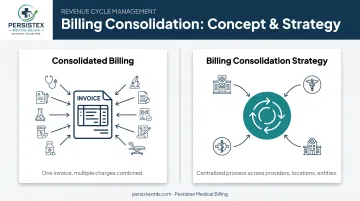
Cloud services offer a clear analogy. AWS consolidated billing links member accounts under one management account that pays a single monthly bill, while each account keeps its own usage detail. SaaS vendors do the same when three subscriptions land on one invoice.
In a medical practice, the pattern looks familiar: several providers, locations, or service lines feeding one billing workflow instead of separate queues, spreadsheets, and payer follow-ups.
The goal never changes, regardless of industry:
- Reduce administrative complexity
- Prevent missed or duplicate payments
- Create a single source of truth for what's owed and what's been collected
For growing practices, fragmented billing isn't a minor annoyance you can live with forever. Add departments, locations, or providers, and the moving pieces multiply fast. What worked for one provider becomes unmanageable at five. Consolidation stops being optional and becomes how you keep the numbers straight.
How Does Consolidated Billing Work?
Consolidated billing follows a repeatable process no matter what industry you're in. Whether it's a cloud platform linking accounts or a medical practice linking providers, the mechanics are similar.
Here's the general sequence:
- Enrollment or linking — You connect accounts, providers, or service lines to the central billing system. A multi-provider clinic, for instance, links each provider's claims under one billing entity so all revenue flows to the same place.
- Tracking and aggregation — The system records charges, usage, or claims from each linked source individually first, then pulls them into the central system without losing the underlying detail.
- Invoice or statement generation — Aggregated charges compile into one itemized document so every underlying charge stays transparent.
- Payment and reconciliation — One payment is collected, then allocated back to the correct accounts, departments, or providers behind the scenes.
That last step is where a lot of systems break down if they weren't built for it. Reconciliation only works cleanly when the underlying data lines up in the first place.
What Makes Consolidation Actually Work
A few technical prerequisites separate a smooth consolidation from a messy one:
- Aligned billing cycles — every linked source needs to close on comparable dates
- A consistent payment method — so reconciliation doesn't require chasing down five different payment rails
- Standardized data formats — claim fields, charge codes, and statement layouts need to match across every source being combined
Skip any of these, and you end up with a "consolidated" bill that still requires someone manually cross-checking five spreadsheets. You've added a summary page without fixing the fragmentation underneath.
Billing Consolidation in Medical and Healthcare Practices
Healthcare practices face a version of this problem that's more tangled than most industries. Multiple providers. Multiple locations. Dozens of payers, each with its own claim requirements, timelines, and denial patterns. Every one of those generates its own billing workflow if nobody steps in to unify it.
Patient Statement Consolidation
When a patient sees two providers for one episode of care, they shouldn't get two confusing bills. Patient statement consolidation combines charges from multiple visits, services, or providers into one clear statement. Patients see a single balance instead of sorting through a stack of bills.
Revenue Cycle Consolidation
This is the operational backbone—one system for every provider and location instead of siloed billing per provider. It centralizes:
- Claims submission
- Denial management
- Payment posting
- Cross-location reporting
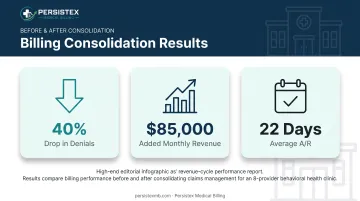
Persistex handles this for an eight-provider behavioral health clinic by running claims, denial appeals, and payment posting through one coordinated team rather than eight disconnected processes. The result: a 40% drop in denials, $85,000 in added monthly revenue, and average A/R down to 22 days.
The Reporting Advantage
Without consolidation, a practice owner has to piece together separate reports from each provider just to answer "how are we doing this month?" With it, one dashboard shows total collections, denial rates, and A/R across the whole practice.
Persistex's real-time dashboards put the same view in one place instead of five:
- Collections trends
- Denial rates by payer
- A/R aging
- Clean claim rates
The HIPAA Dimension
Combining patient billing data across providers raises the compliance stakes. HHS guidance permits a covered entity to use protected health information for its own payment activities, but the minimum necessary standard still generally applies—access stays limited to what each role actually needs.
Consolidating records across providers widens the surface area for data handling, so the underlying safeguards matter more, not less.
Persistex builds HIPAA compliance into every process it runs, covering scheduling through final payment under one connected workflow instead of leaving each provider to manage billing alone.
Key Benefits of Consolidating Your Practice's Billing
Consolidating billing delivers clear operational and financial gains:
- Time savings: One centralized workflow replaces separate logins, formats, and follow-ups per provider. A solo psychiatry practice that partnered with Persistex reported getting 15+ hours back per week.
- Cash flow visibility: A single view of A/R, collections, and denials makes forecasting far more accurate than provider-by-provider reports. As one outpatient owner put it: "I can see exactly where every dollar is in the revenue cycle."
- Fewer missed payments and denials: Unified tracking catches coding errors, missed claims, and unpaid balances early. A multi-provider clinic director recovered over $200,000 in previously lost revenue with a clean claim rate above 97%.
Those gains matter because A/R rarely improves on its own. MGMA's 2026 survey found days in A/R held steady for 43% of practices year over year, while 32% saw it climb. Without active management, A/R tends to drift the wrong direction.
Billing Consolidation vs. Consolidation in Accounting
These two terms get confused constantly, but they're solving different problems.
| Aspect | Billing Consolidation | Accounting Consolidation |
|---|---|---|
| What it combines | Invoices, claims, collections | Financial statements |
| Purpose | Operational efficiency, day-to-day collections | Reporting for ownership, tax, investors |
| Governed by | Internal workflow design | GAAP consolidation rules (ASC 810) |
| Who uses it | Billing staff, RCM teams | CFOs, accountants, auditors |
Accounting consolidation combines the financial statements of a parent organization and its subsidiaries into one set of books. Under U.S. GAAP's ASC 810 standard, this applies when one entity has a controlling financial interest in another. That ownership test is a completely different trigger than "we have multiple providers billing separately."
Same goal of a single view—different layer. Billing consolidation runs operations (invoicing, claims, collections). Accounting consolidation supports financial statement reporting.
For a group that owns several practice entities, both often matter at once. You need consolidated billing to keep day-to-day collections moving, and you may separately need consolidated financial statements when those entities share an ownership structure.
Is Billing Consolidation Right for Your Practice?
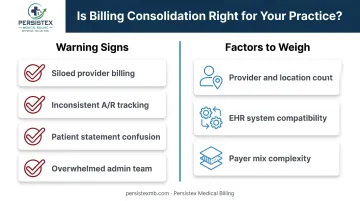
If several of the issues below sound familiar, consolidation is usually the right move.
Warning signs you need to consolidate:
- Each provider bills independently with no shared oversight
- A/R tracking is inconsistent from one location to the next
- Patients complain about receiving multiple confusing statements
- Your admin team is buried managing separate payer workflows per provider
Factors to weigh before consolidating:
- Total provider and location count
- Whether existing EHR/practice management systems are compatible with each other
- How complex your payer mix is across providers and locations
Most practices lack the in-house resources to build a consolidated system from scratch. Partnering with a specialized medical billing and RCM provider usually beats trying to engineer one internally.
Persistex already runs a consolidated, multi-provider billing infrastructure for practices from solo psychiatrists to 15+ provider clinics. Most onboarding completes in 2–4 weeks.
Frequently Asked Questions
What does billing consolidation mean?
Billing consolidation combines multiple invoices, accounts, or billing processes into one unified statement or system. The goal is less complexity and fewer missed payments across every linked source.
How does consolidated billing work?
It follows four steps:
- Link the accounts you want combined
- Aggregate charges from each source
- Generate one itemized invoice
- Reconcile the single payment back to the correct accounts
What is consolidation in accounting?
It's the combination of financial statements across a parent company and its subsidiaries, governed by GAAP rules like ASC 810. It's separate from operational billing consolidation.
Is billing consolidation the same as outsourcing medical billing?
No. Consolidation centralizes billing processes and data, while outsourcing means handing that centralized process to a third-party partner. Practices often pair the two together.
How does billing consolidation help multi-provider practices specifically?
It eliminates siloed, provider-by-provider billing and gives owners one unified view of collections, denials, and A/R across the whole practice. You stop reconciling five separate reports by hand.
Does consolidating billing cost extra for a medical practice?
Consolidation itself carries no inherent extra fee. Cost depends on whether you build it in-house or partner with an RCM provider offering flat-rate or percentage-based pricing, like Persistex's flexible model with no long-term contracts.