
National denial rates already sit in a wide range, with AAPC citing 15-20% as the national average and only 5% considered best practice. HFMA's numbers run lower, at 5-10%. Either way, Hawaii's layered payer mix compounds the risk of falling into the high end of that range.
This article breaks down what makes Hawaii billing different, what's changing in the RCM process for 2026, the KPIs worth tracking, and how to evaluate an RCM partner that can actually keep up.
Key Takeaways
- Hawaii’s payer mix (Med-QUEST, TRICARE, HMSA, Kaiser) plus strict filing deadlines make specialized RCM essential in 2026
- National denial rates of 5–20% show why proactive claim management beats reactive processing
- AI claim scrubbing and real-time dashboards are now core RCM infrastructure, not optional add-ons
- Specialized RCM partners drive higher clean-claim rates, faster A/R, and fewer denials
Why Hawaii's Healthcare Billing Landscape Is Unique in 2026
Hawaii isn't just "another state" for billing purposes. The rules stack differently here. Filing deadlines leave no room for error. HMSA's commercial PPO and HMO claims must be filed within one year. QUEST Integration claims follow the same one-year window from service or discharge, with one important exception:
- When Medicare or another payer is primary: six months from the EOB or 12 months from service, whichever is longer
- Missed the deadline: file a waiver request within 120 days There's little room to recover a claim that slips through the cracks. TRICARE volume is substantial. Tripler Army Medical Center supports roughly 264,000 beneficiaries across active-duty, retired, and veteran populations. Schofield Barracks alone serves an estimated 156,000 beneficiaries, including 42,000 active-duty personnel. That's a lot of coordination-of-benefits complexity for any practice treating military families alongside civilian patients. Med-QUEST has its own operational structure. Hawaii's Medicaid program separates QUEST Integration, Fee-for-Service, and Community Care Services into distinct tracks, each with its own provider memos and rules. Practices can't apply a generic Medicaid billing approach here. Telehealth rules are Hawaii-specific. A November 2023 Med-QUEST memo requires modifier FQ for covered audio-only mental health services, but it doesn't specify a place-of-service code. The guidance's expiration date makes 2026 compliance worth double-checking before you submit claims. Geographic isolation adds staffing strain. Hawaii's high cost of living and small talent pool make billing staff turnover a real threat. Losing one trained coder on a two-person billing team can stall claims for weeks.

The Revenue Cycle Management Process: What's Changing in 2026
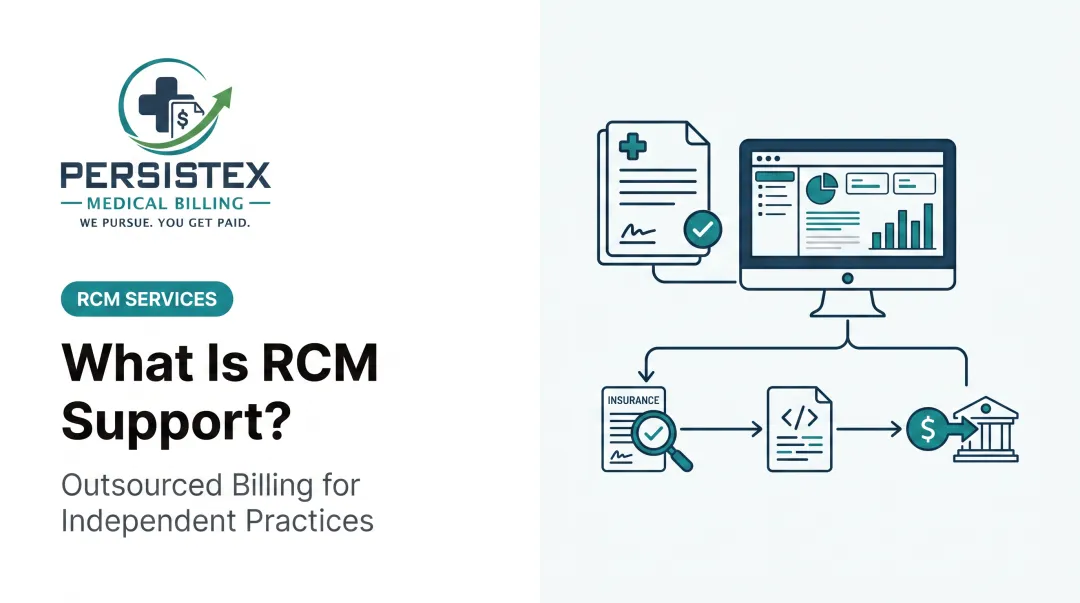
RCM breaks into three phases:
- Front-end: verification and authorization
- Mid-cycle: coding and charge capture
- Back-end: claims, payment posting, and A/R follow-up
Most revenue leakage happens at the front end. A missed eligibility check or authorization gap turns into a denial weeks later.
Coding Updates to Track
CMS's FY2026 ICD-10-CM guidance splits into two file sets: one for encounters from October 1, 2025 through March 31, 2026, and an updated set for April 1 through September 30, 2026.
AMA's CPT 2026 release adds 288 new codes and 418 total changes, with new Category I codes effective January 1, 2026. Updates cover digital health and AI-related services. AMA's 2026 CPT code set release marks this as one of the more consequential CPT updates in recent years.
Practices that don't assign someone to own this calendar risk clean claim rates slipping the moment new codes go live.

Automation Is Becoming Standard
Claim scrubbing, eligibility checks, and denial prediction tools are shifting from optional extras to baseline infrastructure. At Persistex, every appointment gets a real-time eligibility check before the visit. That catches coverage issues before they become denials, instead of after a claim bounces back.
Proactive Beats Reactive
Given Hawaii's tight filing windows, waiting for a denial before addressing it is a losing strategy. Denial prevention — catching eligibility gaps, coding errors, and authorization issues before submission — protects revenue in a way after-the-fact appeals can't match once a filing deadline has passed.
Top RCM Challenges Facing Hawaii Practices in 2026
Rising denial complexity. Coding rules differ across Med-QUEST, HMSA, and TRICARE. A claim that's clean for one payer can bounce for another, and Hawaii's telehealth modifier requirements add another layer most mainland billers aren't tracking.
Staffing shortages and turnover. MGMA's 2025 poll found 29% of practices reported higher turnover than the prior year, and Hawaii's cost of living makes retaining trained billing staff even harder. A small island practice with one biller has no backup if that person leaves.
Rising patient financial responsibility. HFMA's 2025 survey found providers collected only 24% of patient billings after insurance. That national figure still points to four operational gaps:
- Upfront benefit verification and cost estimates
- Clear, transparent billing statements
- Flexible payment plan options
- Documented follow-up processes for outstanding balances

Key 2026 RCM Trends & KPIs Hawaii Providers Should Track
Benchmarks vary by specialty and payer mix, but these core KPIs give Hawaii practices a clear 2026 starting point:
| KPI | Target Range |
|---|---|
| Clean claim rate | 98% |
| First-pass resolution rate | 95-97% |
| Days in A/R | 30-40 days |
| Denial rate | Under 10% (varies by source) |
| Net collection rate | 95-99% |

Two trends are reshaping how practices hit those numbers.
Patient-Centered Billing Is Gaining Ground
Transparent statements and digital payment options are no longer optional extras. They directly affect collection rates. MGMA found that 41% of medical groups updated their payment plans or options within the past year, a clear signal that patients expect clarity, not surprise bills.
Real-Time Visibility Matters
Dashboards that show collections trends, denial rates by payer, A/R aging, and payer performance side-by-side let practices spot problems before they compound, without loading another task onto an already stretched billing team.
How to Choose the Right RCM Partner for Your Hawaii Practice
Not every billing company can handle Hawaii's payer complexity. Look for:
- Specialty expertise — a partner who understands your specific billing codes and payer quirks, not a generalist
- Denial management track record — root-cause analysis and multi-level appeals, not just resubmission
- EHR/PM integration — compatibility with systems like AdvancedMD, Kareo, athenahealth, and DrChrono, which are common across Hawaii practices
- Transparent pricing — no hidden fees, clear percentage or flat-rate structures
- Real reporting — dashboards you can actually check, not a quarterly PDF

Dedicated account teams beat call centers, especially when you're juggling Med-QUEST, TRICARE, and HMSA rules simultaneously. A rotating call-center rep won't remember your practice's specific payer quirks from one call to the next.
Persistex Medical Billing illustrates this model in practice. The company maintains a 98% clean claim rate and has helped clients cut denials by 40%, with a team holding CPC, CPB, RHIT, and CCS certifications.
Its no-contract, flexible pricing and integrations with AdvancedMD, Kareo, athenahealth, and DrChrono suit practices — including behavioral health and general medical clinics — that need specialty-aware billing without rigid terms.
Whatever partner you choose, verify their experience with the EHR/PM systems your practice already runs. Switching systems mid-transition creates more problems than it solves.
Frequently Asked Questions
What is healthcare revenue cycle management (RCM)?
RCM is the end-to-end financial process covering everything from patient scheduling and insurance verification through coding, claims submission, and final payment collection. It links clinical activity to collected revenue so practices get paid for the care they deliver.
Why do Hawaii medical practices need specialized RCM support?
Hawaii's Med-QUEST complexity, high TRICARE volume, strict filing deadlines, and limited local billing talent pool make generic RCM approaches risky. Specialized support catches payer-specific rules before they become missed deadlines.
How do RCM companies reduce claim denials?
Through upfront eligibility verification, coding accuracy reviews, automated claim scrubbing before submission, and proactive appeals when denials do occur. Strong programs stop denials before submission and still work appeals when something slips through.
Can outsourcing RCM improve cash flow for Hawaii practices?
Yes. Outsourcing typically means faster claim turnaround, fewer coding errors, and reduced A/R days. Practices often see measurable improvements within 30-60 days of onboarding a dedicated partner.
What should Hawaii practices look for in an RCM partner?
Specialty expertise, transparent reporting, EHR/PM system compatibility, and a proven denial management track record. Dedicated account teams matter more than call-center support when payer rules get complicated.
How is AI changing revenue cycle management in 2026?
AI tools now support predictive denial analytics, automated claim scrubbing, and coding assistance, catching issues before submission rather than after a rejection. Adoption is growing, though results vary by vendor and practice type.