Not every denial code carries equal weight, though. A short list of codes shows up again and again across payers and specialties, and they account for most of the delayed or lost revenue practices see each month.
This guide breaks down the 10 denial codes to watch most closely in 2026, why they happen, and how practices — including specialty clinics like behavioral health — can get ahead of them.
Key Takeaways
- Denial codes (CARCs) explain why a payer adjusted or rejected a claim, and they're printed right on your EOB or ERA
- Ten codes covering missing data, coding mismatches, authorization gaps, and timely filing drive most preventable revenue loss
- Most denials are "soft," meaning they're correctable with better front-end processes, not permanent losses
- Behavioral health and multi-provider practices face extra complexity around session limits and documentation
- Dedicated billing oversight consistently cuts denial volume and speeds collections
Overview of Denial Codes in Medical Billing for 2026
A denial code, technically called a Claim Adjustment Reason Code (CARC), tells a provider why a payer paid a claim differently than it was billed — or didn't pay it at all.
CARCs are typically paired with a Group Code that assigns financial responsibility:
- CO (Contractual Obligation): Balance stays with the provider
- PR (Patient Responsibility): Balance shifts to the patient
Medicare rules state that beneficiaries can only be billed when a PR code is attached, not a CO code.
Pressure on this system is building. In MGMA's 2025 reporting, practices described payer AI systems automatically downcoding E/M visits or triggering denials more often, adding extra appeal work along the way. It isn't a measured national spike yet, but it matters as 2026 payer audits lean further into automation.
Specialty billing adds another layer of difficulty. Behavioral health claims, for example, involve psychotherapy add-on codes, time-based documentation, and session-limit authorizations that don't apply to a routine primary care visit. This is exactly the kind of nuance where a dedicated billing partner earns its keep.
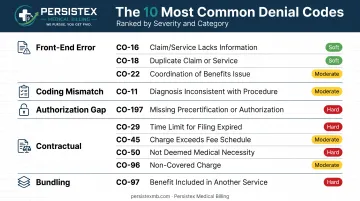
Here's the breakdown of the 10 codes most likely to affect provider revenue in 2026.
Top 10 Medical Billing Denial Codes for 2026
These codes were selected based on how frequently they appear across payer remittance data and how consistently they show up in industry billing reports, not a single proprietary dataset.
CO-16 – Claim Lacks Information or Has Errors
CO-16 is the denial code billers see most often. It fires when a claim is missing a required element: a modifier, patient demographic detail, or an authorization number. It almost always arrives with a remark code pointing to the specific gap.
| Aspect | Detail |
|---|---|
| Common Cause | Incomplete registration or claim data entry |
| Prevention Strategy | Claim scrubbing software paired with front-desk data checklists |
| Revenue Impact | Usually correctable within days, but each resubmission cycle adds delay to cash flow |
CO-11 – Diagnosis Inconsistent with Procedure
This code flags a mismatch between the ICD-10 diagnosis and the CPT procedure billed. It's a coding-accuracy issue, and it hits harder in specialties like behavioral health where documentation nuance matters more than a simple checkbox diagnosis.
| Aspect | Detail |
|---|---|
| Common Cause | Outdated or non-specific diagnosis codes |
| Prevention Strategy | Certified coder review plus pre-submission medical necessity checks |
| Appeal Difficulty | Moderate — resolvable with corrected documentation |
CO-18 – Duplicate Claim or Service
CO-18 shows up when a claim looks identical to one already submitted. X12's official guidance assigns duplicate claims to Group Code OA rather than CO, except in workers' compensation cases. If you see CO-18 on an EOB, don't assume the labeling matches that standard exactly.
| Aspect | Detail |
|---|---|
| Common Cause | Resubmission before the payer finishes processing the original claim |
| Prevention Strategy | Claim status tracking and clearinghouse duplicate alerts |
| Revenue Impact | Low complexity fix, but it still delays the payment cycle |
CO-22 – Coordination of Benefits (COB) Error
This one happens when a payer believes another insurer should pay first. Outdated COB information on file is almost always the root cause.
| Aspect | Detail |
|---|---|
| Common Cause | Incorrect or stale coordination-of-benefits data |
| Prevention Strategy | Insurance verification at every single visit, not just intake |
| Revenue Impact | Requires payer-to-payer coordination before resubmission |
CO-29 – Timely Filing Limit Exceeded
Once a payer's filing deadline passes, CO-29 becomes one of the costliest denials on this list. There's typically no appeal path once the window closes.
| Aspect | Detail |
|---|---|
| Common Cause | Delayed documentation or slow internal claim-submission workflows |
| Prevention Strategy | Automated deadline tracking with 24-72 hour submission targets |
| Revenue Impact | Often unappealable: direct, permanent revenue loss |
CO-197 – Precertification/Authorization/Notification Absent
CO-197 fires when a required prior authorization is missing, expired, or never obtained. It hits hardest on high-cost, high-scrutiny services, and behavioral health is no exception. Session-limit authorizations in particular can lapse mid-treatment if nobody's tracking them.
| Aspect | Detail |
|---|---|
| Common Cause | Authorization not verified before scheduling or before the date of service |
| Prevention Strategy | A dedicated authorization tracking workflow that flags upcoming re-authorization needs |
| Revenue Impact | High: this one frequently requires a formal appeal to recover |
CO-45 – Charges Exceed Fee Schedule
CO-45 is usually a contractual adjustment, not a denial in the traditional sense: the billed charge exceeds what the payer's contract allows, so the difference is written off automatically.
| Aspect | Detail |
|---|---|
| Common Cause | Outdated fee schedules or an incorrect charge entered on the claim |
| Prevention Strategy | Regular payer contract audits and fee-validation tools |
| Revenue Impact | Almost always a write-off, and not typically appealable |
CO-50 – Non-Covered Services (Medical Necessity)
This code appears when documentation doesn't sufficiently justify the service as medically necessary under the payer's coverage policy.
| Aspect | Detail |
|---|---|
| Common Cause | Insufficient clinical documentation tied to the service billed |
| Prevention Strategy | Strong progress notes written against the payer's specific medical policy criteria |
| Appeal Difficulty | Moderate to high, depending on documentation quality |
CO-96 – Non-Covered Charge(s)
CO-96 signals that the specific service isn't covered under the patient's benefit plan. It's a broad code, so it usually needs a paired remark code to pinpoint the exact reason.
| Aspect | Detail |
|---|---|
| Common Cause | Service excluded from the patient's specific benefit plan |
| Prevention Strategy | Pre-visit benefit verification with clear patient cost communication |
| Revenue Impact | Often shifts financial responsibility to the patient |
CO-97 – Service Included in Another Procedure (Bundling)
This is a classic NCCI bundling denial. CMS's National Correct Coding Initiative edits prevent certain code pairs from being billed together unless a clinically appropriate modifier applies. CMS guidance on Modifier 59 is explicit that it should only be used when no more specific modifier fits, and never solely to bypass an edit.
| Aspect | Detail |
|---|---|
| Common Cause | Unbundling errors or missing/misapplied modifiers |
| Prevention Strategy | Coder training on current NCCI edits plus automated coding validation |
| Revenue Impact | Preventable in most cases with correct modifier application |
Why These Denial Codes Matter More in 2026
This list was built from patterns that repeat across payer remittance data and keep showing up in industry billing reports. It is a directional picture of where practices lose revenue, not a single closed dataset.
The pressure behind it is real. In an AMA survey of 1,000 practicing physicians, 61% said unregulated payer AI was increasing prior-authorization denials. That figure is a concern, not a confirmed national denial-rate spike, but it signals that automated payer review is tightening.
What matters most for recovery:
- Most of the codes above are soft denials: correctable and resubmittable, not permanent losses
- CO-16, CO-18, and CO-22 are almost entirely front-end process failures
- CO-29 and CO-45 are the exceptions: once triggered, they're rarely recoverable
- Denial management is a controllable lever, not a fixed cost of doing business
That last point drives the rest. Treat denials as inevitable overhead and the losses stick. Treat them as a process problem, and most of this list becomes fixable.
How to Reduce Denial Rates: Best Practices for 2026
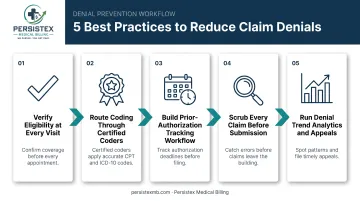
Cutting denial rates comes down to a handful of disciplined habits, applied consistently rather than occasionally.
- Verify eligibility at every visit — not just at intake. Benefits change mid-year more often than practices expect.
- Route coding through certified coders. CPC- and CCS-credentialed coders working from current ICD-10/CPT updates catch errors generic billers miss.
- Build a dedicated prior-authorization tracking workflow. High-denial services like behavioral health therapy and imaging lose revenue fast when session limits or re-auth windows slip.
- Scrub every claim before submission. Catching CO-16 and CO-18 issues pre-submission is far cheaper than fixing them after a denial hits.
- Run denial trend analytics and a structured appeals process. Without this, recoverable revenue simply gets written off.
Specialized RCM partners compound these gains. Persistex's CPC- and CCS-certified team runs coding against current code sets, and clients see coding-related denials drop by an average of 35%.
One eight-provider behavioral health clinic that partnered with Persistex started at a 35% denial rate and cut it by 40%, adding roughly $85,000 in monthly revenue. Persistex's appeals success rate sits above 72%, driven by root-cause analysis on every denial rather than resubmitting and hoping.
None of this requires a massive internal build-out. It requires certified coders, real-time eligibility checks, disciplined authorization tracking, and someone actually reading the denial reason before resubmitting.
Conclusion
Denial codes aren't random noise on an EOB. They follow predictable, preventable patterns. Those patterns directly shape a practice's cash flow and administrative workload.
How does your current denial rate compare to industry norms? Can your billing workflow scale as patient volume grows?
If the answer isn't a confident yes, Persistex offers a free billing and denial audit for practices across Massachusetts and New England. Persistence plus expertise, applied to every claim you've earned but haven't collected yet.
Frequently Asked Questions
What are the most common denial codes in medical billing?
CO-16, CO-11, CO-18, CO-29, and CO-197 are among the most frequently seen. They stem from missing information, coding mismatches, duplicate claims, filing deadlines, and missing authorizations.
What are the most common medical billing errors?
Incorrect patient data, ICD-10/CPT coding mismatches, missing prior authorizations, and late claim filing top the list. Most trace back to front-desk data entry or outdated eligibility records.
What is the difference between a claim rejection and a claim denial?
A rejection means the claim never entered payer processing: fix the error and resubmit. A denial means the payer processed and refused payment, which may require a formal appeal.
What is the difference between hard and soft denials?
Soft denials are correctable and resubmittable, like a missing modifier. Hard denials, such as exceeded filing deadlines, are generally unrecoverable once triggered.
How can a practice appeal a denied claim?
Review the specific denial reason and remark code, gather supporting documentation such as clinical notes, and resubmit the appeal within the payer's specified window.
How often should practices review their denial codes and trends?
Monthly or quarterly review works best for most practices. Regular pattern analysis catches recurring issues, like a specific payer's authorization requirements, before they compound into bigger losses.