

For solo practitioners, this rarely matters — one person fills both roles. But in multi-provider behavioral health groups and TMS clinics, where several clinicians bill under a single group entity, getting rendering and billing provider fields right affects credentialing, reimbursement speed, and audit risk.
The stakes are real. In a 2024 MGMA Stat poll, 60% of medical group leaders reported higher denial rates than the year before, with registration errors, eligibility issues, and identifier mistakes named as recurring culprits, according to MGMA's research on reducing claim denials.
This guide breaks down what each provider role means, exactly where they show up on the claim form, and how getting the setup right protects your revenue.
Key Takeaways
- Rendering provider = clinician who did the work; billing provider = entity that bills and gets paid.
- Use a Type 1 NPI in Box 24J for rendering; a Type 2 NPI in Box 33 for billing.
- Solo practices often use the same person for both roles — group practices almost never do.
- Mixing these fields up is a preventable cause of denials, delayed payment, and payer scrutiny.
- Correct EHR/PM setup cuts denials, speeds payment, and keeps rework low.
Rendering Provider vs Billing Provider: Quick Comparison
Here's how the two roles compare on the claim fields that matter most.
| Category | Rendering Provider | Billing Provider |
|---|---|---|
| Definition/Role | Individual clinician who actually performed or supervised the billed service | Person or organization legally responsible for submitting the claim and collecting payment |
| NPI Type | Type 1 (individual) NPI | Type 2 (organizational) NPI, or an individual NPI for solo practitioners |
| CMS-1500 Location | Box 24J | Box 33, with NPI in 33a and qualifier in 33b |
| Tax ID/Payment | Not typically linked to Box 25 | Tax ID/EIN populates Box 25; remittance goes here |
| Credentialing Focus | Individual licensure and payer enrollment for the specific CPT code | Group payer contracts and organizational enrollment |
Both fields are required. Neither is optional, and neither one substitutes for the other — a point that trips up more practices than you'd expect.
What Is a Rendering Provider?
The rendering provider is the individual clinician who personally delivered the billed service. According to the National Uniform Claim Committee, this is the person (or, in some definitions, the company) that rendered the care: not a supervisor, not the practice owner, and not whoever happens to hold the group's contract.
Payers require this field for one reason: it confirms that a specific, credentialed clinician performed the exact CPT or HCPCS code billed. Without accurate rendering data, a payer can't verify the service was provided by someone eligible to perform it, and that's a fast track to a denial.
Getting this field right has a direct operational payoff. Accurate rendering provider data reduces "provider not eligible" denials and speeds up adjudication, since the payer can match the claim to a known, enrolled clinician on the first pass.
One important wrinkle: some payers require a supervising provider instead of, or in addition to, the clinician who actually performed the service. Medicare's incident-to rules are a clear example. The supervising physician or practitioner bills for services performed by auxiliary personnel, provided they remain actively involved in the treatment plan.
Behavioral health services under incident-to billing specifically require general supervision, per CMS guidance on incident-to services and supplies.
Use Cases of the Rendering Provider Field
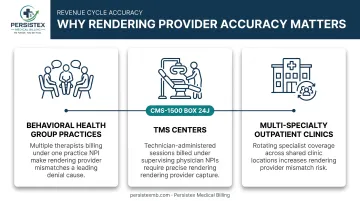
This field does the heaviest lifting in clinics where multiple clinicians treat patients under one shared billing entity:
- Behavioral health group practices — several therapists and psychiatrists billing under one group NPI, each needing individual payer enrollment
- TMS centers — technicians administering treatment sessions under physician supervision, where the supervising clinician's credentials determine billability
- Multi-specialty outpatient clinics — rotating providers across locations, each requiring accurate rendering data tied to their specific credentials
A common and costly mistake: entering the group's NPI, or a supervising physician's NPI, in the rendering field when a different clinician actually performed the service. Payers cross-reference this against enrollment records. If the rendering NPI doesn't match someone credentialed for that specific code, the claim gets kicked back. No medical necessity issue is required.
What Is a Billing Provider?
The billing provider is the entity holding the financial relationship with the payer — the one whose Tax ID appears in Box 25, and the one that actually receives the check. Box 33 on the CMS-1500 always identifies this party, whether it's an individual or an organization.
For group practices, centralizing billing under one organizational Type 2 NPI and Tax ID simplifies:
- Payer contract management (one set of terms, not one per clinician)
- Remittance tracking across every rendered service
- Revenue consolidation when multiple providers contribute to the same books
A key variation: solo practitioners frequently serve as their own billing provider, using a personal NPI in both Box 24J and Box 33. Group practices, TMS centers, and multi-location clinics almost always use a separate organizational entity instead, since it's more efficient to manage one payer relationship than a dozen.
Why the Billing Provider Stays Fixed
This field stays constant even as rendering providers rotate. Picture a TMS center with three clinicians and two technicians on staff: the people performing treatment change from claim to claim, but the billing entity submitting every claim stays the same.
That consistency supports higher clean-claim rates. Persistex maintains a 98% clean claim rate across its client base, driven by scrubbing and verifying claims (including provider fields) before they reach a payer.
Set the billing provider up correctly once, and you do not need to re-check it on every claim that follows.
Where practices run into trouble is when they add clinicians without updating enrollment records tied to that organizational NPI, or when they use the wrong Tax ID for a specific location under the same group.
Common Errors and a Real-World Example
A handful of mistakes account for most provider-field denials, and they show up again and again in behavioral health billing especially:
- Using a group NPI in the rendering provider box: list the individual clinician who performed the service instead
- Failing to credential each clinician with every payer the practice contracts with, not only the ones they see most often
- Mismatched or outdated NPI/Tax ID data left over from staff turnover or practice restructuring
The downstream impact is predictable: reworked claims, delayed reimbursement, increased payer scrutiny, and billing staff spending hours chasing corrections instead of submitting new claims.
Behavioral health payers also tend to enforce supervision and enrollment rules more strictly than general medical payers. That makes these errors more frequent and more expensive in this specialty.
Case Study: Fixing Provider Setup Errors
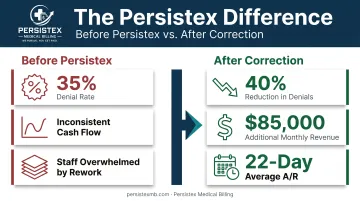
One Persistex client, a multi-provider behavioral health clinic with eight clinicians billing under a shared entity, shows what those errors cost in practice.
Before Persistex:
- 35% denial rate across submitted claims
- Inconsistent cash flow that made staffing and planning difficult
- Billing staff overwhelmed by rework
Persistex ran a free billing audit and pinpointed where provider setup and claims workflow were creating friction. The team then rebuilt the process around a corrected, verified configuration in the clinic's EHR and billing systems.
After correction:
- 40% reduction in denials
- $85,000 in additional monthly revenue
- Average A/R settled at 22 days
If your practice is seeing recurring denials tied to provider fields or you're not sure your setup is clean, Persistex's certified billing team offers a free audit to find out exactly where the gaps are.
Conclusion
Rendering provider and billing provider aren't competing options — both are required on every claim, every time. The real work is making sure your scheduling system, EHR, and billing platform all agree on who performed the service and who's getting paid for it.
For growing behavioral health practices adding clinicians and locations, that consistency translates directly into fewer denials, faster reimbursement, and revenue you can actually predict month to month. Get the configuration right once, and it stops being something you think about.
Frequently Asked Questions
What is a billing provider?
The billing provider is the person or organization responsible for submitting claims and receiving payment. On the CMS-1500, the billing provider's organizational NPI goes in Box 33 and the Tax ID in Box 25.
What are the three types of billing?
Medical billing splits into professional billing (individual clinicians on the CMS-1500 or 837P) and institutional/facility billing (837I for hospitals and facilities). Group billing is a third arrangement, where a practice reassigns billing rights to a shared organizational entity.
What is a rendering provider on an insurance claim?
The rendering provider is the individual clinician who personally performed the billed service. They're identified by their individual Type 1 NPI in Box 24J of the claim form.
Can the rendering provider and billing provider be the same?
Yes. Solo practitioners often serve as both, using one NPI in both fields. Group practices typically separate the roles, with individual clinicians rendering care and an organizational entity handling billing.
Which CMS-1500 boxes are used for rendering vs billing provider information?
Rendering provider details go in Box 24J. Billing provider information populates Box 33, with the Tax ID entered separately in Box 25.
What happens if rendering and billing provider details are mixed up on a claim?
Mismatched provider fields commonly trigger denials, delay reimbursement, and invite additional payer scrutiny. Billing staff then spend extra time correcting and resubmitting claims that should have paid the first time.