
This breakdown is built for medical practice owners, administrators, and billing staff across specialties — behavioral health, TMS, primary care, pediatrics, chiropractic, podiatry, and beyond. In every one of these settings, timely reimbursement determines whether the lights stay on.
RCM gets used constantly as a buzzword but rarely gets explained step by step. That gap causes practices to misdiagnose exactly where their revenue is leaking. This guide walks through each RCM step, why it matters, what affects performance, and when a specialized partner might make sense.
Key Takeaways
- RCM is a connected, cyclical process with 8 core steps, not a one-off billing task
- Front-end errors in registration or eligibility verification drive most downstream denials
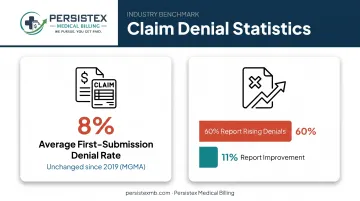
- Single-specialty practices report an 8% average first-submission denial rate, and 60% say denials are rising
- Staffing, technology, payer mix, and specialty coding knowledge determine how well each RCM step performs
- In-house teams and outsourced RCM partners can both succeed; the right fit depends on volume and complexity
What Is Revenue Cycle Management (RCM)?
RCM is the administrative and financial process that tracks patient revenue from first contact through final payment resolution. Its job is simple: get you paid accurately and on time for every service rendered, with as little administrative drag as possible.
That's a different goal than "getting claims paid faster," though the two overlap. RCM is the framework; billing is one task inside it.
RCM vs. Medical Billing
Medical billing means generating a claim, submitting it to the payer, and following up on payment. It's one component of the cycle.
RCM covers the full financial journey:
- Scheduling and pre-registration
- Insurance eligibility and authorization
- Clinical documentation and coding
- Claim submission and payment posting
- Denial management and patient collections
Treat billing as the whole system, and you'll miss the front-end problems that cause most of the back-end pain.
Why RCM Matters for Healthcare Practices
Structured RCM exists to reduce revenue leakage, protect cash flow, and keep documentation aligned with what payers actually reimburse. Without it, practices are reacting to problems instead of preventing them.
Practices need consistency: predictable claims processing, steady cash flow, and documentation that supports every dollar billed.
MGMA's 2023 DataDive found an 8% aggregate first-submission denial rate among single-specialty practices, a figure that has barely moved since 2019, according to MGMA's analysis of strategic RCM improvements. More troubling: 60% of medical group leaders in MGMA's 2024 poll said their denial rates had gotten worse year-over-year, versus just 11% who saw improvement.
That strain compounds fast without structured RCM in place. Every denied claim means:
- Delayed cash flow while staff investigate and resubmit
- Added labor cost per claim
- Risk of the claim aging past the appeal deadline entirely
Behavioral health and other specialty practices feel this more acutely. Prior authorization rules, niche CPT codes, and payer-specific medical necessity documentation add layers many general billing workflows never cover. For those practices, structured RCM is a core operating requirement, not an optional upgrade.
The 8 Core Steps of Revenue Cycle Management
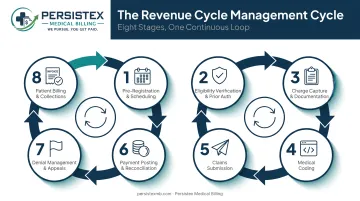
RCM functions as a continuous loop, not a checklist. Each step feeds data and requirements into the next, starting before the patient ever walks in and ending with resolved payment that sets up the next visit's cycle.
Here's how the eight steps connect.
Step 1: Patient Pre-Registration and Scheduling
This step captures demographic and insurance information before the visit happens. It also flags prior authorization needs upfront.
Incomplete front-end data (a wrong policy number, a missed referral requirement) is one of the most common root causes of denials. Fixing it here is far cheaper than fixing it after a claim bounces.
Step 2: Insurance Eligibility Verification and Prior Authorization
This step confirms active coverage, benefits, and the patient's financial responsibility before service is rendered.
Specialty billing adds complexity. Behavioral health visits, for example, often carry session limits, specific CPT and modifier rules, and payer-dependent prior auth. Getting those requirements wrong upfront means the claim is compromised before treatment even starts.
Step 3: Charge Capture and Clinical Documentation
Provider documentation of diagnoses and procedures during the encounter is the foundation everything downstream depends on.
Incomplete notes create two risks:
- Underbilling — services rendered but not captured, meaning lost revenue
- Audit exposure — documentation that doesn't support the level of service billed
Step 4: Medical Coding
Certified coders translate clinical documentation into standardized CPT, ICD-10, and HCPCS codes. This is where clinical language becomes billable, reimbursable data.
Coding errors are a leading driver of denials. Credentials matter here: coders holding CPC or CCS certification bring standardized training in code selection, modifier use, and payer-specific rules that generic data entry staff simply don't have.
Step 5: Claims Submission
Clean claims get submitted electronically to payers or clearinghouses. "Clean" means the claim needs no additional investigation or development before the payer can process it.
First-pass acceptance (the clean claim rate) is the metric to watch here. Rework doesn't just delay payment; it pushes the claim into a slower, more manual review queue where errors compound.
Step 6: Payment Posting and Reconciliation
Payments and remittance advice get posted to patient accounts. Adjustments are logged, and any underpayment against the contracted payer rate gets flagged immediately.
This step is where discrepancies surface. Skip careful reconciliation, and underpayments quietly become permanent write-offs.
Step 7: Denial Management and Appeals
Denied or underpaid claims get investigated, corrected, and appealed. This is the highest-leverage step in the entire cycle, and often the most neglected.
The stakes are real. KFF's analysis of 2024 marketplace data found that fewer than 1% of denied claims were ever appealed, even though insurers upheld only 66% of the appeals that were filed — meaning 34% of appealed denials got overturned, according to KFF's review of ACA marketplace claims denials.
Practices that don't appeal are leaving recoverable money on the table by default.
Step 8: Patient Billing and Collections
Remaining patient balances (copays, deductibles, coinsurance) get billed and collected. This closes out the cycle, but the data generated here — updated insurance, corrected demographics — feeds directly back into Step 1 for the patient's next visit.
That loop is why RCM is cyclical, not linear. Every visit sharpens the data available for the next one — if the process is actually built to capture it.
Key Factors That Affect RCM Performance and Common Mistakes to Avoid
Several inputs determine whether a practice's RCM runs smoothly or ends up in constant firefighting:
- EHR and technology integration — systems that don't talk to each other create manual re-entry and error risk
- Staff training and certification — certified coders and billers catch errors non-certified staff miss
- Payer mix complexity — a practice heavy in Medicaid or multiple commercial plans faces more variable rules than one with a simple payer mix
- Specialty-specific requirements — behavioral health session limits, pediatric vaccine coding, and chiropractic care-plan authorizations all demand niche knowledge
The Billing-Equals-RCM Misconception
Many practices treat RCM as synonymous with billing, so they focus improvement efforts entirely on claim submission. That overlooks the scheduling and eligibility issues that actually cause most denials in the first place.
A related mistake: treating each denial as an isolated incident instead of a data point. Denials cluster around specific payers, codes, or front-desk processes. Without pattern analysis, practices fix the same problem repeatedly without ever solving it.
Clean Claim Rate vs. Net Collection Rate
These two metrics get confused constantly, but they measure different things:
| Metric | What It Measures |
|---|---|
| Clean claim rate | % of claims accepted on first submission |
| Net collection rate | % of collectible revenue actually collected |
HFMA sets 95% as the minimum net collection rate, with 97–99% considered optimal, and recommends keeping days in A/R between 30 and 40 days, according to HFMA's revenue cycle KPI guidance. A/R aged past 90 days should stay under 10% of total receivables.
Falling short on either metric points to a different root cause: clean-claim gaps usually sit on the front end, while a weak net collection rate often means collections follow-through is slipping.
In-House vs. Outsourced RCM: Which Approach Fits Your Practice?
There's no universally right answer here. It depends on volume, complexity, and whether billing expertise already exists on staff.
When In-House RCM Works Well
In-house management tends to work for practices with:
- Larger teams with dedicated, trained billing staff already in place
- Lower claim volume that doesn't overwhelm existing resources
- A relatively simple payer mix without heavy specialty authorization needs
When Outsourcing Makes More Sense
Outsourcing tends to make more sense for:
- Solo or multi-provider practices without dedicated billing expertise on payroll
- Specialties with complex coding needs, such as behavioral health and other authorization-heavy outpatient fields
- Practices already experiencing high denial rates or inconsistent cash flow
This is where a specialized RCM partner pays for itself. Persistex Medical Billing, a Massachusetts-based partner serving independent practices across New England, focuses on behavioral health and outpatient specialties including primary care, pediatrics, chiropractic, and podiatry.
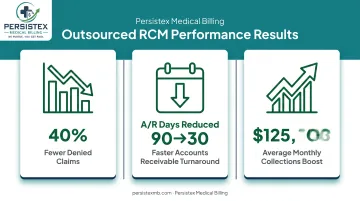
Its team holds CPC, CPB, RHIT, and CCS certifications and manages the full cycle from scheduling through collections, rather than just claim submission. Documented client results include:
- 40% fewer denied claims on average
- A/R days reduced from 90 to 30
- An average $125,000 monthly collections boost
One multi-provider behavioral health clinic with eight providers shows what full-cycle support can do. Starting from a 35% denial rate, the practice cut denials 40%, added $85,000 in monthly revenue, and brought average A/R down to 22 days.
Those results do not come from claim submission alone. They come from fixing the entire cycle, front to back.
If your practice already has trained staff handling a manageable volume cleanly, in-house RCM can absolutely work. If denials are climbing and cash flow feels unpredictable, that's usually the signal to look at specialized outside support.
Frequently Asked Questions
What are the steps of revenue cycle management (RCM)?
RCM runs through eight connected steps: pre-registration and scheduling, eligibility verification and prior authorization, charge capture, medical coding, claims submission, payment posting, denial management, and patient billing and collections. Each step feeds data into the next.
What is the difference between medical billing and revenue cycle management?
Medical billing is one component: generating and submitting claims and collecting payment. RCM is the broader process that also includes scheduling, eligibility verification, coding, and accounts receivable follow-up.
Who typically manages revenue cycle management in a medical practice?
It varies by practice size. Smaller practices often rely on administrators or in-house billing staff, while larger or specialty-heavy practices frequently outsource to dedicated RCM partners for deeper expertise.
How long does the average RCM cycle take from patient visit to final payment?
Clean claims from traditional Medicare typically pay in 10–14 days, while Medicare Advantage claims can take 30–45 days. Practices with strong RCM generally keep total days in A/R between 30 and 40.
What is considered a good clean claim rate in RCM?
A strong target is 98% first-submission acceptance. Rates well below that usually point to front-end or coding issues.
Is outsourcing RCM better than handling it in-house for small practices?
For smaller or specialty practices without dedicated billing expertise, outsourcing often delivers measurable gains, especially when denial rates are climbing or cash flow has become unpredictable.