

For behavioral health, TMS, and other outpatient practices, this isn't abstract. It shows up as:
- Front-desk staff drowning in insurance verification calls
- Providers chasing unpaid claims instead of seeing patients
- Cash flow that swings wildly from month to month
- Billing teams burning out from constant rework
This article breaks down the seven core steps of revenue cycle management, the KPIs worth tracking, proven strategies to fix what's broken, and how to know when outsourcing makes more sense than hiring.
Key Takeaways
- Accurate patient registration and insurance verification stop most downstream denials before claims go out
- Clean claim rate, days in A/R, and denial rate pinpoint exactly where revenue is leaking
- Proactive denial management and workflow automation deliver the biggest measurable collections gains
- Specialty practices see faster gains with billing partners who know niche coding and payer rules
What Are the 7 Steps of the Revenue Cycle Management Process?
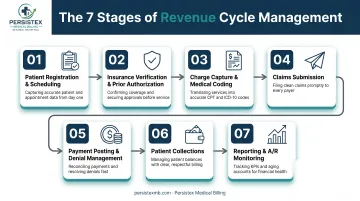
RCM is a connected chain running from the first patient phone call to the final dollar collected. A breakdown at any link leaks revenue somewhere downstream.
1. Patient Registration & Scheduling
Getting demographic and insurance details right at intake sounds basic, but it's the foundation everything else rests on. A misspelled name or wrong group number at this stage can delay a claim weeks later, forcing costly rework.
2. Insurance Verification & Prior Authorization
Confirming active coverage and securing authorizations before the appointment reduces denials and spares patients unpleasant billing surprises. This matters most for services that require pre-approval, including many behavioral health and specialty procedures.
3. Charge Capture & Medical Coding
Translating documented care into billing codes is where many denials start. Behavioral health adds extra risk—therapy and psychiatric services use time-based CPT codes and medical-necessity rules that generalist coders often miss.
Strong coding at this stage means:
- Matching CPT/ICD-10 codes to the note, not the habit
- Catching missing modifiers before the claim goes out
- Flagging incomplete documentation while the visit is still fresh
4. Claims Submission
A "clean" claim is accurate, complete, and compliant with the specific payer's submission rules. Clean claims get adjudicated and paid faster; messy ones bounce back and restart the clock.
5. Payment Posting, Reconciliation & Denial Management
Applying payments correctly against the right claims — and catching denials fast — protects revenue you've already earned. Slow reconciliation hides problems until they've compounded.
6. Patient Collections
Clear statements and flexible payment options close the patient-balance loop and reduce bad debt. Handled poorly, this is where the cycle drags into aging receivables instead of closing cleanly.
7. Reporting & A/R Performance Monitoring
Dashboards on denial rate, days in A/R, clean-claim rate, and net collections show where the chain is breaking. Without routine reporting, the same leaks repeat month after month.
Key RCM Metrics You Should Be Tracking
You can't fix what you don't measure. These core metrics matter most for spotting where revenue is leaking.
Clean Claim Rate
This tracks the percentage of claims accepted on first submission, with no corrections needed. HFMA has cited a 98% clean claim rate as a benchmark used by ambulatory surgery centers (HFMA, 2023). Practices operating well below that range usually have a registration, coding, or payer-rule gap worth investigating.
Days in Accounts Receivable (A/R)
Days in A/R measures how long it takes, on average, to collect payment owed. The American Academy of Family Physicians recommends keeping this metric under 50 days, with 30-40 days considered ideal (AAFP). Anything creeping past 50 signals a slow-moving claims or follow-up process.
Denial Rate and Collection Rate
Track denials by payer and by reason code—not just as one aggregate number. AAFP puts the industry average denial rate at 5%–10%, with under 5% considered desirable.
For collections, aim for an adjusted collection rate of at least 95%. Top performers hit 99% or higher. When collection rate slips, it usually points to a systemic issue upstream, not a one-off billing mistake.
How to Improve Revenue Cycle Management: Proven Strategies
Once you know where the leaks are, here's what actually moves the numbers.
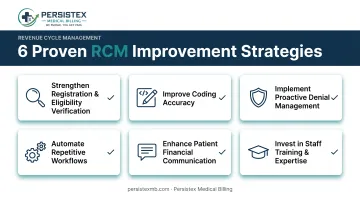
Strengthen patient registration and eligibility verification. Real-time insurance checks at intake, paired with thorough demographic data collection, cut first-pass denials before a claim is ever submitted.
Improve coding accuracy and clinical documentation. Regular coding audits and a tighter feedback loop between coders and providers reduce coding-related denials. Specialty-specific expertise matters here: coders fluent in behavioral health, primary care, and other outpatient specialty requirements catch errors that generalist billers miss.
Implement proactive denial management. Shift from reactively fixing rejected claims to analyzing denial patterns and preventing them at the source. When denials do happen, fast, well-documented appeals recover revenue that would otherwise be written off.
Automate repetitive workflows. Automating eligibility checks, claim scrubbing, and payment reminders cuts manual errors and speeds up the entire cycle, freeing staff for complex accounts and patient follow-up.
Enhance patient financial communication. Upfront cost estimates, clear billing statements, and flexible payment options (portals, payment plans) improve collections and patient satisfaction at the same time.
Invest in staff training and specialized expertise. Payer rules change constantly, and ongoing training keeps billing teams current. Many practices supplement in-house staff with certified specialists (CPC, CPB, RHIT, or CCS credentialed coders) for complex specialty billing they can't justify hiring full-time.
Common RCM Challenges That Slow Down Payments
Even well-run practices hit the same recurring friction points.
- Constantly changing payer rules. Medicare, Medicaid, and commercial payers update coding and submission requirements on a rolling basis. Manually tracking every change across multiple payers is nearly impossible for a small billing team.
- Staffing shortages and burnout. Billing roles now need specialized coding knowledge, not just data entry. Overburdened teams, especially solo billers covering multiple specialties, are far more prone to costly errors and turnover.
- Coding and documentation gaps. Missing or incomplete clinical documentation creates rework, stalls authorizations, and denials that get costlier the longer they sit. A single missing modifier can delay payment by weeks.
These three issues rarely occur in isolation. A staffing gap often causes the documentation gaps that trigger denials, which then get buried under payer rule changes nobody had time to review.
When Outsourcing Revenue Cycle Management Makes Sense
Not every practice needs to outsource. But certain signs suggest it's time to seriously consider it:
- Days in A/R keep climbing past 50-60 days
- Denials are mounting and appeals aren't keeping pace
- Staff or providers spend 15+ hours a week on billing instead of patient care
- Monthly collections swing unpredictably from month to month
If any of these sound familiar, here's what to look for in an RCM partner:
- Specialty expertise — someone who understands your specific coding and payer landscape, not generic billing
- Transparent reporting — real dashboards, not vague monthly summaries
- EHR/PMS integration — seamless connection to your existing systems
- No long-term contract lock-in — flexibility to leave if results don't materialize
Those criteria are exactly what Persistex Medical Billing is built around for behavioral health, primary care, and outpatient practices. The company maintains a 98% clean claim rate, has delivered an average 40% reduction in denied claims, and reports an average $125,000 monthly collections boost for client practices.
Its team holds CPC, CPB, RHIT, and CCS certifications and works as a dedicated U.S.-based account team rather than a rotating call center. That setup matters when psychotherapy session limits, specialty coding rules, or payer quirks need someone who already knows the specialty.

Frequently Asked Questions
How can I improve revenue cycle management?
Focus on accurate registration and eligibility verification, clean claim submission, proactive denial management, workflow automation, and ongoing staff training. Each step plugs a common leak between patient intake and final payment.
What are the 7 steps of the revenue cycle?
Registration and scheduling, insurance verification and prior authorization, charge capture and coding, claims submission, payment posting, denial management, and patient collections. Each step feeds directly into the next.
What is considered a good clean claim rate?
Top-performing practices target a 95–98% clean claim rate. Rates well below that usually point to gaps in registration, coding, or payer-rule compliance worth fixing first.
How many days should A/R stay outstanding?
AAFP recommends keeping days in A/R under 50, with 30-40 days considered ideal. Longer A/R typically signals slow claims processing, weak follow-up, or unresolved denials piling up.
Should small or solo practices outsource revenue cycle management?
Outsourcing is often a strong fit for solo and small practices without in-house coding depth. It returns staff and provider hours to patient care instead of billing follow-up.
What's the difference between medical billing and revenue cycle management?
Medical billing is one component (submitting and following up on claims) within the broader RCM process. RCM spans everything from patient registration through final payment collection.