

This guide is for practice owners, billing staff, and healthcare administrators running behavioral health, TMS, and general medical practices. Charge entry accuracy directly affects your cash flow, your denial rates, and your compliance exposure — every single billing cycle.
Many practices confuse charge entry with charge capture or medical coding. That confusion is expensive. Teams end up troubleshooting the wrong step when claims come back denied, wasting hours chasing a problem in the wrong department.
Here's what this article covers: what charge entry actually is, why it matters to your revenue cycle, how the process works step-by-step, and which factors determine whether your charge entry is helping or hurting your bottom line.
Key Takeaways
- Charge entry converts coded clinical services into billable line items between coding and claim submission
- Clean charge entry cuts denials, speeds reimbursement, and protects revenue cycle health
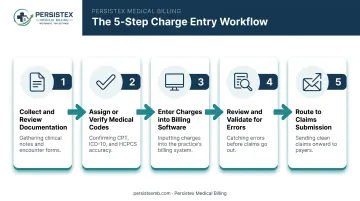
- The process runs through five stages: documentation review, code verification, entry, validation, and claims routing
- Documentation quality, staff skill, your EHR/PM system, and specialty complexity drive accuracy
- Wrong codes, missing modifiers, and duplicates are preventable with trained staff or a billing partner
What Is Charge Entry in Medical Billing?
Charge entry is the step that turns a patient visit into a billable claim record in your billing software. Billers enter demographics, insurance details, diagnosis codes (ICD-10), and procedure codes (CPT/HCPCS) so the encounter can move toward submission.
AAPC describes charge entry as the function that gets correct insurance and demographic information into the billing system: a narrower job than most people assume.
The goal is clear: turn a documented patient encounter into an accurate, submission-ready insurance claim. Every data point has to line up, or the claim stalls before it reaches the payer.
Charge Entry vs. Charge Capture
People use these two terms interchangeably, and that's a mistake.
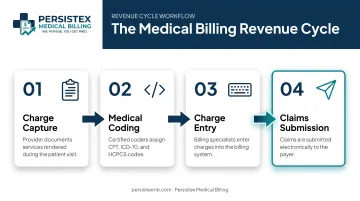
- Charge capture: the provider's action of documenting and submitting the services rendered during a visit
- Charge entry: what happens next—reviewing that documentation, matching it to the correct codes, and entering the data into the billing system
AAPC's coverage of charge capture audits treats these as distinct process breakdowns worth auditing separately — because errors in one don't necessarily mean errors in the other.
Charge Entry vs. Medical Coding
Coding assigns the CPT, ICD-10, and HCPCS codes that describe a service. Charge entry takes those codes and inputs them, along with service dates, units, pricing, and payer-specific data, into the billing record.
Where does this sit in your revenue cycle sequence? After provider documentation and coding, and before claims submission. That handoff is where claims fall apart when nobody verifies the data before it goes out.
Why Charge Entry Matters in the Revenue Cycle
Correct charge entry is what actually enables reimbursement. Get a code wrong, miss a modifier, or mismatch a patient ID, and your collections drop or the claim bounces back entirely.
The scale of the problem is real. MGMA's 2024 DataDive reporting found an 8% first-submission denial rate across single-specialty practices, and 60% of surveyed medical group leaders said denial rates had increased compared to the prior year.
MGMA's cited denial drivers include insufficient documentation, incorrect patient IDs, modifier errors, and registration mistakes during EHR transitions. Charge entry sits at the center of nearly all of them.
What the Revenue Cycle Actually Needs
Your revenue cycle demands three things from charge entry:
- Consistency across every claim, regardless of who's entering data that day
- Timely submission so cash flow doesn't stall waiting on backlogged charges
- Reduced rework: fewer claims bounced back for correction and resubmission
What Goes Wrong Without It
Skip the discipline, and here's what typically follows:
- Missed charges that quietly disappear from your revenue
- Delayed payments stretching your A/R days
- Compliance exposure from incorrect coding or documentation mismatches
- Revenue leakage that can take weeks to even trace back to its source
Practices should track a few internal indicators to catch problems early: days to enter charges, missing charge rates, and coding accuracy. There's no universal industry benchmark for these — define them for your own operation and monitor the trend.
Specialty billing raises the stakes further. Behavioral health, for example, uses psychotherapy and psychiatric codes with documentation and modifier rules most generalist billers rarely see. Primary care, pediatrics, chiropractic, and podiatry each add their own payer quirks. That is where a CPC/CPB-certified team like Persistex earns its keep: specialty coding knowledge keeps charge entry clean when payers scrutinize every line.
How the Charge Entry Process Works (Step-by-Step)
Charge entry takes documented, coded services and converts them into structured, billable data ready for submission. The inputs are consistent: provider documentation, assigned CPT/ICD-10/HCPCS codes, patient demographics, and insurance details.
Claim scrubbers, coding editors, and internal review checkpoints exist to catch errors before a claim reaches the payer. That control layer keeps the process reliable instead of reactive. Here is how the workflow usually runs.
Step 1: Collect and Review Documentation
Gather provider notes, procedures performed, and diagnosis details from the visit. Every billable service needs to be captured here. Anything missed at this stage is revenue you likely will not recover later.
Step 2: Assign or Verify Medical Codes
Confirm that CPT, ICD-10, and HCPCS codes match what's documented. Incorrect codes remain one of the leading causes of denials, and this step is where most of them get caught or missed.
Step 3: Enter Charges into Billing Software
Input patient, provider, code, and pricing details into your practice management system (AdvancedMD, Kareo, athenahealth, or similar platforms). This is the literal "entry" in charge entry. It is the most mechanical step, but accuracy still depends entirely on what happened in Steps 1 and 2.
Step 4: Review and Validate for Errors
Cross-check entries against documentation and coding guidelines. This catches missing modifiers, duplicate entries, and mismatched data before they become someone else's problem downstream. Pre-submission audits and diagnosis-to-procedure linkage checks belong here too.
Step 5: Route to Claims Submission
Once validated, charges move to the claims team for generation and submission (electronic or paper) to the payer. From this point, the claim is out of your hands and into adjudication.
Key Factors That Affect Charge Entry Accuracy
Accuracy isn't random. It's determined by a handful of specific, controllable factors:
- Documentation completeness: Incomplete or unclear provider notes are a direct cause of coding and entry errors downstream
- Practice size and specialty complexity: High-volume practices or specialties like behavioral health require more nuanced coding knowledge than a standard office visit
- EHR/PM system integration: How cleanly charges flow from documentation to billing affects both speed and accuracy
- Staffing model: Whether entry is handled by generalist office staff, a dedicated in-house team, or a specialized partner with certified coders (Persistex's team, for example, holds AAPC and AHIMA credentials)
- Compliance requirements: HIPAA and payer-specific coding rules vary, and every entry has to reflect them correctly
Miss any one of these, and accuracy erodes — often invisibly, until denial rates or A/R days start climbing.
Common Charge Entry Errors, Misconceptions, and Getting It Right
The biggest misconception? That charge entry is simple data entry. It's not. It requires coding knowledge and awareness of payer-specific rules. Typing skills alone won't cut it.
The Charge Entry vs. Charge Capture Mix-Up
Teams frequently blame the wrong step when denials pile up. If charge capture (the provider's documentation) was incomplete, no amount of careful charge entry will fix the resulting claim. Diagnosing the actual failure point matters more than assuming it's always "a billing issue."
Accurate Entry Doesn't Guarantee Payment
Even a perfectly entered claim can still get denied. Payer adjudication, prior authorization requirements, and medical necessity reviews sit downstream of charge entry. Accuracy reduces risk, but it doesn't eliminate it.
KPIs Flag Problems, They Don't Explain Them
A rising "missing charges" or falling "coding accuracy" metric tells you something's wrong. It doesn't tell you why. That takes an actual audit, not just a dashboard glance.
Signals You Need Outside Help
Watch for these warning signs:
- Denial rates climbing month over month
- A/R days steadily growing instead of holding steady
- Staff burning excessive hours on claim corrections instead of new charges
When these show up together, they usually point to a systemic charge entry problem rather than a one-off mistake. That is often when partnering with a specialized RCM provider makes a measurable difference.
Persistex, for example, maintains a 98% clean claim rate and 99.2% coding accuracy across its client base.
Having a process on paper isn't the same as having one that's consistently followed. Correctly applied charge entry, day after day, is what actually protects your revenue — not the existence of a workflow diagram.

Frequently Asked Questions
What is charge entry in medical billing?
It's the process of entering coded patient service data — demographics, diagnoses, procedures, and insurance details — into a billing system to create a claim. It happens after coding and before claim submission.
What's the difference between charge entry and charge capture?
Charge capture is the provider documenting and submitting services rendered during a visit. Charge entry is the coder or biller reviewing, matching, and entering that data into the billing system afterward.
Who is responsible for charge entry in a medical practice?
Small practices often assign this to billers or office managers. Larger practices, and many outsourced billing partners, use dedicated charge entry specialists trained specifically for the task.
What happens if charge entry is delayed or inaccurate?
Expect claim rejections, delayed reimbursement, underpayment, or compliance risk. Fixing these issues after the fact typically requires costly claim rework and extends your A/R days.
Can charge entry be outsourced?
Yes. Many practices outsource to specialized medical billing companies for faster turnaround, fewer errors, and less administrative burden on in-house staff.
How often should charge entry be reviewed for errors?
Review before every claim submission. Daily or weekly checks, depending on your practice's volume, catch coding or data mistakes early — before they compound into denials.