Introduction
What's actually costing your practice more money: the claims that get denied outright, or the ones that get paid quietly at the wrong rate? Most practice owners obsess over denials and miss the second problem entirely — underpayments and coding drift that never trigger a rejection, just a smaller check.
Heading into 2026, that blind spot gets harder to manage. New CPT and ICD-10-CM code sets, shifting payer rules, and updated CMS guidance all land at once, and each one changes what a "clean" claim actually looks like.
The core pain points haven't gone away either: denial rates that creep upward, constant coding and regulatory churn, and administrative strain that hits small-to-midsize practices hardest.
This guide gives you a complete, phase-by-phase audit checklist, benchmarks for reading your results, the denial reasons still doing the most damage, and a repeatable system for keeping all of it on schedule.
TL;DR
- A full audit checklist covers the entire revenue cycle: verification, coding, claims, payment posting, and compliance
- Set a fixed cadence (monthly for high-volume practices, quarterly or annually for smaller ones) with a consistent sample size every cycle
- Compare results to benchmarks (clean claim rate, documentation support rate) before treating a variance as a real problem
- Eligibility gaps, missing authorization, coding errors, and timely filing misses remain the top preventable denial drivers
- Specialty practices need audit checks built around their specific CPT codes and prior authorization rules
What You Need Before Running a Medical Billing Audit in 2026
An audit is only as good as what goes into it. Pick the wrong sample size, skip access setup, or use inconsistent tools, and you'll get a superficial pass/fail exercise instead of real findings you can act on.
Tools and Resources Required
Before you start, gather:
- EHR/practice management system access with permissions to pull encounter-level records
- Remittance and claims data: 835/837 files or clearinghouse reports covering your sample period
- Current CPT, ICD-10-CM, and HCPCS reference tools reflecting the latest code set
- Payer contracts and fee schedules to check paid amounts against what's actually owed
- Prior audit reports for comparison against this cycle
- A standardized checklist template you apply the same way every cycle
Preconditions and Setup
Define your audit scope first. Pick a fixed sample size (for example, 20 encounters per provider) and keep that number identical every cycle. Change the sample size between audits and you lose the ability to spot real trends versus noise.
Confirm HIPAA-compliant access controls are in place so whoever's auditing can pull records without disrupting clinical workflow or triggering unnecessary access alerts.
Not every practice has in-house coding or audit expertise sitting around, and that's fine. Practices without that bandwidth often bring in a specialized billing partner.
Persistex Medical Billing supports this process with AAPC- and AHIMA-certified coders (CPC, CPB, RHIT, CCS) so practices don't have to build an audit function from scratch.
The Complete 2026 Medical Billing Audit Checklist
Run the checklist in the same order a claim actually travels — registration, coding, submission, payment, compliance. Findings at each stage only mean something in light of what happened before it. A coding error, for instance, looks different if eligibility was never confirmed in the first place.
Patient Registration & Insurance Verification
For every sampled encounter, confirm:
- Demographic accuracy (name, DOB, policy number match payer records)
- Active eligibility and benefits verified before the visit, not after
- Prior authorization or referral requirements confirmed and documented
- Coordination of benefits checked when a patient has multiple coverages
Coding, Documentation & Medical Necessity Accuracy
Review whether CPT, ICD-10, and HCPCS codes actually match the documentation in the chart — not what the provider intended to bill, but what the note supports.
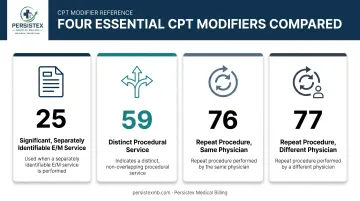
Pay close attention to modifier usage:
| Modifier | Correct Use |
|---|---|
| 25 | Significant, separately identifiable E/M service on the same day as another procedure |
| 59 | Distinct procedural service (separate site, encounter, or specimen), not just to bypass an edit |
| 76 | Repeat procedure by the same physician |
| 77 | Repeat procedure by a different physician, same day |
Also check coding consistency across providers for similar visit types. If one provider bills a level 4 visit for cases everyone else bills as a level 3, look closer before a payer does.
The AMA released the CPT 2026 code set on September 11, 2025, with 418 changes: 288 new codes, 46 revisions, and 84 deletions, effective January 1, 2026.
CMS's FY2026 ICD-10-CM guidelines run in two file periods: October 2025 through March 2026, then an April update covering April through September 2026. Every 2026 audit should confirm the practice coded against the correct file for the date of service.
Claims Submission, Denials & Appeals Tracking
- Verify claim completeness and scrubbing before every submission
- Confirm submission falls within each payer's timely filing window
- Log denial reasons verbatim, not paraphrased or summarized
- Separate technical rejections (a claim kicked back by the clearinghouse for a formatting error) from adjudicated denials (a payer decision after review) — they require entirely different fixes
Payment Posting, Contractual Adjustments & A/R Review
- Confirm paid amounts match contracted rates, line by line
- Review adjustment and remark codes for accuracy, not just amount
- Audit aging A/R buckets for balances sitting past 60 or 90 days
- Assign a named owner and a deadline to every unresolved variance found
Compliance & Regulatory Alignment for 2026
Confirm the practice aligns with:
- The 2026 Medicare Physician Fee Schedule, including updated conversion factors and the -2.5% efficiency adjustment on designated non-time-based services
- HIPAA security safeguards for anything touching electronic PHI
- No Surprises Act good-faith estimate requirements for uninsured or self-pay patients
- Current payer credentialing and revalidation status for every provider billing under the practice
Special Considerations for Behavioral Health & TMS Billing
Behavioral health and TMS billing carries its own audit checklist:
- Correct use of TMS-specific CPT codes 90867 (initial session with mapping), 90868 (subsequent session), and 90869 (motor threshold re-determination), plus required modifiers
- Prior authorization documentation on file for TMS or psychiatric services, including medical-necessity support
- Session or unit limits checked against the specific payer's policy, not a generic assumption
When authorization approval rates lag, the gap usually traces back to incomplete medical-necessity documentation rather than an unusually difficult payer. Practices that outsource this work often use partners like Persistex Medical Billing, which reports a 95% prior authorization approval rate and a 98% clean claim rate across behavioral health and outpatient billing, as a performance benchmark during audits.
How to Interpret Your Audit Results
Reading the numbers wrong is almost as costly as skipping the audit. Miss a real problem and revenue keeps leaking; overreact to normal variance and you burn staff time chasing noise. Benchmarks fix that.
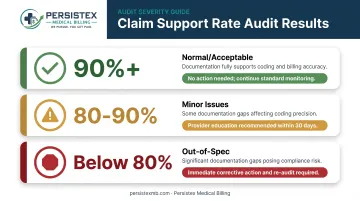
| Category | What It Looks Like | Action Required |
|---|---|---|
| Normal/Acceptable | Documentation support rate at or above 90%, high clean claim and first-pass acceptance rates | Light-touch monitoring, no changes needed |
| Minor Issues | Support rate in the 80–90% range, coding variation limited to one or two providers | Targeted coaching, not full escalation |
| Out-of-Spec | Support rate below 80%, a denial reason repeating across the sample, payment variances tied to modifier errors | Pause, escalate, fix the root cause before continuing |
For context, HFMA reports an industry-average denial rate of 5-10%, with anything under 5% considered optimal. MGMA's DataDive benchmark separately puts the aggregate first-submission denial rate around 8% for single-specialty practices.
If your audit lands well above those figures, dig into the root cause.
Drift detection is the step most practices skip. Compare this cycle's metrics against the last one. Did the corrective actions from your previous audit actually move the numbers, or did the same issue resurface under a different name? If the same problem returns, escalate the fix before the next cycle.
Common Billing Errors & Top Denial Reasons to Watch in 2026
Most preventable revenue loss traces back to a short, repeatable list. Naming them keeps the audit focused instead of chasing every possible error.
Top categories to check:
- Eligibility and coverage lapses at the time of service
- Missing prior authorization
- Coding and modifier errors, especially modifier 25 misuse
- Insufficient medical necessity documentation
- Timely filing misses
MGMA’s 2024 analysis names insufficient documentation, incorrect patient ID or eligibility, untimely filing, and incorrect modifier use as recurring drivers of first-submission denials. It does not publish current percentage shares for each category.
Three process mistakes undermine audit reliability:
- Inconsistent sample sizes between cycles, which makes trend comparison meaningless
- Treating rejections and denials as the same category, when a formatting rejection needs a resubmission and an adjudicated denial needs an appeal
- Reviewing codes one at a time instead of coding distribution across providers—payer algorithms flag outliers that claim-by-claim review misses
Failing to assign a named owner and deadline to every finding is the single biggest reason the same issues show up again next cycle. A finding without an owner is just a note nobody acts on.
Audit Cadence, Compliance & Best Practices for 2026
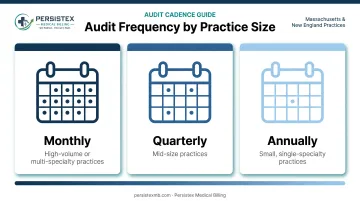
How often you audit depends on volume:
- Monthly for high-volume or multi-specialty practices
- Quarterly for mid-size practices
- At minimum annually for small, single-specialty practices
Escalate compliance risks the same day they're found. Waiting a week to flag a HIPAA gap or a modifier pattern defeats the purpose of catching it early. Keep a dated corrective action plan (CAP) on file; it's your protection if a payer or regulator ever audits the practice externally.
Ownership matters more than the checklist itself:
- Leadership sets the thresholds and approves escalations
- Revenue cycle staff run the actual audit process
- Providers own documentation quality on their own charts
Without that split, findings sit in a report nobody reads instead of becoming real change.
When internal bandwidth can't hold that cadence, a dedicated RCM partnership covers the gap without adding staff. Persistex Medical Billing's model uses named account teams, transparent reporting, and no rotating call-center support. Client practices have seen 40% fewer denied claims and A/R days cut from 90 to 30—benchmarks a well-run internal cadence should target too.
Frequently Asked Questions
What should be included in a medical billing audit checklist?
A complete checklist covers patient and insurance verification, coding and documentation accuracy, claims submission and denial tracking, payment posting, and regulatory compliance. Each stage should be reviewed in the order a claim travels.
What are the key steps in a medical billing audit?
Define your scope and sample size, then review documentation and coding. Analyze claims and denials, verify payments against contracted rates, check compliance, and assign corrective actions with owners and deadlines.
What are the top 5 denials in medical billing?
Eligibility issues, missing prior authorization, coding or modifier errors, insufficient medical necessity documentation, and timely filing misses account for most preventable denials.
How often should a practice conduct a medical billing audit?
High-volume or multi-specialty practices should audit monthly. Smaller, lower-complexity practices can run quarterly or annual audits, as long as the sample size stays consistent between cycles.
How long does a typical medical billing audit take?
It depends on sample size and scope. A focused internal review might take a few days, while a full external audit covering multiple providers and stages can take a few weeks.
Should a practice handle billing audits internally or outsource them?
Internal audits are faster and cheaper but can miss blind spots your own team is too close to see. Specialized partners bring outside benchmarking and specialty-specific expertise, particularly for behavioral health and other complex outpatient billing.