
Most practices assume clinical documentation improvement (CDI) belongs to hospital HIM departments with dedicated staff and software. But outpatient, behavioral health, and specialty practices face the exact same documentation-to-reimbursement risks — usually with far fewer resources to catch problems before they become denials.
This guide covers practical CDI best practices for practices of any size: what to fix first, where documentation typically breaks down, and how to build a program that actually sticks.
Key Takeaways
- Vague or generic documentation is a leading cause of denials and downcoding, not a minor administrative issue
- Behavioral health and TMS practices face extra scrutiny around medical necessity and session-level detail
- Copy-forward notes and note bloat quietly erode documentation quality across nearly every specialty
- A structured CDI program with clear metrics typically shows results within 30-60 days
What Is Clinical Documentation Improvement (CDI) and Why It Matters
CDI is the ongoing process of making sure medical records are accurate, complete, and specific enough to support both the care delivered and the codes billed for it. Done well, it becomes a habit built into daily charting—not a one-time cleanup project.
You'll often hear "documentation integrity" and "documentation improvement" used interchangeably, but they point to different priorities:
- Integrity focuses on accuracy and ethics — the record reflects what actually happened, full stop
- Improvement focuses on workflows and gaps — fixing the process that produces the record
In 2019, ACDIS (the Association of Clinical Documentation Integrity Specialists) renamed itself over this distinction, moving from "Improvement" to "Integrity." The shift underscored a core principle: clarify the record even when the change has no direct revenue impact.
The Direct Line From Documentation to Denials
Vague or unspecific notes don't just look sloppy. They create a mismatch between what's billed and what's proven, and payers deny on that mismatch every day. When the chart lacks the detail coders need, codes get under-specified or mismatched—and those claims are the ones payers kick back first.
Why This Hits Behavioral Health and TMS Practices Harder
Outpatient behavioral health and TMS practices carry a heavier documentation burden than most primary care settings:
- Medical necessity must be re-established for ongoing coverage, not just the initial visit
- Session-level specificity (time, modality, response) directly determines whether a code is billable
- Prior authorizations and reauthorizations hinge entirely on what's written in the chart
Miss any of these, and you risk more than a single denial. Future session authorizations can fall through as well.
CDI Best Practices Physicians and Practices Should Follow
Foundational Documentation Best Practices for Any Practice
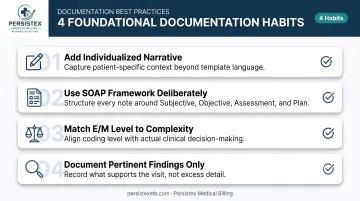
Most documentation problems aren't dramatic. They're small, repeated habits that compound over hundreds of visits. Start here:
- Add individualized narrative. Click-box EHR templates produce notes that look identical across visits, which is a red flag for reviewers and a weak defense in an audit.
- Use the SOAP framework deliberately. In Subjective, Objective, Assessment, Plan notes, the Assessment section is where you prove medical necessity.
- Match E/M level to true complexity. Boilerplate templates tend to inflate or flatten every visit to the same level, regardless of what actually happened.
- Document pertinent findings only for follow-ups. Defaulting to "all normal" comprehensive exam templates on a routine follow-up doesn't match the visit's actual scope and invites scrutiny.
None of this requires new software. It requires providers to treat each note as a standalone clinical and legal document rather than a copy of the last one.
Specialty-Specific CDI Practices for Behavioral Health and TMS Documentation
Behavioral health and TMS documentation carry requirements that general medical charting doesn't.
For psychotherapy and E/M codes, CMS requires documented start and stop times, or total session time, and this time must be tracked separately from any E/M time on the same visit. The code selected has to match the clock:
| Code | Time Range |
|---|---|
| 90832/90833 | 16-37 minutes |
| 90834/90836 | 38-52 minutes |
| 90837/90838 | 53+ minutes |
A note stating "supportive psychotherapy given" isn't enough. CMS guidance requires a detailed description of the therapeutic intervention, session frequency, measurable goals, and documented progress or lack thereof.
For TMS documentation supporting CPT codes 90867-90869, the record needs to capture:
- Treatment parameters and motor threshold determination
- Session counts, since 90867 can typically only be reported once per episode
- Clinical response data that supports continued treatment or reauthorization
- The prescribing psychiatrist's face-to-face evaluation of contraindications
For behavioral health diagnoses, severity and comorbidities need explicit documentation. Payers scrutinize behavioral health medical necessity closely, and an unspecified diagnosis code is one of the easiest reasons for a reviewer to deny or downgrade a claim.
Common CDI Challenges Practices Face (and How to Solve Them)
Every practice hits the same handful of documentation problems. The good news: they're fixable once you name them.
Communication gaps between providers and billing staff. Coders often can't ask a provider a direct clinical question without risking a leading query. The fix is a standardized query process: open-ended or multiple-choice questions that request clarification without suggesting the answer.
Note bloat from copy-paste and pulled-forward data. This is more common than most practices realize. A 2022 peer-reviewed study of 6.6 million ambulatory notes found that 18% used copy-paste functionality, with 12% of note content directly copied, and usage varied from 11% to 59% depending on specialty.
The risk isn't just redundancy. Outdated information persists, and clinically important details get buried under repeated text. The fix: encourage encounter-specific notes, even if they're shorter.
ICD-10 specificity gaps in behavioral health. Unspecified diagnosis codes are a common weak point in behavioral health charts. Ongoing provider education paired with a coder feedback loop, where coders flag recurring specificity issues back to providers, closes this gap over time far better than a one-time training session.
Building a CDI Program for Your Practice: A Step-by-Step Roadmap
A sustainable CDI program needs a defined process, not a dedicated HIM department.
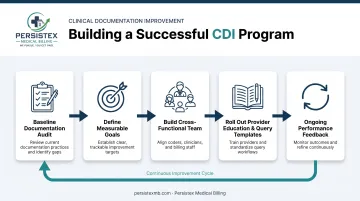
- Run a baseline documentation audit. Identify recurring gaps, denial patterns, and coding accuracy issues before building anything new. You can't fix what you haven't measured.
- Define measurable goals. Pick 2-3 targets, such as reduced denials, improved query response rates, or higher coding specificity, rather than a vague "improve documentation" mandate.
- Build a small cross-functional team. Providers, front-office staff, and a coding or billing partner should all have a seat at the table. Working in silos is where most CDI efforts stall.
- Roll out provider education and query templates. Standardized, non-leading query templates clarify ambiguous documentation without steering the provider's clinical judgment.
- Use ongoing performance feedback to refine habits. Whether from an internal audit process or an outsourced billing partner, feedback needs to be continuous, not an annual event.
For a solo practitioner, steps 3 and 4 often collapse into a single relationship with a billing partner who flags documentation issues as part of routine claim review, rather than a separate internal committee.
Key CDI Metrics That Prove Program Success
You need numbers, not impressions, to know if a CDI program is working. Track these:
- Clean claim rate: claims accepted without edits on first submission. Industry benchmarks put a strong target around 98%.
- Denial rate: denied dollars divided by submitted claim dollars. A 5-10% range is average industry-wide; under 5% is optimal.
- Query response and agreement rates: how often providers respond to documentation queries, and how often they agree without a full revision.
- A/R days: accounts receivable outstanding. A 30-40 day range is a healthy target.
- Coding accuracy percentage: the downstream proof that documentation improvements are translating into billing accuracy.
None of these move overnight. But a practice that's improving documentation should see denial rates trending down and clean claim rates climbing within a few billing cycles.
How Persistex Strengthens Documentation and Revenue Outcomes for Practices
Documentation review works best when it happens before a claim goes out the door, not after a denial arrives. That's the core of how Persistex approaches CDI for its clients.
Persistex's CPC, CPB, RHIT, and CCS-certified coding team reviews charts for documentation gaps as a standard part of pre-submission workflow — checking that the diagnosis supports the procedure, that the clinical record justifies the billed service level, and that modifier requirements are met before the claim is scrubbed and sent.
This matters most in specialties where documentation requirements are dense and unforgiving:
- Behavioral health: Psychotherapy time, diagnosis severity, and medical necessity must be clear or reimbursement stalls
- Primary care and family medicine: E/M level support, preventive visit detail, and chronic condition specificity drive clean payment
- Pediatrics: Vaccine and well-visit documentation has to match coded services and payer rules
- Chiropractic and podiatry: Care-plan notes, CMT detail, and routine foot-care coverage criteria need tight alignment before submission
The results show up in the numbers. Persistex reports a 98% clean claim rate and 99.2% coding accuracy across its client base, with an average 35% reduction in coding-related denials driven largely by pre-submission documentation checks.
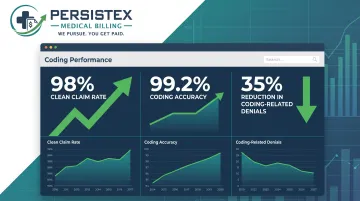
Practices typically see measurable improvement within 30–60 days of moving documentation review upstream—fewer coding-related denials, faster clean claims, and less rework after submission.
Strong CDI is not a side project from billing. It is the foundation that keeps revenue intact.
Frequently Asked Questions
What are the 7 C's of clinical documentation?
The 7 C's typically cover client's words, clarity, completeness, conciseness, chronological order, confidentiality, and correctness. Together they keep records accurate, defensible, and easy to review.
What is the difference between clinical documentation integrity and clinical documentation improvement?
Integrity refers to accuracy and ethical completeness in the record itself. Improvement refers to the workflows and processes used to close documentation gaps. Most programs use both terms to describe the same underlying work.
Who is responsible for CDI in a small or solo practice?
Responsibility is typically shared. Providers document the encounter, office staff support workflow consistency, and an outsourced billing or coding partner often catches gaps before claims are submitted.
How long does it take to see results from a CDI program?
Most practices see measurable improvement in denial rates and clean claim rates within 30-60 days of consistent implementation, when documentation feedback is applied regularly—not as a one-time fix.
Does CDI only apply to hospitals, or does it matter for outpatient practices too?
CDI matters just as much for outpatient, behavioral health, and specialty practices. Documentation-to-reimbursement risks match those in hospitals, but outpatient practices usually have fewer resources to manage them.
What tools or technology can help with clinical documentation improvement?
EHR-integrated review tools, standardized query templates, and structured note formats all help. Many practices also rely on a coding or billing partner to provide ongoing documentation feedback without adding internal staff.