That gap between care delivered and revenue collected has a name: revenue cycle management, or RCM. It's the end-to-end financial process that keeps a practice paid, covering everything from the moment a patient books an appointment to the day their final balance hits zero.
This article breaks down what RCM actually means, walks through the process step by step, and covers how to strengthen it. We'll also look at why RCM gets especially complicated for specialties like behavioral health, where session limits, prior authorizations, and niche CPT codes trip up billers who aren't trained for them.
Key Takeaways
- RCM covers the full financial journey—from registration to payment—not just claims submission
- Denial rates are climbing industry-wide, with 60% of practices reporting increases in 2024
- Six connected steps, from registration to appeals, determine whether a practice actually gets paid
- Tracking clean claim rate, days in A/R, and denial rate exposes problems early
- Specialty billing, such as behavioral health, needs certified, specialty-trained expertise
What Is RCM in Medical Billing?
Every practice earns revenue the moment care is delivered. Getting paid for it is another story.
Revenue Cycle Management (RCM) is the full financial process that runs a patient's account from scheduling through final payment and reconciliation. The Healthcare Financial Management Association frames it as tracking patient-derived revenue from the first appointment to the last payment—registration, benefit verification, care delivery, claims, reimbursement, and payer and patient communication.
In plain terms: RCM is everything that has to go right for a practice to collect what it earned.
RCM vs. Medical Billing: What's the Difference?
Medical billing is one piece of RCM, not the whole picture. Billing covers claim submission, payer follow-up, and sending patient statements. That's it.
RCM adds several layers most people don't think about:
- Patient registration and demographic accuracy
- Insurance eligibility verification before the visit
- Coding compliance and documentation review
- Denial management and appeals
- Provider credentialing with payers
- Financial reporting and analytics
Think of billing as one department inside a much larger operation.
The Three Phases of the Revenue Cycle
RCM runs in three broad phases, and it's cyclical, not a one-and-done transaction:
- Pre-service - scheduling, insurance verification, prior authorization
- Service - coding, charge capture, claim submission
- Post-service - payment posting, denial management, accounts receivable follow-up
Each phase feeds the next. A mistake made during pre-service, like an unverified insurance plan, shows up weeks later as a denied claim during post-service. Practices that treat RCM as a connected system, rather than isolated tasks, tend to collect more of what they've actually earned.
The RCM Process: Key Steps Explained
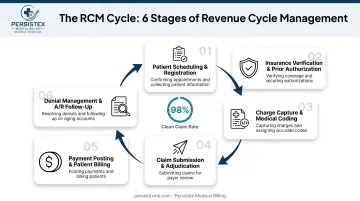
Revenue cycle management isn't one task. It's six connected steps, and missing one weakens the rest of the chain.
Patient Scheduling & Registration. Everything starts here. Front-desk staff collect demographic details, insurance information, and contact data at first contact. A single typo in a policy number or birth date can bounce a claim weeks later.
Insurance Verification & Prior Authorization. Before the appointment, staff confirm active coverage, benefits, and whether the service requires prior authorization. A 2020 MGMA Stat poll of medical group leaders found prior authorization was the single most-cited cause of denials, named by 42% of respondents. Behavioral health and other specialty services often need medical-necessity documentation and payer sign-off before care is billed.
Charge Capture & Medical Coding. Once care is delivered, documented services get translated into ICD-10, CPT, and HCPCS codes. Coding accuracy directly drives reimbursement. Undercoding leaves money on the table; overcoding invites audits.
Claim Submission & Adjudication. Clean claims go out electronically to payers, who review them and respond with full payment, partial payment, or denial. The cleaner the claim, the faster and more complete the payment.
Payment Posting & Patient Billing. Once a payer responds, staff reconcile the payment against what was expected and bill the patient for any remaining balance, such as copays, deductibles, or coinsurance.
Denial Management & A/R Follow-Up. A denial is not the end of the claim. Staff investigate the reason, file an appeal, and track aging A/R so revenue does not quietly disappear.
Appeal success rates vary by payer and specialty, so persistent, well-documented follow-up matters. Persistex's appeals process, for example, recovers payment on more than 72% of the denied claims it pursues.
Why RCM Matters for Your Practice
Effective RCM turns unpredictable reimbursement into steady, forecastable cash flow. Instead of guessing whether a payment lands this month or three months from now, practice owners can actually plan around their revenue.
The cash-flow impact is measurable. Every extra day a claim sits in accounts receivable is money a practice already earned but can't yet spend. Persistex has documented results such as:
- A/R days cut from 90 to 30
- 15 hours a week recovered for a solo psychiatry practice
- A 28% jump in collections alongside those time savings
Those same habits cut regulatory exposure. Accurate documentation and correct coding are a practice's first line of defense in an audit. Sloppy coding invites payer scrutiny, while clean, well-documented claims rarely do.
Patients notice the difference too. Clear, accurate statements reduce the confused phone calls and disputed balances that stall collections. When patients understand exactly what they owe and why, they pay faster—especially important as high-deductible plans shift more of the bill to patients.
Common RCM Challenges Practices Face
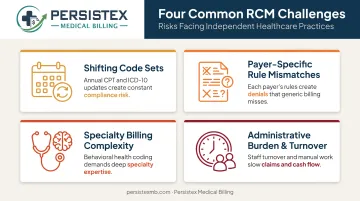
Even well-run practices hit the same recurring obstacles:
- Constantly shifting code sets. CPT codes update every January 1, and ICD-10-CM has both scheduled and midyear updates. Staff who miss an update submit claims with codes that no longer exist.
- Payer-specific rules that don't match. One payer's clean claim is another payer's denial. Claim-adjustment reason codes get interpreted differently across payers, so a fix that works for one plan can fail for another.
- Specialty billing complexity. Behavioral health billing involves psychotherapy and telehealth CPT codes, strict session-limit tracking, and modifier rules that generalist billers frequently get wrong.
- Administrative burden and turnover. Prior authorization alone eats up significant staff time every week, and billing and coding roles see above-average turnover as remote work options pull experienced staff toward other employers.
Left unaddressed, these problems show up in the numbers. One Persistex behavioral health client saw its denial rate fall from 30% to under 8% within three months after specialty-trained coders took over its claims process.
Best Practices to Strengthen Your RCM
Three habits separate practices with strong RCM from those constantly fighting denials.
Automate eligibility and claim checks. Real-time eligibility verification catches coverage problems before a claim is submitted, not weeks later after a denial. Practices that verify eligibility at every visit, not just for new patients, catch far more issues upfront.
Track the KPIs that actually predict revenue trouble. Four metrics tell you almost everything about revenue cycle health:
| KPI | Target Benchmark |
|---|---|
| Clean claim rate | 98% or higher |
| Days in A/R | 30-40 days |
| Denial rate | 5% best practice, under 7% acceptable |
| Net collection rate | 95% minimum, 97-99% optimal |
These figures come from HFMA's published guidance for healthcare providers, though results vary by specialty, payer mix, and geography.
- Keep staff current on coding and payer changes. Code sets change every year, and payer policies shift even more often. Ongoing training, not a one-time onboarding session, is what keeps denial rates low over the long run.
In-House RCM vs. Outsourcing: Which Is Right for You?
The right model depends on your practice size, denial rates, and how much specialty billing you handle.
The Case for In-House RCM
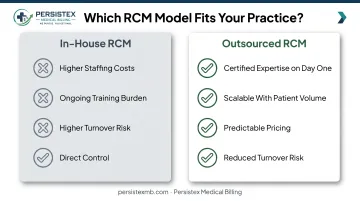
Keeping billing in-house means direct, day-to-day control over every claim and every staff decision. For larger practices with the budget to build a full team, that control can be valuable.
The tradeoffs:
- Salaries for certified coders and billers add up quickly, especially for professionals with multiple credentials
- Training staff on annual code changes and payer policy updates takes ongoing time and money
- Turnover hits hard: billing and coding roles see above-average attrition, and losing a trained biller means retraining from scratch
The Case for Outsourcing
Outsourcing trades some day-to-day control for access to a team that's already certified, trained, and scaled.
- Certified expertise on day one — no ramp-up training a new hire on your specialty's coding quirks
- Scalability as volume adjusts with patient load, without a hiring or layoff decision
- Predictable costs through percentage-based or flat-rate pricing, without long-term contracts
When Outsourcing Makes the Most Sense
Outsourcing tends to pay for itself fastest for:
- Growing practices adding providers faster than their billing team can absorb
- Practices with denial rates climbing above the 5-7% acceptable range
- Specialty practices, like behavioral health, where coding requires training most generalist billers simply don't have
That gap is what Persistex Medical Billing was built to close. The team holds CPC and CPB certifications through AAPC, plus RHIT and CCS credentials through AHIMA, and maintains a 98% clean claim rate with a 40% average reduction in denied claims.
Instead of rotating call-center staff, Persistex assigns dedicated account teams who know each practice's specialty — from behavioral health session limits to chiropractic care-plan authorizations — and answer the phone directly.
Frequently Asked Questions
What is the RCM process in medical billing?
RCM spans patient registration, eligibility verification, coding, claims submission, payment posting, and denial management. It's the full financial lifecycle of a patient encounter, not just the billing step.
What's the difference between medical billing and revenue cycle management?
Billing is one component, covering claims and payer follow-up. RCM covers the entire financial journey, from the moment a patient is scheduled through the moment their balance is fully resolved.
What are the most important RCM KPIs to track?
Clean claim rate, days in A/R, denial rate, and net collection rate are the four core metrics. Together, they reveal whether your revenue cycle is healthy or leaving revenue uncollected.
Why do claims get denied, and how can RCM reduce denials?
Common causes include coding errors, missing prior authorization, and eligibility issues. Proactive RCM processes, like real-time eligibility checks and claim scrubbing, catch these problems before submission instead of after a denial.
Should a small practice outsource RCM or manage it in-house?
Outsourcing is often more cost-effective for smaller or specialty practices that can't justify a full in-house billing team. The right call still depends on practice size, in-house expertise, and current denial rates.
How does RCM differ for specialties like behavioral health?
Behavioral health and similar specialties need specific CPT codes, stricter session-limit and prior-authorization rules, and coders with specialty training. Generalist billers without that background tend to produce far more preventable denials.