
Introduction
A denied claim doesn't announce itself. It just sits there, unpaid, while a practice keeps seeing patients and covering payroll as if the money is already in the bank.
MGMA's 2023 data puts the first-submission denial rate for single-specialty medical groups at 8%, a figure that hasn't budged since 2019 despite years of software upgrades and staff training.
In a 2024 MGMA poll, 60% of medical-group leaders said denials had gotten worse over the past year, not better.
The practices that get paid fastest and most fully aren't lucky. They've built specific habits into their billing workflow.
This guide covers the core billing practices solo providers, multi-provider clinics, and specialty practices—including behavioral health—can use to stop revenue from leaking out the back door.
Key Takeaways
- Clean claims, accurate coding, and fast follow-up form the foundation of a healthy revenue cycle
- Denial management and weekly A/R monitoring recover money most practices simply write off
- Behavioral health billing carries coding and authorization rules generic billing staff often miss
- Outsourcing to a specialty billing partner is now a mainstream way to protect and grow revenue
Overview of Medical Billing's Role in Practice Revenue
Medical billing, or revenue cycle management (RCM), covers everything between a patient booking an appointment and the practice collecting payment. That span includes:
- Eligibility checks
- Coding
- Claim submission
- Denial follow-up
- Patient collections
Every step is a potential point of failure. A single missed authorization or mistyped policy number can turn a fully payable claim into an unpaid one.
The 8% denial benchmark from MGMA isn't a rounding error. On a practice billing several hundred thousand dollars a month, that share is real, recoverable cash sitting in limbo.
The sections below cover the specific practices most tied to faster payment, fewer denials, and stronger monthly cash flow.
Best Medical Billing Practices to Maximize Revenue
These aren't generic tips pulled from a billing textbook. Each practice below addresses a specific, common point where claims stall or get rejected, based on where revenue leakage most frequently occurs.
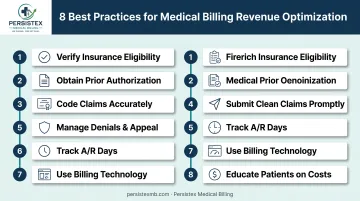
Verify Patient Insurance Eligibility and Information Upfront
Eligibility and registration errors remain a top-cited cause of denials. In an MGMA poll of 619 practice leaders, 29% named demographic issues as their number one denial reason.
The fix is simple but easy to skip: verify coverage before every visit, not just at intake. Patients switch plans, lose coverage, or hit deductible resets without telling anyone.
| Category | Details |
|---|---|
| Key Action | Verify coverage, copay, and demographic data before each appointment via payer portal or clearinghouse |
| Revenue Impact | Fewer front-end rejections and faster first-pass claim acceptance |
| Tools/Resources | Real-time eligibility verification tools integrated with your EHR/practice management system |
Obtain Prior Authorization When Required
Skip a required authorization and the claim is denied. No amount of clean coding will save it. Specialty services and many imaging, therapy, and procedure codes still need documented medical necessity on file before the visit.
The administrative weight here is real. AMA's 2024 survey found physicians average 43 prior authorization requests per week, consuming 12 staff hours, with 27% of requests often or always denied on first submission.
Disciplined tracking changes that math. Persistex maintains a 95% prior authorization approval rate, built on dedicated tracking of payer-specific requirements rather than reactive scrambling after a denial arrives.
| Category | Details |
|---|---|
| Key Action | Confirm authorization requirements and submit documentation before service delivery |
| Revenue Impact | Eliminates avoidable denials tied to missing or expired authorizations |
| Tools/Resources | Payer authorization portals, dedicated pre-auth tracking logs or software |
Code Claims Accurately With Certified Coders
Undercoding leaves money on the table. Upcoding invites audits. Vague documentation causes both. Specialty coding raises the stakes further. Behavioral health encounters, for example, often pair E/M and psychotherapy codes with strict time, modifier, and medical-necessity rules that generalist staff miss.
Certified coders catch what generalist staff often miss. Persistex's CPC-certified coding team has reduced coding-related denials by an average of 35% for its clients through pre-submission audits and diagnosis-to-procedure validation.
| Category | Details |
|---|---|
| Key Action | Assign CPC/CCS-certified coders and double-check codes against documentation before submission |
| Revenue Impact | Higher first-pass claim acceptance and fewer compliance-related audits |
| Tools/Resources | Updated CPT/ICD-10 code sets, coding audit checklists |
Submit Clean Claims Promptly
A clean claim, meaning error-free and complete, gets paid on the first pass. A messy one bounces back and starts the clock over, sometimes right up against a payer's filing deadline.
Those deadlines vary more than most practices expect. Original Medicare allows 12 months. Cigna gives participating providers 90 days. Some state Medicaid programs, like Ohio's, allow up to 365 days. Waiting to submit is a needless gamble against rules that differ by payer.
| Category | Details |
|---|---|
| Key Action | Submit fully documented claims within 24-48 hours of the encounter |
| Revenue Impact | Shorter reimbursement cycles and reduced rework from resubmissions |
| Tools/Resources | Claims scrubbing software, automated submission workflows |
Manage Denials Proactively and Appeal Aggressively
Most denied claims are winnable, yet most practices never fight them. According to an AHIMA Journal analysis, as many as 60% of denied claims are never resubmitted at all.
The gap is follow-up, not coding skill or payer policy alone. Persistex's appeals process wins more than 72% of the claims it appeals, recovering revenue most practices would otherwise write off entirely.
| Category | Details |
|---|---|
| Key Action | Review every denial's reason code and resubmit or appeal within the payer's window |
| Revenue Impact | Recovers revenue that would otherwise be permanently lost |
| Tools/Resources | Denial tracking logs, payer appeal templates |
Track and Reduce Accounts Receivable (A/R) Days
A/R days measure how long it takes to collect after a service is rendered. AAPC identifies 40-50 days as the general industry performance metric, with anything past 60 days signaling below-average revenue-cycle health.
Claims aging past 90 days rarely get collected at all. Weekly aging reports with assigned follow-up ownership catch problems while they're still fixable. Persistex clients typically move from around 90 days in A/R down to roughly 30, well inside the healthy range.
| Category | Details |
|---|---|
| Key Action | Run weekly A/R aging reports and assign follow-up on claims over 30 days |
| Revenue Impact | Faster, more predictable cash flow and fewer uncollectable balances |
| Tools/Resources | A/R aging dashboards, automated payment reminders |
Use Billing Technology and Transparent Reporting
Manual billing invites errors that compound quietly for months. Integrated EHR/practice management software catches mistakes before submission and gives real-time visibility into where claims actually stand.
Dashboards tracking clean claim rate, denial rate by payer, and collections trends let a practice spot a problem in week one instead of discovering it in month three.
| Category | Details |
|---|---|
| Key Action | Adopt EHR-integrated billing software with real-time claim tracking |
| Revenue Impact | Earlier error detection and data-driven revenue decisions |
| Tools/Resources | Platforms like AdvancedMD, Kareo, athenahealth, DrChrono, TherapyNotes |
Educate Patients on Costs and Payment Options
Patients who don't understand what they owe tend not to pay quickly, or at all. Upfront cost estimates remove the guesswork, and flexible payment options remove the excuse to delay.
Payment preferences have also shifted. Surveys increasingly show patients would rather settle a medical bill through a text link or online portal than write a check and mail it in.
| Category | Details |
|---|---|
| Key Action | Provide upfront cost estimates and offer digital/flexible payment options |
| Revenue Impact | Higher patient-portion collection rates and fewer bad debt write-offs |
| Tools/Resources | Patient payment portals, text-to-pay and payment plan tools |
Common Billing Mistakes That Quietly Erode Revenue
Most revenue loss isn't one dramatic failure. It's a stack of small, repeated errors that never get fixed because no one's tracking them.
The usual suspects:
- Treating eligibility checks as a one-time intake task instead of a per-visit habit
- Under-training staff as CPT/ICD-10 codes get updated year over year
- Never analyzing denial patterns, so the same mistake repeats claim after claim
- Losing track of payer-specific filing deadlines across multiple insurers
Specialty practices feel this hardest. Behavioral health billing has strict rules around time-based psychotherapy codes, and primary care has its own traps with vaccine and well-visit coding. Generic billing staff without specialty training miss these details constantly—and each miss is a denial waiting to happen.
Why Partnering With a Specialized Billing Team Amplifies These Results
Knowing these best practices is one thing. Executing all of them, consistently, on top of running a practice, is another. Most solo providers and small clinics simply don't have the staff hours or specialty-specific coding knowledge to do it well in-house.
That gap is exactly what Persistex Medical Billing was built to close. Based in Massachusetts and serving practices nationwide, Persistex is an RCM partner built around behavioral health and multi-specialty outpatient billing, staffed by a team holding CPC, CPB, RHIT, and CCS certifications.
What client practices typically see:
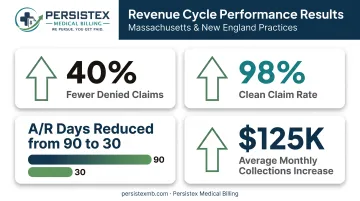
- 40% fewer denied claims on average
- A 98% clean claim rate across all clients
- A/R days cut from roughly 90 to 30
- An average $125K monthly collections boost
One multi-provider clinic director, Dr. Michelle L., put it directly: "We were drowning in denied claims before Persistex. Now our clean claim rate is above 97% and we've recovered over $200K in previously lost revenue."
Beyond the numbers, the model itself is different from most billing vendors:
- Full integration with AdvancedMD, Kareo, athenahealth, DrChrono, and TherapyNotes
- Percentage-based or flat-rate pricing with no long-term contracts
- Dedicated named account teams instead of rotating call-center staff
That last point matters more than it sounds. A named team that knows your specialty follows up on denials the same week they happen, not whenever a ticket queue gets around to it. That same-week follow-up is often what turns a denial into collected revenue instead of a quiet write-off.
Conclusion
None of this comes down to brand reputation or a single silver-bullet fix. Consistent execution is what separates practices with predictable revenue from those constantly chasing unpaid claims.
Start by auditing three numbers: your clean claim rate, your denial rate, and your average A/R days. Those three figures will tell you honestly whether in-house improvements can close the gap, or whether a specialized billing partner would get you there faster.
If you want a clearer read on where revenue is slipping, Persistex Medical Billing offers a revenue cycle assessment that pinpoints the gaps. Reach out at contact@persistexmb.com to get started.
Frequently Asked Questions
What are the three types of billing?
Professional billing covers physician and provider services (CMS-1500 form). Institutional or facility billing covers hospitals and facilities (UB-04 form). Self-pay billing refers to patients paying out of pocket without using insurance.
What is the most common mistake in medical billing?
Inaccurate or incomplete patient and insurance information at intake is the leading cause of denials, closely followed by coding errors and missed authorization requirements.
How can a medical practice reduce claim denials?
Verify eligibility before every visit, code accurately with certified staff, submit clean claims quickly, and appeal every denial promptly. Those four steps prevent most avoidable denials.
What is a clean claim rate and why does it matter?
It's the percentage of claims paid on first submission without errors or missing information. A higher rate means faster payment, steadier cash flow, and far less staff time on rework.
How long should follow-up on unpaid claims take?
Best practice is to follow up within 30 days of a denied or unpaid claim, with weekly A/R aging reviews so problems get caught before they age past easy recovery.
Should small practices outsource their medical billing?
Outsourcing often makes sense for practices that lack in-house coding expertise or time, especially for specialty billing such as behavioral health. Weigh the cost against your budget and how much control you want to keep.