Introduction
Medical practices lose real money to denied claims every day. MGMA's 2023 DataDive found that single-specialty practices face an average first-submission denial rate of 8%. Delayed payments and understaffed billing offices compound the hit. The financial strain shows up fast.
Payer rules aren't getting simpler either. The AMA's 2024 physician survey found that 84% of physicians reported more medication prior authorizations over the past five years. Staffing shortages in billing departments have pushed many providers toward specialized partners instead of managing everything in-house.
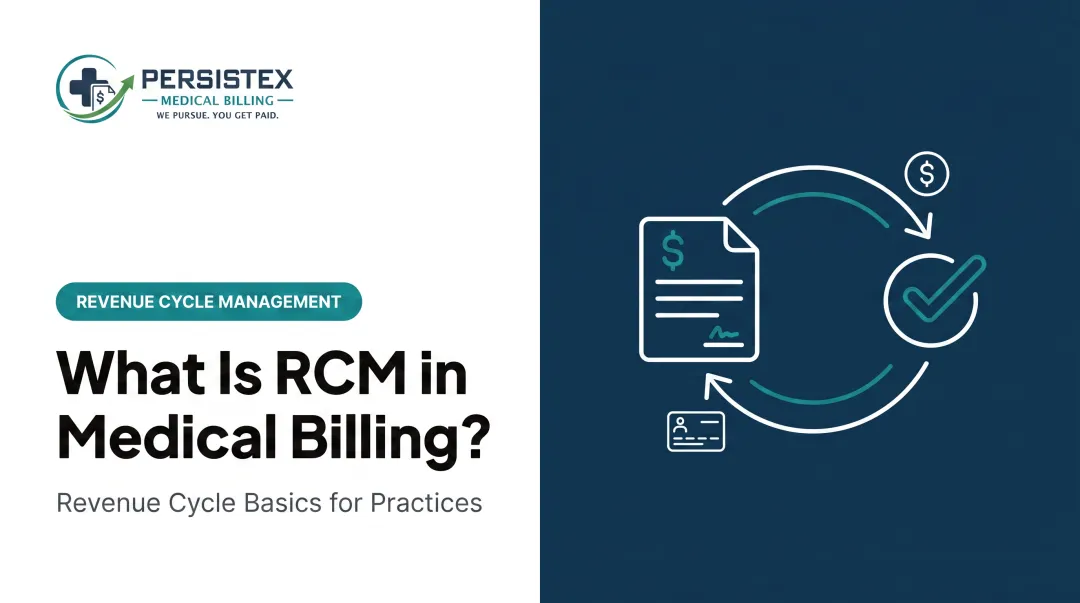
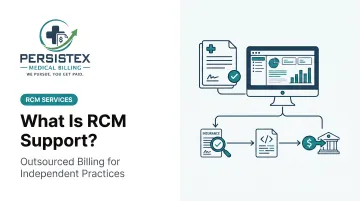
RCM support is what most practices use to close those gaps. It's the mix of people, processes, and technology that runs the full patient-to-payment journey—from the appointment booking to the day the balance is paid in full.
This article covers what RCM support actually means, the 12-step revenue cycle behind it, the benefits practices see, and how to pick the right partner.
Key Takeaways
- RCM support manages every step from registration to final payment, not just claim submission
- Full-cycle RCM spans 12 front-end, mid-cycle, and back-end steps where revenue is won or lost
- Specialized RCM partners cut denials by up to 40% and shrink A/R from 90 days to 30
- Certified coders and clear reporting reduce compliance risk and smooth the patient billing experience
What Is RCM Support?
HFMA defines revenue cycle management as the process that tracks patient revenue from the initial appointment through final payment of the balance. RCM support is what happens when a dedicated team actually runs that process for a practice on every encounter.
RCM support is a continuous cycle that touches registration, eligibility, coding, claims, denials, and collections, then feeds performance data back into the next round of encounters.
"Support" refers to the people and systems doing that work behind the scenes: billing specialists, certified coders, and accounts receivable (AR) analysts, backed by software that flags errors before they become denials. Providers see patients; someone else chases the money.
What Does RCM Stand For?
RCM stands for Revenue Cycle Management. It's called a "cycle" because the process repeats for every single patient encounter, starting with scheduling and ending with payment resolution, whether that payment comes from an insurer, the patient, or both.
Each cycle also generates data. Denial patterns, AR aging, and collection rates from one round of claims inform how the next round gets handled, which is why RCM works best as an ongoing system rather than a one-off fix.
How RCM Support Differs From Basic Medical Billing
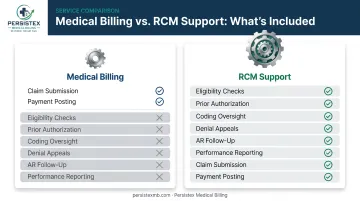
Medical billing is one function inside RCM: preparing and submitting claims, then applying payments once they arrive. RCM support covers far more ground.
| Function | Medical Billing | RCM Support |
|---|---|---|
| Claim submission | ✅ | ✅ |
| Payment posting | ✅ | ✅ |
| Insurance eligibility checks | ❌ | ✅ |
| Prior authorization management | ❌ | ✅ |
| Coding oversight and audits | ❌ | ✅ |
| Denial appeals | Limited | ✅ |
| AR follow-up at scale | Limited | ✅ |
| Performance reporting | ❌ | ✅ |
Think of billing as one gear in a much larger machine. RCM support is the entire machine, including the parts that catch problems before a claim is ever submitted.
Who Delivers RCM Support
Practices generally get RCM support through one of three models:
- Internal billing staff who handle claims alongside other front-desk duties
- Generic billing vendors that process claims but rarely specialize by practice type
- Specialized RCM partners with certified staff and specialty-specific workflows
The strongest teams hold recognized credentials such as CPC (Certified Professional Coder), CPB (Certified Professional Biller), RHIT (Registered Health Information Technician), and CCS (Certified Coding Specialist), and they operate under HIPAA-compliant processes.
Persistex Medical Billing, for example, assigns each client a dedicated, U.S.-based account team rather than routing calls through a rotating queue.
Its coders and billers hold CPC, CPB, RHIT, and CCS credentials, and the company's denial-management process (root cause analysis followed by multi-level appeals) has produced a documented appeals success rate above 72%.
The 12 Steps of RCM Support Explained
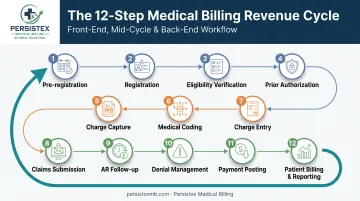
The revenue cycle is typically broken into 12 sequential steps, grouped into three stages: front-end, mid-cycle, and back-end.
| Stage | Step # | Activity |
|---|---|---|
| Front-end | 1 | Pre-registration |
| Front-end | 2 | Registration and demographics capture |
| Front-end | 3 | Insurance eligibility verification |
| Front-end | 4 | Prior authorization |
| Mid-cycle | 5 | Charge capture |
| Mid-cycle | 6 | Medical coding (ICD-10, CPT, HCPCS) |
| Mid-cycle | 7 | Charge entry and claim creation |
| Back-end | 8 | Claims submission |
| Back-end | 9 | AR follow-up |
| Back-end | 10 | Denial management and appeals |
| Back-end | 11 | Payment posting and reconciliation |
| Back-end | 12 | Patient billing, collections, and performance reporting |
Front-End Steps (Patient Access)
Steps 1 through 4 happen before a claim is even created. Pre-registration and demographics capture set the foundation. Eligibility verification confirms the patient's coverage is active. Prior authorization clears services that need payer approval in advance.
Errors here are the leading cause of downstream denials. A mistyped member ID or a missed authorization at step 4 can void a claim weeks later, no matter how clean the coding was.
Mid-Cycle Steps (Charge Capture & Coding)
Steps 5 through 7 translate the clinical encounter into billable data. Charge capture logs what was done. Coding assigns the correct CPT, ICD-10, and HCPCS codes. Charge entry turns that coding into a submittable claim.
Coding accuracy directly determines reimbursement. Persistex's certified coders maintain 99.2% coding accuracy and help clients cut coding-related denials by 35%, largely by validating diagnosis-to-procedure linkage before a claim leaves the building.
Back-End Steps (Billing, Collections & Analytics)
Steps 8 through 12 close the financial loop:
- Claims submission — sends the finished claim to the payer
- AR follow-up — tracks unpaid claims at 30-, 60-, and 90-day intervals
- Denial management — investigates and appeals rejected claims
- Payment posting — reconciles what was paid against what was billed
- Patient billing and reporting — collects remaining balances and measures performance
Specialized RCM support providers manage all 12 steps end-to-end as one accountable process. That differs from fragmented handling, where a front-desk employee owns eligibility, a separate coder handles charts, and no one owns the denial once it lands.
Gaps between handoffs are where revenue quietly disappears.
Key Benefits of RCM Support for Medical Practices
Fewer denials. Proactive eligibility checks and claim-scrubbing catch errors before submission instead of after rejection. Persistex's own case data shows this in action: an eight-provider behavioral health clinic with a 35% denial rate saw denials drop by 40% after implementing full-cycle RCM support.
Faster reimbursement. Consistent A/R follow-up and structured appeals shorten payment timelines. One documented Persistex outcome cut a client's average A/R from 90 days to 30. That predictability makes payroll and overhead planning far less stressful.
Time back for providers. Outsourcing the administrative burden frees up hours that used to disappear into billing software. A solo psychiatry practice reported saving 15+ hours per week after outsourcing, along with a 28% revenue increase in the same period.
Collections growth. Full-cycle RCM compounds results over time. Reported outcomes include:
- A 32% average collections increase across RCM clients
- A $125,000 average monthly collections boost from strong RCM execution
- One multi-provider clinic recovering more than $200,000 in previously lost revenue
Lower compliance risk. Certified coders (CPC, CPB, RHIT, CCS) run pre-submission chart audits that catch undercoding, overcoding, and documentation gaps before they become audit liabilities. The same reviews keep claims aligned with payer-specific rules and HIPAA requirements.
Better patient experience. Real-time eligibility checks before appointments give patients a clearer picture of what they'll owe. Transparent dashboards also let practice owners track every claim in flight. As one Persistex client, Dr. David R., put it: "I can see exactly where every dollar is in the revenue cycle."
Signs Your Practice Needs RCM Support
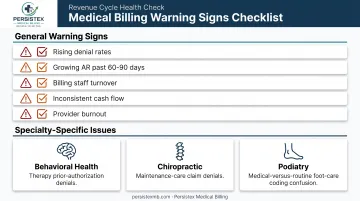
Some warning signs are hard to miss once you know what to look for:
- Rising denial rates that keep creeping upward each quarter
- Growing accounts receivable with claims sitting unpaid past 60 or 90 days
- Staffing shortages or turnover in the billing office
- Inconsistent cash flow from month to month
- Provider burnout from chasing paperwork instead of patients
Specialty-specific issues compound the problem:
- Behavioral health: session-limit authorizations and ongoing re-authorization paperwork
- Chiropractic: care-plan tracking and correct modifiers on CMT codes 98940 through 98943
- Podiatry: routine foot-care coverage rules that generic billing staff often misread
Even well-performing practices aren't immune. A professional RCM assessment can uncover hidden revenue leakage a busy front office never had time to notice, whether an authorization quietly expired or a payer contract has been underpaying for months.
In-House vs. Outsourced RCM Support: Which Is Right for You?
| Factor | In-House | Outsourced |
|---|---|---|
| Control | Direct, immediate | Requires trust and communication |
| Staffing cost | Salaries, benefits, turnover risk | Included in service pricing |
| Technology investment | Practice pays and maintains | Partner typically provides |
| Certified expertise | Depends on hiring | Built into the partnership |
| Scalability | Limited by headcount | Flexible with practice growth |
| Contract flexibility | N/A | Varies by provider |
In-house billing gives practices direct control over their process. The tradeoff is real: staffing costs, turnover, and the burden of keeping billing software and payer rules current all fall on the practice.
Outsourced RCM support gives practices access to certified experts and scalable capacity without adding headcount. The main tradeoff is that it requires clear communication and trust in an external partner. Pricing models vary, and some, like Persistex, offer flexible percentage-based or flat-rate pricing with no long-term contracts required.
A hybrid approach works well for many practices. Keep front-desk functions such as scheduling and check-in in-house, while outsourcing coding, denial management, and A/R follow-up to a specialized partner who handles those functions daily.
How to Choose the Right RCM Support Partner
Not every billing vendor fits every practice. A few things worth checking before signing anything:
- Specialty-specific expertise. Behavioral health billing, general outpatient billing, and family medicine coding all have different quirks. A generic, one-size-fits-all vendor often misses them.
- Verified credentials. Look for CPC, CPB, RHIT, or CCS certifications on the team, plus U.S.-based, HIPAA-compliant operations.
- Transparent reporting. Ask to see a sample dashboard before committing. If a vendor can't show real-time denial rates, A/R aging, and collections trends, that's a red flag.
- EHR and PM integration. Partners that connect directly with systems like AdvancedMD, Kareo, athenahealth, DrChrono, or TherapyNotes cause less disruption during onboarding.
- Flexible pricing. Providers offering flexible rates with no long-term contracts (the model Persistex follows) let practices of any size access the same caliber of RCM support usually reserved for large hospital systems.
Frequently Asked Questions
What does RCM stand for?
RCM stands for Revenue Cycle Management, the end-to-end financial process that tracks patient care from scheduling through final payment. It covers eligibility, coding, billing, and collections in one continuous cycle.
What are the 12 steps of RCM?
Most frameworks group about a dozen steps into three phases: front-end (scheduling, registration, eligibility, prior auth), mid-cycle (charge capture, coding), and back-end (claims, payment posting, denials, A/R, reporting). Each step feeds the next across a care episode.
What is the difference between RCM support and medical billing?
Medical billing is one function within RCM: submitting claims and posting payments. RCM support also covers eligibility verification, coding oversight, denial management, and performance reporting.
How much does RCM support typically cost?
Pricing models vary between percentage-based and flat-rate structures, depending on practice size and claim volume. Many providers, including Persistex, offer flexible pricing with no long-term contracts required.
Can small or solo practices benefit from RCM support?
Yes. RCM support scales from solo practitioners to large multi-provider clinics, giving smaller practices access to the same end-to-end revenue management larger health systems use.
How soon can a practice see results after starting RCM support?
Many practices see measurable improvements in denials and collections within 30 to 60 days of onboarding. Denied-claim recovery and A/R cleanup often begin even sooner.