That burden shows up everywhere: denied claims piling up, front-desk positions sitting empty for months, compliance rules shifting faster than staff can track them. Providers end up doing paperwork instead of seeing patients.
Healthcare business process outsourcing (BPO) has become the go-to fix. This article breaks down what it actually means, the main types of services available, the benefits practices see, and how to pick a partner that won't let you down.
Key Takeaways
- Healthcare BPO delegates non-clinical work (billing, coding, IT, patient support) to specialized outside experts
- Core workstreams cover financial/RCM, clinical support, IT infrastructure, and patient engagement
- Practices gain cost savings, stronger compliance, staffing flexibility, and faster cash flow
- Choose partners with healthcare-specific experience, verified HIPAA compliance, and transparent reporting
- Specialty billing partners often beat generic BPO providers on niche coding and payer rules
What Is Healthcare Business Process Outsourcing?
Business process outsourcing means hiring an outside company to handle a function you'd otherwise manage internally. In healthcare, that means non-clinical work (the paperwork, the phone calls, the claims), not patient treatment itself.
Clinical decisions stay in-house. Diagnosis, treatment plans, and direct patient care remain with your providers, always. What moves to a BPO partner is everything around those decisions:
- Medical billing and coding
- Claims submission and follow-up
- Scheduling and registration
- IT infrastructure and data security
- Patient communication and call center support
Healthcare BPO isn't just software you buy and install. It pairs trained specialists (certified coders, billing experts, compliance officers) with automation tools that speed up repetitive tasks. The people matter as much as the technology, sometimes more.
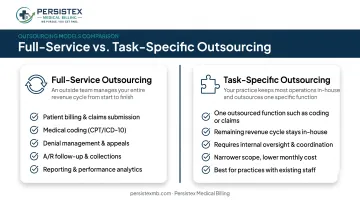
Practices can outsource in two ways: full-service (an outside team runs your entire revenue cycle end-to-end) or task-specific (you hand off just one piece, like claims processing or coding, and keep the rest in-house).
Why Adoption Is Accelerating
The global healthcare BPO market is projected to grow from $423.1 billion in 2026 to $756.55 billion by 2034, a 7.5% compound annual growth rate, according to Fortune Business Insights. Rising claim complexity, tighter payer rules, and persistent staffing gaps are driving that growth.
Types of Healthcare BPO Services
Not all outsourcing looks the same. Practices typically choose from four broad categories, often mixing more than one.
Financial & Revenue Cycle Management (RCM) Outsourcing
This is the most common entry point. RCM outsourcing covers:
- Medical billing and claims submission
- CPT/ICD-10/HCPCS coding
- Denial management and appeals
- Accounts receivable follow-up
Generic billing vendors handle the basics fine. But specialty RCM partners like Persistex Medical Billing focus on behavioral health and outpatient billing. Niche CPT codes and payer-specific rules demand deeper expertise than a one-size-fits-all vendor typically offers.
Clinical & Administrative Support Outsourcing
This category covers the back-office tasks that eat up staff hours without touching patient treatment:
- Medical transcription
- Data entry and chart prep
- Patient scheduling
- Registration and intake
IT & Data Infrastructure Outsourcing
Healthcare organizations outsource IT because the stakes have gotten too high to manage casually. EHR systems require constant updates. Cybersecurity threats target healthcare data specifically because it's valuable and, frankly, often under-protected.
Maintaining an in-house team capable of managing EHR uptime, patching vulnerabilities, and meeting HIPAA's technical safeguards is expensive. Outsourced IT partners spread that cost across many clients, which makes advanced security and compliance affordable for smaller practices.
Patient Engagement & Call Center Outsourcing
Practices use this category to keep phones answered and messages returned without hiring overnight staff:
- Outsourced answering services
- Telehealth technical support
- 24/7 patient communication lines
Why Healthcare Organizations Are Turning to BPO
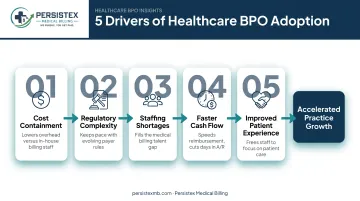
Five forces are pushing practices toward outsourcing, and they tend to compound each other.
Cost containment. Outsourcing converts fixed administrative overhead (salaries, benefits, training, software licenses) into flexible, scalable spend. MGMA identifies financial uncertainty, cash-flow continuity, compliance demands, and access to skills unavailable in-house as the key factors practices weigh before making the switch.
Regulatory complexity. HIPAA, CMS rules, and payer policies change constantly. A dedicated outsourcing partner tracks those shifts full-time; an overworked office manager can't.
Staffing shortages. Front-office turnover hit 40% in MGMA's 2023 aggregate across primary care, surgical, and nonsurgical practices. BPO fills that gap without a six-month hiring cycle.
Faster, more predictable cash flow. Persistex clients show the payoff clearly: one behavioral health clinic cut average A/R to 22 days and reduced denials by 40%, adding $85,000 in monthly revenue. Results vary, but the pattern (fewer denials, faster payment) shows up consistently with specialized RCM partners.
Improved patient experience. When front-office staff aren't buried in claims corrections, they can actually focus on the person standing in front of them.
Common Challenges & How to Choose the Right BPO Partner
Outsourcing isn't risk-free. Three concerns come up most often:
Common Outsourcing Concerns
- Data security and HIPAA risk: handing PHI to a third party requires trust and verification
- Loss of process control: practices worry about losing visibility into their own billing
- Staff resistance: internal teams sometimes view outsourcing as a threat to their jobs
None of these are dealbreakers, but they need to be addressed directly.
Mitigation Strategies That Work
- Insist on clear SLAs with defined response times
- Require real-time, transparent reporting dashboards — not black-box summaries
- Roll out changes in phases, with staff training built into the transition
What to Look for in a Partner
| Criteria | Why It Matters |
|---|---|
| Healthcare-specific experience | Generic BPO firms miss specialty nuance |
| Verified HIPAA compliance | Protects you from shared liability |
| EHR/PM system integration | Avoids duplicate data entry and delays |
| Transparent, no-hidden-fee pricing | Prevents surprise costs later |
A phased onboarding (audit, custom strategy, integration, then ongoing optimization) reduces friction for existing staff far more than an abrupt switch.
Why Specialty Expertise Matters for Billing & RCM Outsourcing
Generic BPO providers can process a claim. What they often can't do is navigate the coding nuances that specific specialties demand.
Behavioral health billing, for example, requires fluency in psychotherapy codes 90832–90838, psychiatric evaluation codes 90791/90792, session-limit authorizations, and telehealth billing rules: territory that trips up billers who mostly handle general E/M claims.
This is where a specialized partner like Persistex Medical Billing adds value. Its coders hold CPC, CPB, RHIT, and CCS certifications and work with dedicated named account teams rather than rotating call-center staff. Documented outcomes across its behavioral health and outpatient clients include:
- 98% clean claim rate across all clients
- 72%+ appeals success rate on denied claims
- 40% fewer denials at one multi-provider behavioral health clinic
- $85,000 monthly revenue increase for that same clinic
- Average A/R days reduced from 90 to 30
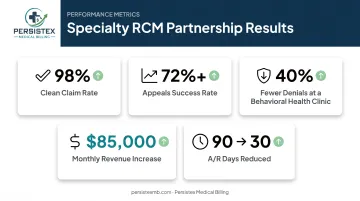
Niche coding knowledge and payer-specific experience cut denials and speed payment—the practical gap between specialty-focused RCM partners and generic outsourcing vendors.
Frequently Asked Questions
What is a BPO in healthcare?
A healthcare BPO is a third-party company that handles non-clinical administrative functions — billing, coding, data entry, scheduling — so practices can focus on patient care instead of paperwork.
What are the four types of BPO?
In healthcare, BPO typically covers four function types: financial, clinical, IT, and patient engagement. Providers also classify work by delivery location — onshore, nearshore, or offshore — according to IBM's overview.
Why are healthcare companies outsourcing IT?
Cybersecurity demands, EHR maintenance, and the cost of running an in-house IT team have made outsourcing more practical. Specialized IT vendors spread security investment across many clients, making stronger protection affordable.
Is healthcare BPO HIPAA compliant?
Reputable providers operate as HIPAA business associates, meaning they sign agreements committing to encryption, access controls, breach reporting, and regular audits. Vendors remain directly liable for violations, not just the practice.
How much can a medical practice save by outsourcing billing or RCM?
Savings vary by practice, but they typically come from fewer denials, faster collections, and eliminating in-house billing overhead. Some Persistex clients have reported monthly revenue increases in the tens of thousands of dollars.
Is healthcare BPO only useful for large hospitals, or can small practices benefit too?
Small practices often see the biggest relative impact. Outsourcing gives solo practitioners access to certified coders and dedicated account teams without building a full in-house billing department.