
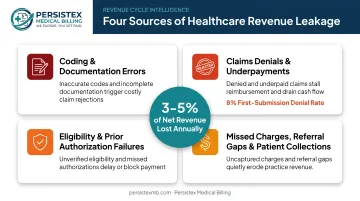
The scale isn't small. Hospitals lose an estimated 3% to 5% of net revenue every year to leakage, according to HFMA, and independent practices face many of the same structural gaps, just with less cash buffer to absorb the loss.
Behavioral health and TMS practices carry extra risk. Complex prior authorizations, niche CPT codes, and heavier payer scrutiny make leakage more likely and harder to spot.
This guide breaks down where leakage actually comes from, what happens when it goes unchecked, and the concrete steps that protect your revenue and your ability to focus on patient care.
Key Takeaways
- Revenue leakage is earned income you never collect, not a planned write-off or contractual adjustment.
- Coding mistakes, unresolved denials, eligibility failures, and weak patient collections drive most of the loss.
- Left unchecked, leakage shrinks margins and burns out staff.
- Real-time eligibility checks, certified coding, and proactive appeals close most gaps before cash stalls.
- Routine audits and the right billing partner keep leakage from creeping back.
Common Causes of Healthcare Revenue Leakage
Revenue leakage is money your practice legitimately earned for services rendered but never actually collects. That's different from an expected write-off or bad debt, where you've already decided a balance is uncollectible. Leakage is money you should have received, often lost because nobody caught the problem in time.
It rarely comes from one big mistake. Leakage typically stems from small breakdowns stacking up across the revenue cycle: at the front desk during registration, in the middle of the coding and claims process, and on the back end during collections.
Coding and Documentation Errors
Manual coding slips, outdated CPT or ICD-10 codes, and clinical notes that don't fully support the billed service are a fast track to denials and underpayments. A code that was valid last year but got revised in the annual update can deny an entire batch of claims.
Specialty billing multiplies this risk. Behavioral health codes such as psychotherapy add-ons and psychiatric evaluations (90791/90792) need precise modifier use and medical-necessity documentation that generalist coders often lack. Miss one detail and the claim bounces.
Certified, specialty-trained coders make a measurable difference. Persistex's AAPC- and AHIMA-credentialed team maintains 99.2% coding accuracy and has helped clients cut coding-related denials by an average of 35% by validating diagnosis-to-procedure linkage before claims go out.
Claims Denials and Underpayments
Every denied claim delays revenue at best and erases it at worst. MGMA's 2023 DataDive data found single-specialty practices see an 8% first-submission denial rate on average — roughly one in twelve claims bounces back before you've collected a dime.
Denials get the attention, but underpayments do just as much damage. When a payer reimburses below your negotiated contract rate, there's often no red flag; the claim shows as "paid," so nobody questions it. Without systematic remittance audits comparing what you were paid against what your contract promised, those shortfalls pile up unnoticed.
Eligibility and Prior Authorization Failures
Skip an eligibility check or mishandle a prior authorization, and you can deliver a service that's simply never covered. That balance typically becomes uncollectible: the patient never consented to pay out of pocket, and the payer has no obligation to reimburse an unapproved service.
Behavioral health practices feel this acutely:
- Session-limit authorizations that expire mid-treatment
- Telehealth-specific coverage rules that vary by payer
- Medical-necessity documentation requirements tied to each authorization request
- Re-authorization deadlines that, if missed by even a day, turn covered sessions into write-offs
Missed Charges, Referral Gaps, and Patient Collections
Some leakage never even makes it to a claim. A service gets performed but never charted for billing. A patient gets referred for a follow-up and never schedules it. A balance sits unpaid past 120 days until it's effectively dead money.
Patient collections have gotten harder, too. KFF's 2024 Employer Health Benefits Survey found 87% of covered workers are enrolled in plans with a general annual deductible, averaging $1,787 for single coverage, with nearly a third carrying deductibles of $2,000 or more. That's a lot of the bill landing on the patient, not the payer. If your billing isn't clear about what's owed and when, plenty of that balance never gets collected.
What Happens If Revenue Leakage Is Ignored
Ignored leakage doesn't stay small. A gap that costs a few hundred dollars a month in year one becomes a structural hole in your margins by year three. The same root causes keep generating the same losses, claim after claim.
The downstream effects show up in ways that feel disconnected from billing at first:
- Practices can't afford to hire or retain skilled staff
- Providers compensate by seeing more patients, which accelerates burnout
- Growth stalls because there's no cash buffer for a new hire, location, or technology upgrade
- Training budgets shrink, so the same errors keep repeating
Warning Signs You're Losing Revenue to Leakage
Watch for these patterns before leakage becomes a crisis:
- Rising A/R days beyond 45–60 days: collections are slowing, not just fluctuating
- Growing denial rate or backlog of unappealed denials: earned money sitting unclaimed
- Inconsistent monthly collections despite steady patient volume: the process is broken, not the patient load
How to Prevent Revenue Leakage
Preventing leakage takes a layered system—one that catches problems at multiple points before they turn into lost revenue.
Real-Time Eligibility and Prior Authorization Verification
Verifying coverage and authorization before every visit closes the single biggest front-end leakage gap. When eligibility is confirmed and authorization is in hand before a patient walks in, you eliminate the risk of delivering a non-covered service.
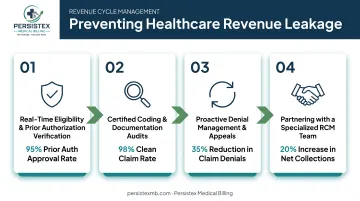
Doing this manually for every appointment, every day, is exhausting, and exhaustion is exactly when checks get skipped. Automated verification tools reduce that burden by flagging coverage issues automatically. Persistex builds real-time eligibility checks into every client's workflow before each appointment, contributing to a 95% prior authorization approval rate.
Certified Coding and Documentation Audits
Routine coding audits catch errors before a claim goes out the door, not after a denial letter comes back. Fixing a code before submission takes minutes. Appealing a denial takes weeks.
Specialty-certified coders make audits more effective. Coders holding AAPC CPC/CPB or AHIMA RHIT/CCS credentials understand the nuance of complex specialties—behavioral health, primary care, pediatrics—in a way generalist coders simply don't. Persistex's certified team validates diagnosis-to-procedure linkage on every claim before submission, contributing to a 98% clean claim rate across its client base.
Proactive Denial Management and Appeals
Tracking denial patterns and appealing every eligible claim recovers revenue that would otherwise be written off. Most practices can identify their top three or four denial reasons within a single quarter of tracking, and those same reasons usually account for the majority of denied dollars.
Persistence is the differentiator. Plenty of denied claims are simply abandoned rather than resubmitted, leaving recoverable revenue on the table. Persistex's denial management process combines root-cause analysis with multi-level appeals, and the team reports winning more than 72% of the appeals it files.
Partnering with a Specialized Revenue Cycle Management Team
Practices without in-house billing expertise are at a structural disadvantage. Niche payer rules, specialty coding requirements, and shifting documentation standards are hard to keep up with alongside running a clinical practice.
This is the gap a specialized RCM partner closes. Persistex, a Massachusetts-based, AAPC/AHIMA-certified billing team focused on behavioral health and outpatient specialty billing, reports outcomes such as:
- 40% fewer denied claims
- 98% clean claim rate
- Average A/R days cut from 90 to 30
One multi-provider clinic director recovered more than $200,000 in previously lost revenue after switching. Results like these come from a team that knows the coding, authorization, and payer rules these practices actually face—not from generic billing software alone.
Tips for Long-Term Prevention and Control
Fixing leakage once isn't the same as keeping it fixed. Long-term control depends on a few ongoing habits:
- Schedule routine leakage audits and monthly KPI reviews—denial rate, first-pass yield, and A/R days belong on a standing agenda, not an annual checklist
- Train staff continuously on coding standards, payer policies, and documentation rules as they change
- Keep real-time dashboards visible so billing teams catch trends (for example, a rising payer denial rate) while they're still small
- Use predictive denial flagging and automated eligibility checks to stop bad claims before submission
Persistex clients get real-time dashboards for collections trends, denial rates by payer, A/R aging, and payer performance. That visibility helps a practice catch a leak in month one instead of month six.
Conclusion
Revenue leakage isn't a mystery. It has identifiable root causes across registration, coding, denials, and collections, and every one of them is addressable with the right combination of process and expertise.
Practices that control leakage catch mistakes fast. They rely on routine audits, coding staff who understand their specialty, and technology that flags problems before submission instead of after denial.
Whether that means building the expertise in-house or partnering with a team that already has it, the goal is the same: turning leakage from an ongoing drain into a shrinking line item.
Frequently Asked Questions
How do you stop revenue leakage in healthcare?
Stopping leakage takes accurate front-end data collection, real-time eligibility verification, certified coding, and consistent denial appeals, usually backed by regular audits or a dedicated RCM partner. It's a layered process, not a single fix.
What is a revenue leakage audit in healthcare?
A revenue leakage audit systematically reviews registration, coding, claims, and collections data to find where earned revenue is slipping through. It typically benchmarks denial rates, missed charges, and underpayments against your contracted rates.
What does revenue leakage mean in healthcare?
Revenue leakage is the unintentional loss of money you've already earned—from billing errors, denials, underpayments, or process gaps—not revenue you deliberately wrote off.
What is another term for revenue leakage in healthcare?
You'll sometimes see it called "revenue loss" or "leakage in the revenue cycle." It's often confused with uncompensated care, but that term technically refers to charity care and bad debt.
How much revenue do healthcare practices typically lose to leakage each year?
Industry estimates put leakage at about 3% to 5% of net revenue each year. For an independent practice, that can mean tens or hundreds of thousands of dollars lost to preventable billing and collections gaps.
Is revenue leakage the same as claim denials?
No. Denials are one major cause, but leakage also includes missed charges, unverified eligibility, referral gaps, and patient balances that never get collected.