
That gap in understanding is costly. Incomplete billing knowledge leads to preventable denied claims, delayed reimbursement, and staff drowning in paperwork instead of patient care.
This guide breaks down what medical billing actually is, walks through the process step-by-step, clarifies how it differs from medical coding, and explains when outsourcing makes financial sense.
Key Takeaways
- Medical billing turns clinical care into claims and payment—the backbone of practice cash flow
- Coding and billing are separate but connected—mixing them up costs practices money
- Front-end errors like bad eligibility checks are a leading cause of back-end denials
- Specialty practices, especially behavioral health, face stricter coding and authorization rules
- Rising denials or staff burnout are strong signals it's time to consider outsourcing
What Is Medical Billing?
Medical billing is the process of turning a patient's diagnosis and treatment into a formal claim, then submitting that claim to an insurance payer (or the patient directly) for payment. It's the financial translation layer between clinical care and getting paid for it.
Three parties are involved in nearly every transaction:
- The patient – receives care and may owe a portion of the cost
- The healthcare provider – delivers services and submits documentation of what was done
- The payer – the insurance company (or government program) that reviews the claim and reimburses the provider
Money flows from payer to provider, with the patient covering copays, deductibles, or coinsurance. When any link in that chain breaks, whether it's a coding error or a missed filing deadline, reimbursement stalls.
Billing Sits Inside a Bigger System: RCM
Medical billing is a core piece of Revenue Cycle Management (RCM) — the financial process that tracks a patient's account from scheduling through final payment. The Healthcare Financial Management Association describes RCM as spanning registration, benefit verification, care delivery, claims, and patient communication.
Billing is where documented services become claims and, ideally, payment.
Accuracy matters because denials aren't rare. MGMA's 2024 industry poll found an 8% first-submission denial rate across single-specialty practices, and 60% of surveyed medical group leaders said denial rates had climbed year over year.
Every denied claim means delayed cash flow, extra staff hours, and sometimes revenue that never gets recovered.
Specialty Billing Adds Complexity
Specialty work follows different rules than a standard primary care visit. Behavioral health billing, for example, uses its own CPT sets, tighter session-limit authorizations, and more documentation scrutiny. Some services also use narrow code ranges — such as 90867–90869 for TMS treatment — that generalist billers often mishandle.
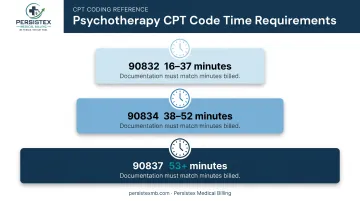
Timed psychotherapy codes add another layer, and each band needs documentation that supports the minutes billed:
- 90832 – 16–37 minutes
- 90834 – 38–52 minutes
- 90837 – 53 minutes or longer
Generic billing knowledge isn't enough here. A biller who misses authorization limits or specialty modifiers will create denials a trained specialty team would catch before submission.
Types of Medical Billing: Professional vs. Institutional
Not every claim looks the same, and the format depends entirely on where care happened.
Professional billing covers services from physicians and non-institutional providers. This includes most outpatient practices: behavioral health, primary care, pediatrics, chiropractic, and podiatry. These claims are submitted using the CMS-1500 form (paper) or the 837-P format (electronic) [9][10].
Institutional billing covers facility-based care, such as hospitals and skilled nursing facilities. These claims capture equipment use, lab work, and facility fees, and they're submitted via the UB-04 form or the 837-I electronic format [11].
Why does this distinction matter to a practice owner? It determines:
- Which billing software and clearinghouse connections you need
- Which claim forms your staff (or billing partner) must know how to complete
- The specific expertise required to catch errors before submission
If you run an outpatient practice — the kind Persistex works with every day — you almost always fall into professional billing. Knowing that up front keeps you from buying the wrong systems or hiring for the wrong skill set.
The Medical Billing Process: Step by Step
Every claim moves through the same general sequence, whether it's a five-minute chiropractic adjustment or a 45-minute therapy session.
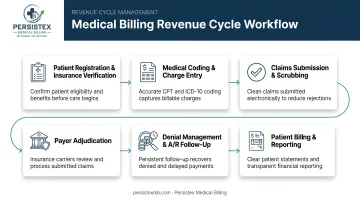
Patient registration and insurance verification. Staff collect demographics and insurance details, then confirm eligibility and coverage before the visit even happens. Skipping this step is one of the most common causes of downstream denials.
Medical coding and charge entry. Coders convert the visit into ICD-10 diagnosis codes and CPT procedure codes, then compile them into a superbill that lists everything performed.
Claims submission and scrubbing. Before a claim goes out, billers scrub it for errors such as mismatched codes, missing modifiers, and incomplete patient data, then submit it electronically as a clean claim. Industry benchmarks put a strong clean-claim rate around 98%, per HFMA's KPI guidance. Anything meaningfully below that signals a process problem worth investigating.
Payer adjudication. The insurer reviews the claim and issues one of three outcomes:
- Accepted — paid as submitted
- Rejected — returned for formatting or data errors; correctable and resubmittable
- Denied — processed but refused payment, often requiring an appeal
Denial management and A/R follow-up. This is where root-cause analysis happens. Was it a coding issue? A missing authorization? Staff investigate, appeal when warranted, and persistently follow up until the claim resolves.
Patient billing and reporting. Once insurance has paid its share, the practice generates a final patient statement for any remaining balance. Staff also compile performance metrics (denial rates, days in A/R, and collection percentages) to monitor financial health going forward.
Medical Billing vs. Medical Coding
These two functions get lumped together constantly, but they're distinct skill sets.
Medical coding is the process of assigning standardized codes to a patient encounter. A coder reviews clinical documentation and translates it into the language insurers understand:
- ICD-10 for diagnoses
- CPT for procedures
- HCPCS for supplies and services not covered elsewhere
Medical billing picks up where coding leaves off. The biller takes those codes, builds the claim, submits it, tracks its status, and manages denials or appeals.
Think of it as a sequential handoff:
- Coder identifies what's billable based on documentation
- Biller uses those codes to build, submit, and manage the claim itself
When coding and billing teams don't communicate well, details get lost—a missed modifier or unlinked diagnosis—and claims bounce back.
Persistex keeps the handoff tight with credentials across coding (CPC), billing (CPB), and health information management (RHIT, CCS). A dedicated coding team owns CPT/ICD-10 accuracy; a separate billing team handles submission and follow-up, so nothing falls through the cracks.
Front-End vs. Back-End Medical Billing
Medical billing splits into front-end and back-end work—and both have to stay in sync.
Front-end billing happens before or during the patient visit:
- Registration and demographic collection
- Insurance eligibility verification
- Prior authorization for services that require it
Back-end billing happens after the visit:
- Charge entry and claim scrubbing
- Claims submission
- Payment posting
- Accounts receivable follow-up
Errors at the front end cause denials at the back end. A bad eligibility check today becomes a rejected claim two weeks from now.
If registration and billing staff work in silos, nobody catches the problem until the claim bounces—and you spend extra time fixing what should have been caught up front. Practices that coordinate both sides tightly see fewer denials overall.
Why Billing Errors Drain Practice Revenue — And When to Outsource
Billing errors aren't rare mistakes. They're a recurring drain on practice revenue, and they tend to cluster around a few predictable causes:
- Coding mistakes, still the number one cause of denials
- Missed filing deadlines
- Eligibility gaps that go unnoticed until after the visit
- Incomplete or unsupported documentation
Fixing these errors after the fact costs more than preventing them. And someone has to do that fixing.
Administrative work tied to billing—especially prior authorization—consumes significant staff time. Physicians and their teams average roughly 13 hours per week on prior authorization alone, according to the AMA's 2025 physician survey. That's time pulled directly from patient care.
What a Specialized Billing Partner Brings
Generic billing services and overstretched in-house staff often lack three things a dedicated partner provides:
- Deep specialty coding knowledge (psychotherapy time codes, CMT chiropractic codes, well-visit and vaccine coding)
- Dedicated denial follow-up instead of reactive, occasional appeals
- Proactive revenue cycle management rather than claim-by-claim firefighting
Persistex built its model around exactly this gap. Its AAPC- and AHIMA-certified team maintains a 98% clean claim rate across clients. In one documented case, a multi-provider behavioral health clinic cut denied claims by 40% and added $85,000 in monthly revenue.
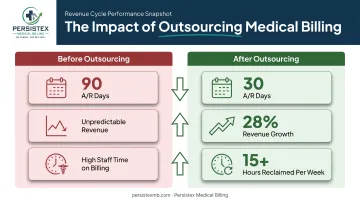
Across its RCM work, Persistex reports A/R days falling from an industry-typical 90 to roughly 30. One solo psychiatry practice owner recovered 15+ hours per week previously spent on billing, alongside 28% revenue growth.
Signs It's Time to Outsource
Consider a specialized billing partner if your practice shows any of these patterns:
- Denial rates climbing month over month with no clear fix
- Billing staff turnover disrupting continuity
- Monthly revenue that swings unpredictably
- Growth that has outpaced what in-house billing staff can handle
None of these problems fix themselves. They tend to compound until a practice either hires specialized help or watches revenue erode.
Frequently Asked Questions
What is the process of medical billing?
Medical billing moves through registration and insurance verification, coding and charge entry, claims submission, payer adjudication, and finally payment collection. See the step-by-step section above for a full breakdown of each stage.
What's the difference between a denied claim and a rejected claim?
A rejected claim fails pre-processing checks—errors, missing data, or formatting issues—and comes back so you can fix and resubmit it. A denied claim was fully processed but payment was refused, and recovery usually means filing an appeal.
Do medical billers need to be certified?
Certification isn't legally required in the U.S. Credentials like CPB (Certified Professional Biller) and RHIT (Registered Health Information Technician) still signal real proficiency and help practices hire with confidence.
Is medical billing the same as revenue cycle management (RCM)?
No. Billing is one component of RCM. Broader RCM also covers scheduling, eligibility checks, prior authorization, and financial reporting across the full patient financial lifecycle.
How long does it typically take to get paid after submitting a claim?
Clean claims are often paid within a few weeks. Medicare, for example, generally must pay or deny clean claims within 30 days. Denials or appeals can stretch that timeline to months.
Should a small practice outsource medical billing or handle it in-house?
Practices seeing rising denials, staff burnout, or inconsistent cash flow often benefit from outsourcing to a specialized partner. Practices with stable volume and dedicated, trained billing staff may manage successfully in-house.