
A recent MGMA Stat poll found that 60% of medical group leaders said their claim denial rates increased year over year, according to MGMA's 2024 analysis. The same research pegged the aggregate first-submission denial rate for single-specialty practices at 8%—a number that hasn't budged since 2019.
Strong revenue cycle management isn't about billing faster. It's about building a predictable, transparent system that starts the moment a patient books an appointment and ends only when the balance is fully paid. This article covers the core steps of the revenue cycle, seven proven best practices, specialty-specific considerations for behavioral health and TMS billing, the KPIs worth tracking, and when outsourcing makes sense.
Key Takeaways
- Clean, complete intake data determines whether claims get paid on the first submission
- Proactive denial management and fast claim scrubbing directly control cash flow speed
- Clean claim rate, days in A/R, and denial rate reveal the true health of a revenue cycle
- Behavioral health billing needs coding and authorization workflows generic RCM processes often miss
Understanding the Revenue Cycle: Core Steps Explained
Revenue cycle management covers every financial touchpoint between a practice and a patient—from the first phone call to the final posted payment. A breakdown at any single step creates downstream revenue loss, even if every other step runs smoothly.
Here's how the cycle actually flows:
- Patient registration and scheduling: capture accurate demographic and insurance details at first contact so clean claims start upstream—get this wrong, and every later step inherits the error.
- Insurance eligibility verification: confirm active coverage, network status, prior authorization needs, and patient responsibility before the appointment.
- Medical coding and charge capture: assign correct CPT and ICD-10 codes tied directly to chart documentation—coding errors remain the top cause of denials.
- Claims submission and processing: transmit complete, payer-specific claims through the clearinghouse and monitor status so nothing sits unsubmitted or quietly rejected.
- Payment posting and denial management: record payments and adjustments accurately, then investigate and appeal denials instead of writing them off.
- Patient billing, collections, and reporting: send timely statements, track accounts receivable, and use KPIs to refine the process continuously.
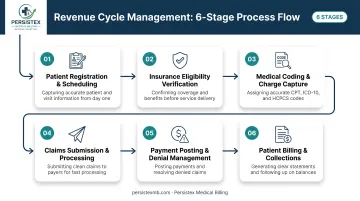
Each step feeds the next. A missed eligibility check at registration becomes a denied claim two weeks later. A vague chart note becomes an underpaid encounter. Practices that run RCM as one connected system catch these breaks early and keep more of what they earn.
7 Best Practices for Stronger Revenue Cycle Management
These practices apply whether billing happens in-house or through an outside partner. None of them work as one-time fixes. Consistent execution is what improves results, week after week, claim after claim.
Verify Eligibility and Benefits Before Every Appointment
Upfront eligibility checks catch coverage gaps and prior authorization requirements before service is rendered, not after a claim bounces back weeks later. Experian's 2025 State of Claims report found that 68% of respondents identified inaccurate or incomplete patient data at intake as a driver of denials, according to Experian Health's 2025 report.
Persistex builds this into its workflow directly, running real-time eligibility checks and benefits verification before every scheduled visit, so coverage problems surface while there's still time to fix them.
Collect Patient Financial Responsibility Estimates Upfront
Deductibles keep climbing. KFF's 2025 Employer Health Benefits Survey found the average single-coverage deductible now sits at $1,886, with more than a third of covered workers facing deductibles of $2,000 or higher, according to KFF's 2025 survey. Giving patients a clear cost estimate before or at the point of service improves collections and reduces billing surprises that damage patient relationships.
Practices that pair eligibility verification with financial counseling tend to collect more, faster, with fewer patient complaints.
Prioritize Coding Accuracy and Specialty-Specific Documentation
Precise coding tied to complete chart documentation prevents denials before they happen. Specialty rules make this harder than it looks. Behavioral health session coding, primary care preventive visits, and procedure-heavy fields like chiropractic or podiatry each carry distinct CPT/ICD-10 linkage and documentation requirements.
Generic coding that misses those nuances is a common denial source. Specialty-trained review catches mismatches before claims go out.
Persistex's coding team runs pre-submission audits that validate diagnosis-to-procedure linkage and confirm documentation supports the billed level of service. Clients see a 35% average reduction in coding-related denials from that process.
Track Every Claim Through Its Full Lifecycle
A claim that sits unsubmitted for two weeks is just as costly as one that's denied outright: it's revenue frozen in limbo. Every claim needs monitoring from submission through adjudication to payment, with flags for anything stuck in pending, rejected, or unsubmitted status before it ages past recovery.
Systematic follow-up at set intervals (30, 60, and 90 days) keeps aging claims from disappearing into the background noise of a busy billing office.
Build a Proactive Denial Management Process
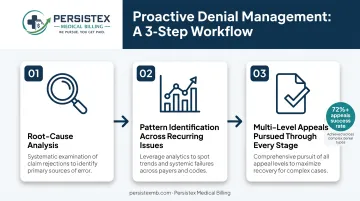
Resubmitting a denied claim without understanding why it was denied just wastes another cycle. A proper process identifies root causes (coding errors, missing documentation, payer-specific quirks) and appeals aggressively rather than writing revenue off.
Persistex reports a 72%+ appeals success rate built on three steps: root-cause analysis of each denial, pattern identification across recurring issues, and multi-level appeals pursued through every available stage.
Use Automation and Real-Time Analytics
Manual eligibility checks and claim scrubbing don't scale, and they leave too much room for error. Automated eligibility verification, claim scrubbing before submission, and real-time dashboards give staff visibility into cash flow bottlenecks as they happen rather than a month later during reconciliation.
Every claim Persistex handles is scrubbed and reviewed before submission, which contributes to the firm's 98% clean claim rate across its client base—well above the industry average.
Invest in Ongoing Staff Training
Coding rules and payer policies change constantly. Regular training on updates keeps error rates low and reduces the staff turnover that disrupts billing continuity. That risk is real: small practices often lose billing staff to burnout or better offers elsewhere.
Persistex's coding team holds AAPC and AHIMA credentials, including CPC, CPB, RHIT, and CCS certifications, and stays current on regional payer policies across MassHealth and New England Blue Cross Blue Shield plans.
Special Considerations for Behavioral Health and TMS Billing
Behavioral health billing carries complexity that standard billing processes weren't built to handle.
Mental health parity is one layer. Under MHPAEA, insurers can't apply more restrictive financial requirements or treatment limitations to mental health and substance use benefits than they apply to medical and surgical benefits, according to CMS's parity guidance. That includes prior authorization, which must be no more stringent than for medical care.
Session limits, frequently updated codes, and payer-specific psychotherapy authorization rules make generic billing workflows a poor fit.
TMS therapy adds another layer entirely. Prior authorization documentation for TMS often requires:
- Detailed diagnostic history and face-to-face evaluation records
- Rating-scale scores with dates
- Prior TMS treatment history and medication trial documentation, including doses and outcomes
Treat that packet as a structured checklist, not an afterthought. Complete diagnostic history, dated rating scales, and documented medication trials cut avoidable denials and back-and-forth with payers. For behavioral health practices juggling parity rules, session authorizations, and specialty prior auth, a partner that knows these workflows can keep clean claims moving without pulling clinicians into the billing queue.
Key Performance Indicators (KPIs) to Track RCM Success
You can't fix what you don't measure. Three KPI areas give the clearest read on revenue cycle health.
Clean Claim Rate
This metric measures the percentage of claims accepted on first submission without edits or resubmission. Higher rates signal a healthier front-end process: accurate intake, correct coding, and complete documentation.
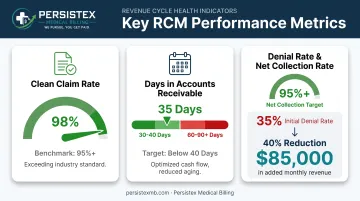
Persistex maintains a 98% clean claim rate across its client base, above the 95% benchmark industry groups often cite as a strong target.
Days in Accounts Receivable (A/R)
Days in A/R tracks the average time between service and payment. Practices with strong front-end processes typically stay in the 30–40 day range. Those with unresolved billing issues often climb past 60 or even 90 days.
Persistex clients average around 30 days, achieved through systematic follow-up at fixed intervals rather than sporadic collection efforts.
Denial Rate and Net Collection Rate
These metrics show whether a practice is capturing revenue it actually earned. HFMA recommends a net collection rate of at least 95%, with 97–99% considered optimal, according to HFMA's revenue cycle KPI guidance.
A multi-provider behavioral health clinic working with Persistex cut its denial rate by 40% from a starting point of 35%. That shift translated into $85,000 in additional monthly revenue.
When to Consider Outsourcing Revenue Cycle Management
Some signs your practice has outgrown its in-house billing capacity:
- Denial rates that keep climbing despite staff effort
- Billing staff turnover that disrupts continuity
- Inconsistent monthly cash flow that makes planning difficult
- Providers spending hours weekly on billing instead of patient care
A specialized RCM partner offers what a generic biller typically can't: dedicated account teams instead of rotating call-center staff, deeper specialty coding expertise, and transparent real-time reporting instead of black-box updates.
Persistex, for example, operates on named account teams with a 24-hour response commitment, rather than ticket queues. Clients have reported results such as:
- 40% fewer denied claims
- A/R days reduced from 90 to 30
- An average $125,000 monthly collections boost
One solo psychiatry practice saved 15 hours per week previously spent on billing and saw a 28% revenue increase.
If billing consumes more time and energy than it returns in collected revenue, evaluate whether a dedicated partner fits your practice's current growth stage.
Frequently Asked Questions
What are the best practices in revenue cycle management?
The top practices are verifying eligibility before every appointment, coding accurately with complete documentation, managing denials proactively, and monitoring KPIs continuously. See the best practices section above for detailed breakdowns of each.
What are the key steps of revenue cycle management?
The core phases run in sequence: patient registration, eligibility verification, medical coding, claims submission, payment posting, denial management, and patient billing/collections with ongoing reporting throughout.
How can I reduce claim denials in my practice?
Focus on accurate coding, upfront eligibility checks, and tracking denial patterns by root cause rather than resubmitting claims one by one. Fixing systemic issues prevents the same denial from recurring across dozens of claims.
What is considered a good clean claim rate?
Top-performing practices aim for clean claim rates in the mid-to-high 90s. Consistent tracking over time helps identify when rates start slipping before it becomes a larger cash flow problem.
Should I outsource my medical billing or keep it in-house?
It depends on practice size, denial rates, and staff capacity. Specialty practices with complex billing, such as behavioral health or primary care, often benefit most from outside expertise that understands payer-specific rules.
How long does it take to see results after improving RCM processes?
Many practices see measurable improvements in collections and denial rates within 30–60 days of implementing changes or onboarding a dedicated RCM partner, with onboarding itself typically completed in 2–4 weeks.