
Denial rates are climbing. AI adoption is uneven across billing companies. Practices that once handled billing in-house are now comparing generalist vendors against specialists who actually understand their CPT codes and payer quirks.
Many practices are asking the same question: is our current billing setup still the right one? This article breaks down what's driving that question, how it's showing up operationally, and what to watch for through the rest of 2026.
Key Takeaways
- Global RCM market nearly doubles: $431.7B in 2026 to $955.5B by 2033 (Grand View Research)
- Denial rates jumped year-over-year, with 60% of medical groups reporting increases
- AI use is still limited, but early adopters see measurable gains in claims and appeals
- Specialization by practice type is the clearest way billing firms win and retain clients
- Compliance and cybersecurity spend is rising after breaches disrupted claims nationwide
Key Trends Shaping the Medical Billing Industry in 2026
Five forces are defining the medical billing landscape this year. Together, they're reshaping how billing companies price their services, staff their teams, and pitch themselves to practices.
AI and Automation Are Reshaping Claims Processing
Automation tools are moving into claims scrubbing, eligibility checks, appeal-letter drafting, and document intake through OCR. The goal is simple: catch errors before a claim goes out the door, not after it comes back denied.
Adoption, though, is still far from universal. MGMA polling found that only 26% of medical groups had redesigned a role or adjusted staffing because of AI in the past year — 68% hadn't made any changes at all. A separate HFMA-FinThrive survey found broader automation use in the revenue cycle among larger healthcare organizations, but only 15% reported clear positive ROI so far.
That gap creates two very different paths:
- Risk for billing companies that sit still while competitors get faster and more accurate
- Opportunity for firms that invest in automation now, before the rest of the market catches up
Automation doesn't replace judgment. A coder still needs to know why a claim was flagged. The firms getting the biggest accuracy gains are the ones pairing trained staff with the right tools, not swapping one for the other.
Specialization Is Becoming the Clearest Path to Differentiation
Generalist billing companies are losing ground to firms that go deep on a specific specialty : behavioral health, TMS, chiropractic, pediatrics, and similar niches. The logic is straightforward: a coder who lives inside psychotherapy CPT codes (90832–90838) or TMS codes (90867–90869) every day catches errors a generalist simply won't see.
Persistex is a case in point. Its coding team focuses on behavioral health and related outpatient specialties, including psychiatric diagnostic evaluation codes (90791/90792), psychotherapy, group therapy, and crisis intervention, plus the modifiers and medical-necessity documentation payers demand.
That specialty depth is tied to a reported 99.2% coding accuracy rate and a 35% reduction in coding-related denials across clients.
MGMA's practice-level data backs the general pattern: single-specialty practices report an 8% first-submission denial rate, and practices that reduced denials most often credited staff trained specifically on the payer rules relevant to their specialty. Specialization isn't just a marketing angle. It shows up directly in prior authorization approval rates and fewer coding-related denials.
Claim Denials Are Rising Sharply, Making Denial Prevention Critical
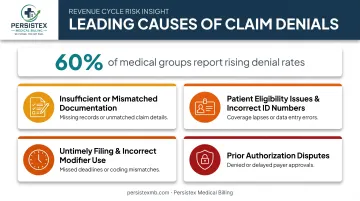
Denials aren't a background problem anymore. They're front and center. In an MGMA poll of medical group leaders, 60% reported higher denial rates in early 2024 than the same period a year earlier, while only 11% saw a decrease.
The leading causes reported were familiar ones:
- Insufficient or mismatched documentation
- Patient eligibility issues and incorrect ID numbers
- Untimely filing and incorrect modifier use (modifier 25 especially)
- Prior authorization disputes, including payers claiming no authorization existed when one was on file
On the government side, CMS reported a 6.55% Medicare improper-payment rate, worth $28.83B, for FY2025 — an improvement from 7.66% the year before, but still a meaningful chunk of revenue at risk.
Rising denials squeeze billing company margins directly: every denied claim means extra staff time on appeals with no guarantee of payment. That's pushing practices to prioritize partners with a real appeals process, not just claim submission. Persistex, for example, reports a 72% appeals success rate, built on root-cause analysis and multi-level appeals rather than treating each denial as a one-off.
Value-Based Care Is Expanding Billing Complexity
Fee-for-service billing is gradually giving way to value-based arrangements: bundled payments, shared savings, and quality reporting requirements layered on top of standard claims. Each of those adds billing tasks that a simple claim submission workflow was never built to handle.
The scale of this shift is already significant. As of January 2025, 53.4% of Traditional Medicare beneficiaries (more than 14.8 million people) were in an accountable-care relationship, up 4.3 percentage points from the year before. HCP-LAN's national data similarly found that 28.5% of payments now flow through models with real downside risk (Categories 3B and 4).
Reconciling quality metrics, shared-savings calculations, and risk-adjustment data alongside standard claims is not something most practices can staff internally without adding headcount. That complexity is a major reason providers keep turning to outsourced RCM expertise rather than building it in-house.
Cybersecurity and Compliance Are Top-of-Mind Investment Priorities
Healthcare data breaches have made HIPAA compliance a board-level issue rather than a background checkbox. The Change Healthcare breach alone affected an estimated 192.7 million individuals, according to HHS OCR notifications, and disrupted claims processing and payment cycles across the country for weeks in early 2024.
The fallout is visible in spending patterns. MGMA polling found that 72% of medical group practices increased cybersecurity spending in 2024, citing rising threats, insurance costs, and infrastructure upgrades as top drivers.
For billing companies, this changes the baseline expectation. HIPAA-compliant, U.S.-based operations aren't a differentiator anymore; they're table stakes. Partners like Persistex meet that bar with 100% U.S.-based, HIPAA-compliant operations as a baseline, not a bolt-on.
What's Driving These Medical Billing Trends
A mix of market, technology, cost, and regulatory forces is accelerating change across the industry at once.
- Technology advances: Automation now handles a meaningful share of routine billing work. CAQH has identified a $20B savings opportunity from administrative automation across healthcare, pushing billing companies to modernize workflows to stay competitive
- Market demand: The U.S. medical billing outsourcing market is projected to grow at an 11.5% CAGR through 2030, within a global RCM market heading toward nearly $1 trillion by 2033
- Cost pressures: Labor remains the largest operating expense for most billing companies, so firms pursue efficiency and specialization instead of simply hiring more staff
- Regulatory influences: CMS's CY2026 Physician Fee Schedule adjusted conversion factors and finalized a -2.5% efficiency adjustment on certain work RVUs. A CFPB medical debt credit-reporting rule (later vacated in court) shows how quickly collections rules can shift
- Competitive dynamics: IBISWorld counted 1,364 U.S. medical billing businesses in 2024, with no single company holding more than 5% share. Offshore firms, in-house teams, and private equity-backed consolidators all compete for the same clients
How These Trends Are Impacting the Medical Billing Industry
These forces are already reshaping operations, pricing, and hiring across billing companies and the practices they serve.
Operational Impact
Billing companies are expanding well past claim submission. Services that once sat on the side are now part of the core offer:
- Benefit verification and prior authorization management
- Real-time eligibility checks before every visit
- Pre-submission claim scrubbing to catch denials early
Persistex runs real-time eligibility verification before every appointment and scrubs every claim before submission, including diagnosis-to-procedure code validation. That two-point process supports a 98% clean claim rate.

Business Impact
Pricing models are shifting too. More billing companies are moving toward lower percentage-based rates or flat-fee structures instead of the higher legacy rates common a decade ago, largely because specialization and automation let firms do more with less overhead.
Specialization is now a growth strategy, not a side project. Firms that build deep specialty knowledge instead of serving every practice type the same way are winning on retention and referrals.
Workforce Impact
Demand for certified billing and coding talent keeps growing. The Bureau of Labor Statistics projects 7% growth for medical records specialists from 2024 to 2034, with about 14,200 openings annually — faster than the average for all occupations.
That demand is pushing credentials like CPC, CPB, RHIT, and CCS from optional to expected. Persistex's team holds all four. Certified coders run the pre-submission audits behind its 99.2% coding accuracy.
Future Signals for the Medical Billing Industry in 2026 and Beyond
Trends keep moving. These are early indicators worth watching over the next one to three years:
- Deeper AI integration in appeals generation, prior authorization, and predictive denial analytics, expanding well beyond today's early-mover minority
- Standardization around EHR-billing integrations, reducing manual reconciliation as practices demand smoother data flow between clinical and billing systems
- Parallel growth of opposite models: private equity-backed consolidation on one side, boutique specialty-focused firms on the other
- Continued volatility in patient payment collection as regulatory attention on medical debt and credit reporting keeps shifting
None of these signals point to a single winning strategy. They describe a market splitting into extremes: scale-driven consolidators and depth-driven specialists, with less room left for the undifferentiated middle.
Conclusion
AI adoption, rising denials, and specialization are the three forces defining medical billing through 2026. None of them are going away, and each one rewards practices and billing companies that move early rather than reactively.
Firms investing in automation now, or partnering with specialty-focused experts, are building a measurable financial edge over those holding back. For practices facing these pressures, working with a specialized, certified revenue cycle team like Persistex can convert them into predictable monthly revenue instead of cash-flow surprises.
Frequently Asked Questions
Are medical billers in high demand?
Yes. The BLS projects 7% job growth for medical records specialists from 2024 to 2034, with roughly 14,200 annual openings. That pace is faster than the average occupation, driven by growing documentation and coding complexity.
How big is the medical billing industry?
The global RCM market is valued at $431.7B in 2026 and is projected to reach $955.5B by 2033. That trajectory points to sustained demand for billing and revenue cycle services.
What industry is medical billing in?
Medical billing falls under healthcare administration and revenue cycle management, bridging clinical care delivery with health insurance and payer systems to convert patient services into provider reimbursement.
Is outsourcing medical billing worth it in 2026?
For many practices, yes. Outsourcing reduces the administrative burden on staff and physicians. One Persistex client reported saving 15+ hours per week and growing collections by 28% after switching from in-house billing.
How is AI changing medical billing in 2026?
AI is currently used for eligibility checks, appeal-letter drafting, and document intake, with early adopters reporting accuracy and efficiency gains. Industry-wide adoption remains limited, so the advantage still favors firms that move first.
What should practices look for in a medical billing partner in 2026?
Look for specialty expertise in your exact practice type, transparent real-time reporting, AAPC/AHIMA-certified staff, and a proven appeals track record. These factors directly affect clean claim rates and how much revenue you actually collect.