

Introduction
Every patient visit sets off a chain of paperwork most patients never see: eligibility checks, coding, claim submission, payer review, payment posting. That chain is billing operations, and when it breaks, practices don't get paid, or they wait months for money they've already earned.
Denied claims pile up. Reimbursements crawl. Front-desk staff and clinicians burn hours on hold with insurers instead of caring for patients. Many practices see A/R stretch past 90 days while denial backlogs grow. Specialty settings such as behavioral health add coding and authorization rules that make the problem worse.
This guide breaks down what billing operations actually means: its core functions, the types of billing procedures involved, the pitfalls that drain revenue, and how practices can strengthen or outsource this work.
Key Takeaways
- Billing operations run from insurance verification through final payment—not just sending invoices
- A 98% clean claim rate is the benchmark; miss it and you get constant rework and delayed cash
- Denials, coder shortages, and slow A/R follow-up are the top threats to steady revenue
- Standardized workflows and real-time KPIs catch problems before they cost the practice money
- Outsourcing to specialists helps practices lock in predictable revenue without adding staff
What Are Billing Operations?
Billing operations is the complete system of processes, people, and technology a practice uses to capture charges, submit claims, and collect payment for services rendered. It is the operational machinery that turns each clinical encounter into collected revenue.
The terms billing operations, medical coding, and revenue cycle management (RCM) get used interchangeably in healthcare, but they describe different layers of the same system:
- Medical coding translates clinical documentation into standardized codes (CPT, ICD-10, HCPCS) that describe what happened during a visit.
- Revenue cycle management covers the full financial arc, from the first appointment booking through final payment.
- Billing operations is the execution layer inside that cycle: the day-to-day work of submitting claims, following up, and collecting what's owed.
Where Billing Operations Fits
Billing operations sits at the intersection of four moving parts that need to stay aligned:
- Front office (scheduling and registration)
- Clinical documentation (what providers record during the visit)
- Insurance payers (who decide what gets paid)
- Patients (who owe whatever remains)
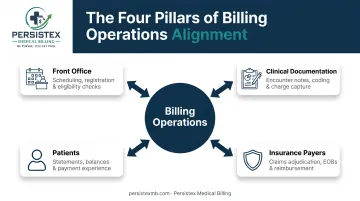
A registration typo, a missed prior authorization, or incomplete documentation can throw any of these out of sync. When that happens, the claim stalls or gets denied.
Compliance isn't optional either. Every step runs inside HIPAA and payer-specific regulatory frameworks, which makes accuracy and data security part of the job description, not an afterthought.
The financial stakes are concrete. MGMA's 2023 DataDive found an 8% first-submission denial rate among single-specialty practices. For a practice billing $500,000 a year, that's tens of thousands of dollars sitting in limbo at any given moment.
Key Functions of Billing Operations in a Medical Practice
Billing operations breaks down into six connected functions. Skip one, and the whole cycle slows down.
1. Patient registration and eligibility verification. Confirming coverage, benefits, and prior authorization requirements before the date of service, not after a denial shows up. This one step prevents the majority of downstream billing headaches.
2. Charge capture and medical coding. Translating clinical notes into accurate CPT and ICD-10 codes. Specialty work raises the difficulty: behavioral health visits, for instance, need precise psychotherapy CPT codes, correct time-based rules, and matching ICD-10 diagnoses. Coders without that training miscode these regularly.
3. Claims submission and clean claim scrubbing. Every claim gets checked for errors before it leaves the building. HFMA sets the clean claim rate benchmark at 98%, meaning only 2% of claims should need rework on first submission.
4. Payment posting and reconciliation. Matching remittances (EOBs and ERAs) against billed and allowed amounts. This catches underpayments that would otherwise slide by unnoticed. Insurers rarely flag their own mistakes.
5. Denial management and appeals. Tracking, investigating, and resubmitting denied claims. A denied claim isn't lost money. It's recoverable, but only if someone follows up instead of writing it off.
6. Reporting and analytics. Monitoring KPIs through dashboards so you catch leakage early instead of discovering problems at year-end.
| KPI | Healthy Benchmark |
|---|---|
| Clean claim rate | 98%+ |
| Denial rate | 5–10% or lower |
| Days in A/R | 30-40 days |
| Net collection rate | 95-99% |
Types of Medical Billing and Common Billing Procedures Explained
Understanding the Three Types of Billing
Patients often get confused seeing multiple bills for one encounter. That happens because medical billing splits into three categories:
- Professional billing covers physician and provider services, submitted via the CMS-1500 form or its electronic equivalent, the 837P claim format.
- Facility/institutional billing covers hospital or ambulatory center charges, submitted via CMS-1450 (837I format).
- Specialty/ancillary billing covers labs, radiology, imaging, and durable medical equipment, often billed separately from the visit itself.
A single office visit might generate a professional claim from the physician and a separate ancillary claim if bloodwork goes to an outside lab. Same encounter, two claims to track.
What a Typical Billing Procedure Looks Like
Every patient encounter moves through the same six-step sequence:
- Registration and eligibility check confirms coverage and benefits before the visit.
- Charge entry and coding turns clinical documentation into billable CPT/ICD-10 codes.
- Claim submission sends the scrubbed claim to the payer electronically.
- Payer adjudication determines approval, partial payment, or denial.
- Payment posting reconciles the remittance against what was billed.
- Patient statement and collections handles whatever balance remains.
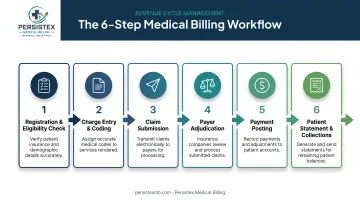
Break any link in that chain, and the payment either stalls or shrinks.
In-House vs. Outsourced Billing Operations
In-house billing keeps direct control over every claim. It also means carrying the full cost of staffing, training, and software—plus absorbing turnover when a trained biller leaves.
Outsourced billing trades some of that control for specialized expertise and scale. A billing partner handles submission, denials, and A/R follow-up so the practice team stays on patient care.
The right fit depends on practice size, claim volume, and how much administrative load the practice can absorb without it touching patient care.
Common Challenges That Disrupt Billing Operations
Three problems account for most billing operations breakdowns.
Claim denials from preventable errors. Coding mistakes, missing prior authorizations, and eligibility gaps drive most denials. A recent MGMA poll found 60% of practices reported rising denial rates year-over-year, with only 11% seeing improvement. Staffing gaps in specialty coding. The AMA has documented a roughly 30% national shortage of medical coders, a gap driven as much by turnover as by growing demand. Few coders arrive already fluent in psychotherapy time-based codes, chiropractic CMT codes, or podiatry coverage rules. Losing a trained biller mid-cycle means claims sit untouched while a replacement spends weeks learning payer quirks.
Slow, unpredictable A/R. Inconsistent claim follow-up stretches accounts receivable and makes cash flow hard to forecast. One MGMA poll found nearly half of practices saw days in A/R increase year-over-year, a trend that compounds fast once denials and staffing issues hit at the same time.
Best Practices to Strengthen Your Practice's Billing Operations
Most billing problems are preventable with the right workflow discipline.
Standardize verification before every visit. Insurance eligibility and prior authorization checks should happen automatically before each appointment, not as damage control after a denial lands. Build it into scheduling, not billing.
Invest in certified coders and run internal audits. Certified coders (CPC, CPB, RHIT, CCS) catch specialty-specific errors that generalists miss. Regular audits that check diagnosis-to-procedure linkage, modifier accuracy, and documentation support catch mistakes before claims go out rather than after they bounce back.
Track KPIs in real time. Don't wait for quarterly reports to find a problem. Monitor:
- Clean claim rate — share of claims accepted on first submission
- Denial rate — percentage of claims payers reject
- Days in A/R — average time from claim to payment
- Net collection rate — revenue collected versus allowed amount
Dashboards that update continuously let a practice catch a slipping metric in week one, not month three, when the revenue is already gone.
Why More Practices Are Outsourcing Billing Operations to Specialists
Outsourcing billing operations has moved well past a last-resort option. MGMA's late-2024 poll found 36% of practice leaders planned to outsource or automate part of their revenue cycle in 2025, with billing, coding, and collections named as the top targets.
Solo providers and multi-provider clinics alike are making the switch—not because they can't manage billing, but because doing it well takes dedicated time few practices can spare.
Persistex Medical Billing was built for exactly this gap, with a specialty focus on behavioral health, primary care, and outpatient practices. Its certified team, holding CPC and CPB (AAPC) plus RHIT and CCS (AHIMA) credentials, maintains a 98% clean claim rate, well above what most practices manage on their own.
Measurable outcomes are what usually convince practice owners to make the switch:
- 40% fewer denied claims on average across clients
- Days in A/R reduced from roughly 90 to 30
- 72%+ appeals success rate on claims that do get denied
- One solo psychiatry practice reclaimed 15+ hours a week previously lost to chasing payments
- A multi-provider clinic recovered over $200,000 in revenue that had been written off
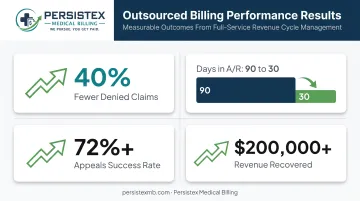
Persistex covers the full arc from patient scheduling through final payment posting, and its revenue cycle management workflow integrates with AdvancedMD, Kareo, athenahealth, DrChrono, and TherapyNotes, so practices don't need to switch systems to get better outcomes.
A specialist partner backs those numbers with structure: dedicated, named account teams instead of rotating call-center staff, plus real-time dashboards covering collections, denials, and A/R aging. A practice administrator can see exactly where every dollar sits in the cycle rather than waiting on a monthly PDF to find out.
Frequently Asked Questions
What are billing operations?
Billing operations is the end-to-end system of processes, people, and technology that practices use to capture charges, submit claims, and collect payment for care delivered. It covers everything from eligibility checks through final payment posting.
What are billing procedures?
Billing procedures are the step-by-step sequence a claim follows: eligibility verification, charge entry and coding, claim submission, payer adjudication, payment posting, and patient collections. Each step needs to happen correctly for the claim to get paid without delay.
What are the three types of billing?
The three primary categories are professional billing (physician services), facility/institutional billing (hospital or ambulatory charges), and specialty/ancillary billing (labs, radiology, DME). A single visit can generate claims across more than one category.
How is billing operations different from medical coding?
Medical coding is one function inside billing operations—the translation of clinical documentation into CPT/ICD-10 codes. Billing operations also covers verification, claims management, payment posting, and collections.
What is a "clean claim rate" and why does it matter?
Clean claim rate measures the percentage of claims accepted by a payer without error on first submission. HFMA sets 98% as the target benchmark; higher rates mean faster, more predictable payment and less staff time spent on rework.
Should my practice outsource its billing operations?
Outsourcing makes sense when denials, staffing gaps, or slow collections are hurting cash flow. A specialized partner—especially one with no long-term contracts and a proven clean-claim track record—often delivers faster returns than building an in-house team from scratch.