
60% of medical group leaders said their denial rates increased in early 2024 compared to the same period the year before, according to an MGMA poll of 235 group leaders. That's not a small trend to shrug off.
RCM gets talked about in abstract terms: processes, dashboards, workflows. But the real proof shows up in whether a practice gets paid on time, whether staff spend less time on hold with insurers, and whether denial rates actually drop. This article breaks down five concrete, measurable benefits practices experience when RCM is executed well.
Key Takeaways
- RCM runs from scheduling to final payment and directly drives practice cash flow
- Five core benefits: faster payments, fewer denials, less admin work, cleaner coding, better data visibility
- Disciplined or outsourced RCM often delivers measurable gains within 30-60 days
- Specialty coding (e.g., behavioral health) trips up generic billing teams far more often than expected
What Is Revenue Cycle Management, Really?
RCM is the end-to-end process of tracking every financial touchpoint of patient care. That starts with scheduling an appointment and ends when the balance is fully collected.
It applies across specialties, from primary care and pediatrics to behavioral health and chiropractic. Some practices manage it in-house. Others hand it to a dedicated billing partner.
Either way, RCM is the system that produces predictable revenue and keeps a practice compliant. Software tools and one-off billing tasks are only pieces of that system. The benefits below are what happens when it actually works.
5 Key Benefits of Revenue Cycle Management
These are operational outcomes tied to cash flow, denial rates, staff hours, and coding accuracy.
Benefit 1: Faster, More Predictable Cash Flow
Disciplined claims submission, timely remittance processing, and consistent patient collections shorten the entire payment cycle. Instead of waiting on unpredictable reimbursement timing, a practice starts collecting on a schedule it can actually plan around.
The measurable effect shows up in two places:
- Shrinking accounts receivable (A/R) days - money moves from "billed" to "collected" faster
- Stabilized monthly revenue - fewer swings between strong and weak collection months
HFMA sets a general benchmark of 30-40 days in A/R for most provider organizations, with anything over 90 days flagged as a red flag needing attention. Persistex has documented client outcomes of taking A/R from 90 days down to 30 through proactive follow-up and clean submissions.
This matters most for practices juggling multiple payers, seasonal patient volume, or thin cash reserves that can't absorb a 60-day payment gap without real strain.
Benefit 2: Fewer Denied Claims and Higher Clean Claim Rates
Claim scrubbing, eligibility verification, and accurate coding catch errors before submission instead of after a denial letter arrives. That distinction matters more than it sounds. Fixing a claim upfront takes minutes. Appealing a denial takes weeks.
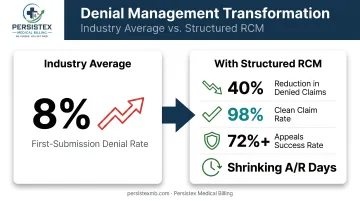
Persistex's documented results include a 40% reduction in denied claims and a 98% clean claim rate across its client base, achieved through pre-submission audits, real-time eligibility checks, and diagnosis-to-procedure code validation.
Four KPIs move when this discipline is in place:
- Denial rate falls as fewer claims bounce back for rework
- Clean claim percentage climbs with pre-submission scrubbing
- Appeals success rate improves (Persistex reports over 72%)
- Days in A/R shrink alongside cleaner first-pass submissions
For context, first-submission denial rates industry-wide sit around 8% for single-specialty practices, and 60% of group leaders reported those rates trending upward, not down. Structured claim scrubbing is one of the few levers that reliably pushes that number the other direction.
Benefit 3: Reduced Administrative Burden and Time Savings
Automating repetitive tasks, like eligibility checks and payer follow-up, removes hours of manual work from front-office and billing staff every week. That time doesn't just disappear. It gets redirected toward patients instead of paperwork.
AMA's 2024 physician work-hour data found physicians spend an average of 7.3 administrative hours per week on tasks like insurance forms and prior authorization, inside a 57.8-hour workweek. For solo practitioners, that number often climbs higher because there's no dedicated billing staff to absorb it.
Persistex's client data reflects this directly: a solo psychiatry practice reported saving 15+ hours per week previously lost to billing tasks after outsourcing, alongside a 28% revenue increase. That's nearly two full workdays returned to patient care.
This benefit compounds fastest for small clinics and solo practitioners who currently handle billing themselves, on top of everything else.
Benefit 4: Improved Coding Accuracy and Compliance
Certified coders and structured coding review reduce the CPT/ICD-10 errors that remain one of the most common causes of claim rejection. Incorrect modifier use alone (particularly modifier 25) is a recurring denial cause MGMA has flagged repeatedly in its practice polling.
Specialty coding raises the stakes further. Behavioral health time-based psychotherapy codes, telehealth modifiers, and payer-specific documentation rules come with details generic billing teams frequently get wrong when they don't handle that specialty volume regularly.
Persistex's certified coding team, holding CPC and CPB credentials, reports:
- 99.2% coding accuracy across reviewed claims
- 35% reduction in coding-related denials for clients
Three KPIs shift when coding accuracy improves:
- Coding accuracy rate on reviewed claims
- Audit and compliance risk exposure
- Share of denials tied to coding errors vs. eligibility or filing issues
Benefit 5: Data-Driven Insights for Smarter Business Decisions
RCM dashboards pull scattered billing data into one place, giving real-time visibility into collections, denials, and payer performance. Without that visibility, problems hide in spreadsheets until someone notices revenue looks light.
That visibility drives decisions that change real outcomes:
- Renegotiating payer contracts with documented underpayment evidence
- Adjusting front-office staffing based on volume trends
- Catching underpayments before they become permanent revenue loss
Persistex's dashboards track collections trends, denial rates by payer, A/R aging, and clean claim rates. One documented outcome: a multi-provider clinic that had been, in the director's words, "drowning in denied claims" recovered more than $200,000 in previously lost revenue after implementing structured tracking and appeals.
Multi-provider clinics and practices adding locations or payers feel this gap first—financial visibility gets harder to maintain manually as complexity grows.
What Happens When RCM Is Missing or Ignored
Skip structured RCM, and the consequences compound—slowly at first, then all at once.
- Cash flow turns unpredictable. Claims processing and follow-up become reactive instead of systematic, and A/R days creep upward instead of staying flat.
- Error rates climb. Manual processes without specialty coding expertise let mistakes slip through, raising both denial rates and audit exposure.
- Burnout and leakage stack up. Staff absorb administrative overflow while small revenue leaks go untracked, and adding a provider or location gets harder than it should.
One documented example: a multi-provider behavioral health clinic started with a 35% denial rate and inconsistent cash flow across eight providers before addressing it. A 35% denial rate does not improve with more hours worked. It takes a different process.
How to Get the Most Value from Revenue Cycle Management
RCM only delivers its full benefit when it's applied consistently across the entire cycle, not just patched in at the claims-submission stage. Scheduling, coding, submission, and collections all need to work together.
A few practical steps make the difference:
- Review core KPIs regularly - denial rate, A/R days, and clean claim rate should be checked monthly, not discovered during tax season
- Act on the trends, not just record them - a rising denial rate from one payer is a signal to investigate, not a footnote
- Consider specialized support - practices in behavioral health and other complex specialties often get more value from a dedicated RCM partner than trying to manage the full cycle in-house
Persistex Medical Billing operates on this model. Practices get end-to-end RCM with dedicated account teams (not rotating call-center staff) and CPC/CPB/RHIT/CCS-certified coders. The team integrates with major EHR and practice management systems, including AdvancedMD, Kareo, athenahealth, DrChrono, and TherapyNotes.

Pricing flexibility matters too. Persistex offers percentage-based or flat-rate engagement with no long-term contracts, so practices are not locked into multi-year commitments before results are proven.
Conclusion
The real value of RCM comes from compounding gains: faster payments, fewer denials, and reduced administrative load that build on each other over months.
These benefits show up directly in cash flow, in hours staff get back each week, and in lower compliance risk. Practices see them in their own reports, not in theory.
RCM works best as an ongoing discipline or partnership, not a one-time cleanup project. Specialized partners like Persistex are built to make that discipline stick.
Frequently Asked Questions
What is revenue cycle management in simple terms?
RCM is the financial process that tracks a patient's care journey from scheduling through final payment. It's designed to make sure providers get paid accurately and on time.
What are the key components of revenue cycle management?
The core stages include registration, eligibility verification, charge capture and coding, claims submission, remittance processing, denial management, and patient collections. Each stage affects how quickly and completely a claim gets paid.
What are the goals of revenue cycle management?
The main goals are faster and more predictable payments, fewer coding or eligibility errors, lower administrative costs, and a better financial experience for patients.
How does RCM help reduce claim denials?
RCM catches coding and eligibility errors before submission through claim scrubbing and verification. That prevents denials outright, rather than relying on appeals after a claim already got rejected.
Can small practices benefit from outsourced RCM?
Solo practitioners and small clinics often benefit the most. They typically lack dedicated in-house billing staff and specialty coding expertise, which is exactly where outsourced RCM adds the most value.
How soon can a practice expect to see results after improving its RCM process?
Most practices see measurable improvements in denial rates and collections within 30-60 days of implementing structured RCM changes. Onboarding with a dedicated partner typically takes 2-4 weeks.