
This guide is for therapists, practice managers, and billing staff who need to submit clean claims for couples and family sessions. Get it wrong, and you're looking at denied claims, incorrect CPT code selection, or an audit that asks for money back.
Couples therapy billing ranks among the most misunderstood corners of mental health billing. The reason: insurance runs on a one-patient, one-diagnosis model, but couples therapy inherently involves two people and a relational focus.
We'll cover what couples therapy billing actually means, the CPT codes and claims process involved, the factors that swing reimbursement, the mistakes that trigger denials or fraud flags, and when self-pay makes more sense than fighting the system.
Key Takeaways
- One "identified patient" with a DSM-5 diagnosis carries the claim — insurance won't pay for relationship growth alone.
- CPT 90847 (patient present) and 90846 (patient absent) apply to ongoing joint sessions; individual codes 90832/90834/90837 don't.
- Billing both partners' insurance for one session, or splitting it into two claims, counts as fraud.
- Coverage varies plan to plan, even within the same carrier, so verify benefits every time.
- Clean documentation and quick denial appeals protect revenue and reduce audit risk.
What Is Couples Therapy Billing?
Couples therapy billing is the process of submitting insurance claims for joint sessions by attaching the treatment to one identified patient's diagnosed mental health condition, not to the couple's relationship itself.
Insurers built their claims systems around a single patient with a single diagnosis. Couples and family therapy don't naturally fit that mold, so billing translates a two-person service into a format the payer's system can process.
That's why "relationship therapy" or premarital counseling, billed as such, almost always gets denied. Without an individual's diagnosed condition driving the treatment, there's no medical necessity for the insurer to point to. Practices offering pure relationship enrichment or premarital work typically bill these sessions as self-pay.
The Identified Patient (IP) Concept
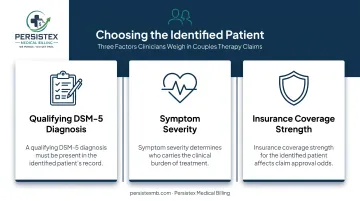
The identified patient is the person whose name, diagnosis, and treatment plan justify the claim. Everyone else in the room supports that person's treatment, at least on paper. Practices typically select the IP based on:
- Who has a qualifying DSM-5 diagnosis, such as an anxiety, depressive, or adjustment disorder
- Whose symptoms are most clinically significant
- Whose insurance plan offers better coverage or serves as the primary payer
Per Medicare's coverage guidance on family psychotherapy, the session's primary purpose must be treating that identified patient's condition, even when the whole couple or family attends together.
This creates real tension for therapists trained in relational modalities. Approaches like Emotionally Focused Therapy or the Gottman Method treat the couple as the client. There's no single "patient" in the room from a clinical standpoint.
Insurance billing forces a different framework onto that work, and documentation has to bridge the gap. That mismatch is a major reason couples and family claims see more coding errors and denials than standard individual psychotherapy claims.
How Couples Therapy Claims Are Processed: CPT Codes and Step-by-Step Billing
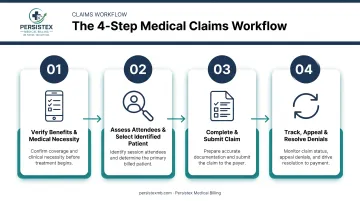
Once you've identified the patient and diagnosis, the claims workflow follows a predictable path: verify benefits, choose the right CPT code, complete the claim correctly, then track it through to payment or appeal.
Key CPT Codes for Couples and Family Therapy
Two codes cover almost every couples and family session:
- CPT 90847 – Family psychotherapy with the identified patient present, 50 minutes. Use when the IP attends alongside a partner or family members.
- CPT 90846 – Family psychotherapy without the identified patient present, 50 minutes. Use when the therapist meets with the partner or family alone to support the IP's treatment.
Per APA Services' psychotherapy coding guide, both codes can be reported for sessions running 26 minutes or longer under standard CPT time rules. A scheduled 50-minute slot alone doesn't prove that much time was delivered. Document actual session length.
Codes 90832 (30 minutes), 90834 (45 minutes), and 90837 (60 minutes) describe individual psychotherapy one-on-one. Using them for an ongoing joint couples or family session misrepresents who was in the room and draws auditor attention. If the note describes two people working through relationship dynamics but the claim says "individual psychotherapy," that gap is easy to spot.
The Claims Process, Step by Step
- Verify benefits and medical necessity. Call the payer and ask specifically about coverage for CPT 90847 or 90846 tied to a diagnosis, not "couples counseling" in general. Generic questions get generic, often wrong, answers.
- Assess attendees and select the identified patient. Evaluate everyone in the room for a qualifying DSM-5 diagnosis. Document why that person was chosen (symptom severity, diagnosis, or plan coverage), then carry the same details onto the claim.
- Complete and submit the claim. Put the identified patient's name, member ID, and diagnosis in the patient fields on the CMS-1500 or superbill. Do not list the partner or family members as patients on that claim; their participation belongs in the clinical note only.
- Track, appeal, and resolve denials. Monitor claim status and appeal incorrect denials quickly. Payers don't reward practices that let appeals sit, and delayed follow-up is where many practices lose money.
When bandwidth is the bottleneck, a behavioral health billing partner like Persistex Medical Billing can run denial root-cause analysis and push appeals through rather than writing claims off.
Factors, Mistakes, and Compliance Risks in Couples Therapy Billing
Key Factors That Affect Coverage and Reimbursement
Two people on the exact same insurance carrier can have completely different coverage for CPT 90847 or 90846. Plan design, not just the carrier name, determines what is covered. Verify benefits on every plan, not once per payer.
A diagnosis code for relationship distress alone (Z63.0) typically is not enough to get a claim paid. The identified patient needs a qualifying mental health diagnosis, mapped accurately from the DSM-5 to the correct ICD-10-CM code.
Per CMS billing guidance on psychiatry and psychology services, covered diagnoses for family psychotherapy generally include adjustment disorders, anxiety disorders, and depressive disorders, not relationship-distress codes standing alone.
Other variables that shift reimbursement:
- Prior authorization: Required before the first session on some plans, not on others
- Visit limits: Annual session caps vary by plan, not only by carrier
- Coordination of benefits: With dual coverage, the primary payer processes first; the secondary pays only what its rules still allow
Common Billing Mistakes to Avoid
A common misconception is that insurance never covers couples therapy. In reality, it is often covered, just not as "couples counseling." Payers reimburse treatment for one partner's diagnosed condition when you bill a family-therapy code.
Other frequent mistakes:
- Using individual codes for joint sessions: Billing 90832, 90834, or 90837 instead of 90847 misstates who received care and can trigger repayment demands
- Double-billing both partners' insurance: Submitting the same joint session to both plans, or as two "individual" visits, is fraud and puts the clinician's license at risk
- Skipping medical-necessity documentation: Every claim needs a treatment plan tied to the identified patient's diagnosis, not a note that "the couple came in"
Compliance Risks That Follow Bad Billing
Coding and documentation errors are not paperwork problems alone. They create audit exposure and, in clear abuse cases, legal risk.
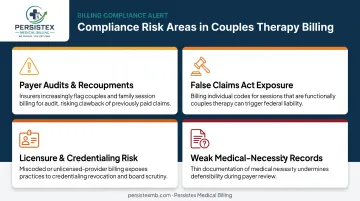
Watch for these exposure points:
- Payer audits and recoupments: Pattern misuse of 90847/90846 or individual codes for joint work often leads to take-backs
- False Claims Act exposure: Knowingly billing a service that was not delivered as coded can support federal or state false-claim actions
- Licensure and credentialing risk: Fraud findings and repeated coding abuse can jeopardize state licensure and panel status
- Weak medical-necessity records: Charts that describe relationship goals without linking care to the identified patient's diagnosis fail medical-necessity review
Correct code selection, one identified patient per claim, and diagnosis-linked notes are the practical controls that keep couples-therapy billing defensible.
When Insurance Billing May Not Be the Right Fit
Some practices run on a strictly relational model: both partners are equal clients, with no individual diagnosis driving the work. Forcing an "identified patient" label onto that structure creates a real conflict: the clinical records say one thing, and the claim says another. For practices built this way, self-pay often fits the treatment model better than insurance ever will.
Session length creates another constraint. CPT 90846 and 90847 are 50-minute codes, and payers apply their contracted rate regardless of how long the session runs past the minimum threshold. A two-hour intensive doesn't generate extra payable units just because it ran long.
When insurance billing isn't the right fit, practices still have options:
- Self-pay rates set by the practice, with full control over session length and format
- Sliding-scale fees based on household income for clients who need flexibility
- EAP benefits, which often cover a set number of sessions at no cost
- HSA/FSA reimbursement when therapy qualifies as medical care
Relationship enrichment alone usually doesn't meet HSA/FSA rules, so confirm eligibility with the plan administrator before relying on it.
Conclusion
Couples therapy billing comes down to three things: picking the right identified patient, using the correct CPT code, and documenting medical necessity clearly enough to survive a payer's second look. Skip any one of those, and denials and audits follow.
Get it right, and clients receive the coverage they're entitled to while your practice gets paid without endless back-and-forth. Clean claims, fewer resubmissions, and less admin time—that's the outcome worth aiming for.
For practices stretched between patient care and admin work, a specialized behavioral health billing partner can close that gap. Persistex Medical Billing works with mental health practices across Massachusetts and New England to keep couples and family therapy claims coded correctly and moving through the payer system without unnecessary delays.
Frequently Asked Questions
Do both parties have to pay for couples therapy?
When insurance is billed, only the identified patient's coverage applies. The partner isn't billed separately through insurance. If the plan doesn't cover it, or the practice is self-pay, couples typically split the cost themselves rather than through two separate claims.
Can CPT 90837 be billed for couples therapy?
No. CPT 90837 is an individual psychotherapy code, not appropriate for ongoing joint sessions. The correct code is 90847, and using 90837 for couples work has led to audit repayment demands.
How much will couples therapy cost?
Costs vary by provider, location, and insurance coverage. Copays and coinsurance depend on the plan; practices can confirm benefits with the insurer or quote self-pay and sliding-scale rates.
What CPT code is used for couples or family therapy?
CPT 90847 applies when the identified patient is present during the session; CPT 90846 applies when they're not. Both describe 50-minute family psychotherapy sessions.
Is billing both partners' insurance for one session considered fraud?
Yes. Submitting claims to two separate policies for a single session charges twice for one service and misrepresents who the client was on each claim. That is insurance fraud.
Why does insurance require an "identified patient" for couples therapy?
Insurance operates on an individual medical-necessity model. It needs one diagnosed patient of record to justify paying for a joint session, even when the treatment addresses the relationship as a whole.