
Introduction
A claim comes back from the payer. The biller opens the EOB and sees it: "non-covered service." No payment. No clear next step. Just a code and a question mark over who's supposed to pay for the visit that already happened.
This scenario plays out daily in practices across the country. Non-covered services denials rank among the most common — and most misunderstood — denial types in medical billing, and they hit cash flow hard when left unresolved.
A 2023 MGMA DataDive analysis found an 8% aggregate first-submission denial rate for single-specialty practices. Sixty percent of medical groups surveyed in early 2024 reported denial rates climbing higher than the year before.
This guide breaks down what a non-covered denial actually means, which codes trigger it, why it happens, whether you can bill the patient, and how to stop it from recurring.
Key Takeaways
- A non-covered denial means the payer excluded the service from benefits, not a filing error on the claim.
- CO-96, PR-96, and CO-252 all flag non-covered charges but shift liability differently between provider and patient.
- Bill the patient only with a PR prefix—and for Medicare, only with a signed Advance Beneficiary Notice (ABN).
- Eligibility checks, prior auth tracking, and clean coding stop most non-covered denials before submission.
What Is a Non-Covered Services Denial in Medical Billing?
A non-covered services denial happens when a payer determines that a specific procedure, supply, or service is excluded from the patient's benefit plan — or from the provider's contract — and won't be reimbursed. It's a coverage decision, not a data-entry mistake.
Every denial on an Electronic Remittance Advice (ERA) is built from two layers:
- CARC (Claim Adjustment Reason Code): the standardized code explaining why the adjustment happened.
- RARC (Remittance Advice Remark Code): an accompanying code that adds the specific detail behind the CARC.
CO vs. PR: The Distinction That Decides Who Pays
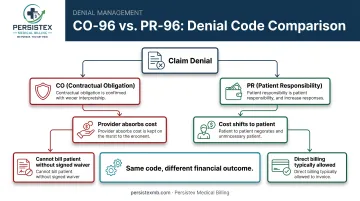
The group code attached to the CARC is what actually determines liability:
- CO (Contractual Obligation): the provider absorbs the cost. Billing the patient is generally off the table.
- PR (Patient Responsibility): the payer has shifted the cost to the patient, and direct billing is typically allowed.
This is a critical distinction. A CO-96 and a PR-96 look nearly identical on paper — same numeric code — but they lead to completely different financial outcomes. CMS confirms that Medicare beneficiaries can only be billed when the PR group code accompanies the adjustment, regardless of what the CARC itself says.
A non-covered denial is not the same as a rejected claim. A rejection means the claim never entered adjudication — bad formatting, invalid member ID, or mismatched NPI.
A non-covered denial means the claim was processed and the payer ruled the service ineligible for payment. That difference changes your entire response strategy.
Denial Codes That Signal Non-Covered Services
Not every "non-covered" denial looks the same on the remittance. Knowing which code you're looking at tells billing staff what to do next.
The Core Codes
- CO-96 (Non-Covered Charges): Most common non-covered code—usually a contractual exclusion or a documentation/coding mismatch.
- PR-96 (Patient Responsibility): Patient-responsibility twin of CO-96 when the service is excluded under the patient's plan.
- CO-252 (Additional Documentation Required): Records needed before adjudication; often overlaps with non-covered cases when the payer wants medical-necessity proof first.
- CO-50 (Not Medically Necessary): the payer's clinical policy doesn't support the service for the diagnosis billed.
- CO-167 (Diagnosis Not Covered): the diagnosis code itself falls outside the payer's coverage policy for that service.
X12's official code set requires that every CARC 96 or 252 denial arrive with at least one supporting RARC — so the remark code, not just the numeric CARC, tells you the real reason.
Quick Reference: Code, Meaning, and Next Move
| Code | Meaning | Typical Next Action |
|---|---|---|
| CO-96 | Contractual non-covered charge | Review documentation/coding; correct and resubmit or appeal |
| PR-96 | Patient-plan exclusion | Bill patient directly (verify no appeal basis first) |
| CO-252 | Documentation needed | Submit requested records within filing window |
| CO-50 | Not medically necessary | Appeal with clinical documentation, or bill patient if ABN was signed |
| CO-167 | Diagnosis not covered | Check diagnosis-to-service policy; correct coding or appeal |
Print this table, tape it to the biller's monitor. It saves real triage time.
Top Causes of Non-Covered Services Denials
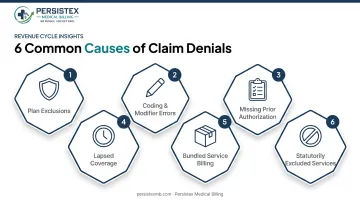
Six recurring issues drive most of these denials, and none of them are random.
- Plan exclusions: the service simply isn't a covered benefit under that specific policy. Medical necessity doesn't matter if the benefit doesn't exist.
- Coding and modifier errors: wrong CPT/HCPCS codes, missing modifiers, or ICD-10 codes that don't support the billed service trigger automatic non-covered flags.
- Missing or expired prior authorization: high-cost imaging, procedures, and behavioral health services often need pre-approval that either wasn't obtained or lapsed before the visit.
- Lapsed or inactive coverage: the policy wasn't active on the date of service, and nobody verified eligibility beforehand.
- Bundled service billing: the charge is already included in a global surgical or E/M package and can't be billed as a standalone line.
- Statutorily excluded services: cosmetic procedures, routine physicals unrelated to a diagnosis, and similar categories are never covered. No amount of documentation changes that.
According to an Experian Health survey cited by AAPC, prior authorization issues and inaccurate data topped the list of reported denial causes, with 77% of respondents pointing to constantly shifting payer policies as the real friction point.
That last part matters. Payer coverage rules aren't static: they update on rolling cycles, which means a service covered in January can be excluded by June without any obvious announcement to your front desk.
Can You Bill the Patient for Non-Covered Services?
This is the question every practice manager actually cares about. The answer depends almost entirely on that CO/PR prefix.
- CO-prefixed denials: generally cannot be billed to the patient unless a signed waiver was obtained before the service.
- PR-prefixed denials: typically can be billed directly, since the payer has already determined the patient owes it.
The ABN Requirement for Medicare Patients
For Medicare beneficiaries, that "signed waiver" has a name: the Advance Beneficiary Notice (ABN), form CMS-R-131.
When a generally covered service is expected to be denied and you want the right to bill the patient, CMS requires the ABN to include a plain-language description of the service, the specific reason it may be denied, and an honest cost estimate.
Skip the ABN on a service expected to be denied, and you generally forfeit the right to collect from the patient. The cost becomes the practice's problem.
Modifiers That Track ABN Status
Four modifiers tell the payer exactly what happened with the ABN:
- GA: mandatory ABN was issued and signed.
- GX: voluntary ABN issued for a service Medicare never covers.
- GY: service is statutorily excluded or isn't a Medicare benefit at all.
- GZ: provider expects a medical-necessity denial but never issued an ABN.
Missing modifiers, or using the wrong one, is a fast way to lose an otherwise defensible patient-billing case.
How to Resolve and Prevent Non-Covered Services Denials
Once the denial lands, the workflow branches into two paths: fix it, or fight it.
Resolve: Correct-and-Resubmit vs. Appeal
Read the full code combination: group code, CARC, and RARC together tell you the real story, not just the numeric code alone.
Verify eligibility and documentation: confirm the patient's coverage was active and that clinical notes support the billed service.
Correct and resubmit when the denial traces back to a coding error, missing modifier, or documentation gap, and do it inside the payer's timely filing window.
File a formal appeal instead when your documentation supports coverage and the denial looks like a misapplication of policy.
File a formal appeal instead when your documentation supports coverage and the denial looks like a misapplication of policy.
For Medicare, redetermination requests are due 120 days from receipt of the initial determination. Commercial payers often allow 90 to 180 days, so check the denial notice rather than assuming a standard window.
Prevent: Stop the Denial Before It Happens
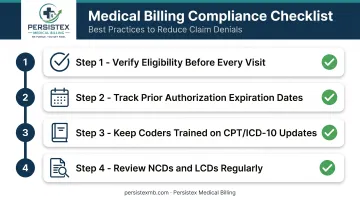
- Verify eligibility before every visit, not just at intake. Coverage lapses more often than practices expect.
- Track prior authorization requirements and expiration dates, especially for imaging, behavioral health, and specialty procedures.
- Keep coders trained on current CPT/ICD-10 updates and payer-specific medical necessity policies.
- Review NCDs and LCDs regularly. Coverage rules shift, and yesterday's covered service can become tomorrow's denial.
This is where a lot of independent practices hit a wall. Denial management takes dedicated time that most front-desk and billing teams simply don't have alongside patient scheduling and daily claims volume.
Persistex Medical Billing was built around this gap, with depth in behavioral health and outpatient billing. Root-cause denial analysis and a multi-level appeals process have delivered a 40% average reduction in denied claims and a 72% appeals success rate for client practices.
Proactive eligibility checks and prior authorization follow-up matter as much as the appeal letter. Front-end verification catches non-covered risks before the claim goes out, so fewer denials land in the first place.
Frequently Asked Questions
What denial codes indicate non-covered services (e.g., CO-96, CO-252)?
CO-96 and PR-96 are the primary codes signaling non-covered charges, while CO-252 signals a related documentation gap. The accompanying RARC on each denial specifies the exact reason.
Can you bill a patient for non-covered charges?
It depends on the code prefix. CO codes generally prohibit patient billing unless a signed ABN or waiver exists beforehand, while PR codes typically allow you to bill the patient directly.
What is the difference between CO-96 and PR-96 denial codes?
CO-96 places responsibility on the provider side of the relationship and is often appealable. PR-96 shifts the cost directly to the patient, with far less room to appeal.
Is a non-covered service denial the same as a claim rejection?
No. A rejection means the claim never entered adjudication due to formatting or data errors. A non-covered denial means the claim was processed but the payer found the service ineligible for payment.
How long do I have to appeal a non-covered services denial?
Medicare allows 120 days from the initial determination (MSN or ERA/EOB) to request a redetermination. Commercial payers set their own deadlines, so confirm the exact window on the denial notice.
What is an Advance Beneficiary Notice (ABN) and when is it required?
An ABN is a written notice given to Medicare patients before a service that may be denied, listing the service, likely denial reason, and estimated cost. A signed ABN obtained beforehand lets you bill the patient if Medicare denies the service as not medically necessary.